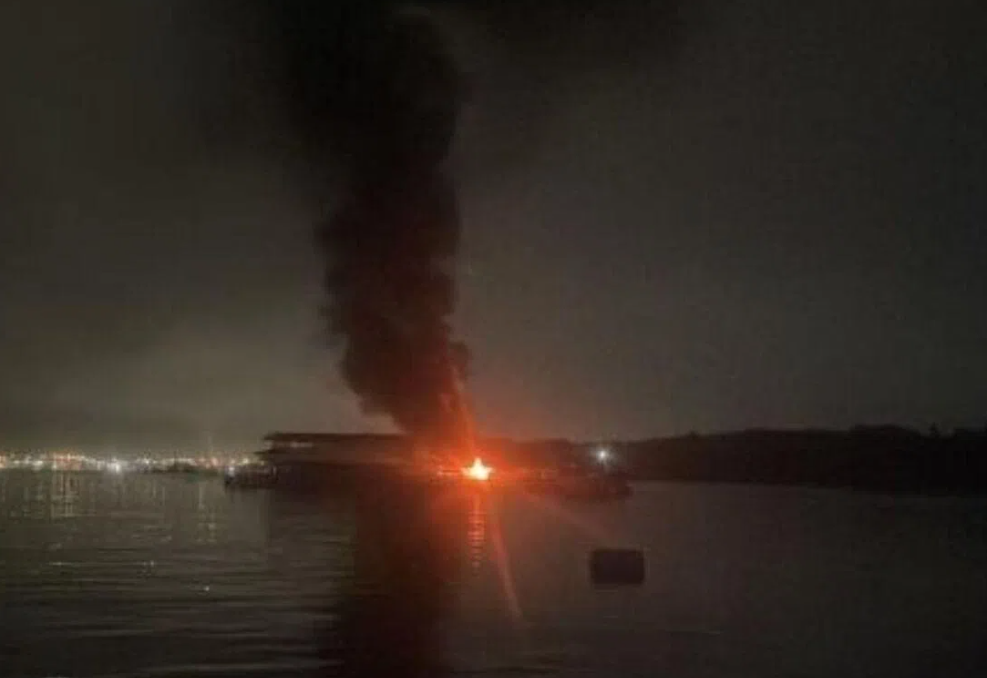
A major fire tore through at least two floating fish farms positioned off Lorong Halus jetty near Pasir Ris on the evening of June 24, prompting an extended firefighting operation that lasted several hours. The Singapore Civil Defence Force (SCDF) received the emergency alert at approximately 8.10pm and responded by mobilising marine vessels from the Maritime and Port Authority of Singapore alongside Airport Emergency Service personnel. Thankfully, no injuries were sustained during the incident, though the economic toll on the farming operations proved severe.
Investigators have zeroed in on a lightning strike as the probable culprit, with evidence suggesting the bolt struck the solar panels installed atop one of the farms. According to reporting by Lianhe Zaobao, the initial ignition at the first facility subsequently spread to at least two neighbouring farms before emergency responders managed to suppress the flames. The proximity of these aquaculture operations to one another created a challenging firefighting scenario, with the blaze potentially jumping between structures as wind and flames carried embers across the water.
The incident has exposed vulnerabilities in Singapore's floating farm infrastructure, particularly regarding renewable energy systems in marine environments. Solar panels have become increasingly common fixtures on these operations as operators seek to reduce energy costs and operational footprints in one of Asia's most densely populated city-states. However, the integration of electrical systems with marine installations creates distinct hazards when severe weather strikes, a reality that farm operators may not have fully anticipated or adequately protected against.
One farm owner estimated personal losses at approximately S$120,000, a substantial sum that represented not merely equipment replacement costs but also the destruction of operational capacity and income-generating potential. The damage extended across multiple critical assets: feed supplies, backup power generators essential for maintaining water aeration and circulation, the photovoltaic panels that had powered daily operations, a fishing vessel, and at least three fish traps. Beyond tangible equipment losses, approximately half of the farm's fish stock escaped through damaged nets, representing lost revenue that will take months to recover through breeding and cultivation cycles.
Particu particularly troubling for affected operators has been the insurance complications surrounding the incident. The farm owner disclosed that filing an insurance claim for the fire would prove impossible, likely owing to specific policy exclusions for weather-related incidents or the manner in which these floating installations are classified by underwriters. This gap in coverage leaves aquaculture operators bearing the full financial burden of climate-related disasters, a significant concern given Singapore's tropical location and the increasing frequency of severe thunderstorms linked to broader atmospheric changes.
This was not an isolated occurrence for these particular operations. The farm owner revealed that solar panels had previously sustained lightning damage on multiple occasions, yet those incidents had been contained because workers were present to respond immediately and prevent escalation into major fires. The absence of personnel on June 24 proved catastrophic; without immediate intervention, the initial spark developed into a conflagration that consumed multiple farms simultaneously. This underscores the challenges facing aquaculture operations that operate with lean staffing models to maximise profitability.
The response to the emergency highlighted the interconnected nature of Singapore's maritime safety infrastructure. Beyond the SCDF's lead role, operators from nearby fish farms voluntarily assisted in containing the blaze, demonstrating the collaborative spirit that characterises Singapore's tightly-knit aquaculture community. Such cooperation reflects both the goodwill amongst neighbouring operators and the practical reality that uncontrolled fires in these densely clustered facilities pose threats to multiple businesses simultaneously.
For the broader Southeast Asian aquaculture sector, the incident offers important lessons about infrastructure resilience and risk management in floating farm operations. As agricultural production increasingly shifts toward maritime environments and renewable energy integration accelerates, ensuring that electrical systems withstand environmental stressors becomes paramount. The experience at Pulau Ubin suggests that operators and regulators may need to reassess lightning protection systems, structural redundancy, and emergency response protocols across the region's growing aquaculture operations.
The fire also raises questions about Singapore's regulatory framework governing aquaculture installations. While the authorities have contacted the Fish Farmers Association of Singapore and Singapore Food Agency for further information, broader considerations about mandatory safety standards, insurance requirements, and emergency preparedness mechanisms warrant examination. As Singapore intensifies its push toward food security through domestic production, ensuring that farming operations can withstand foreseeable environmental hazards becomes increasingly important to the nation's agricultural strategy and the livelihoods of those depending on this sector for income.

