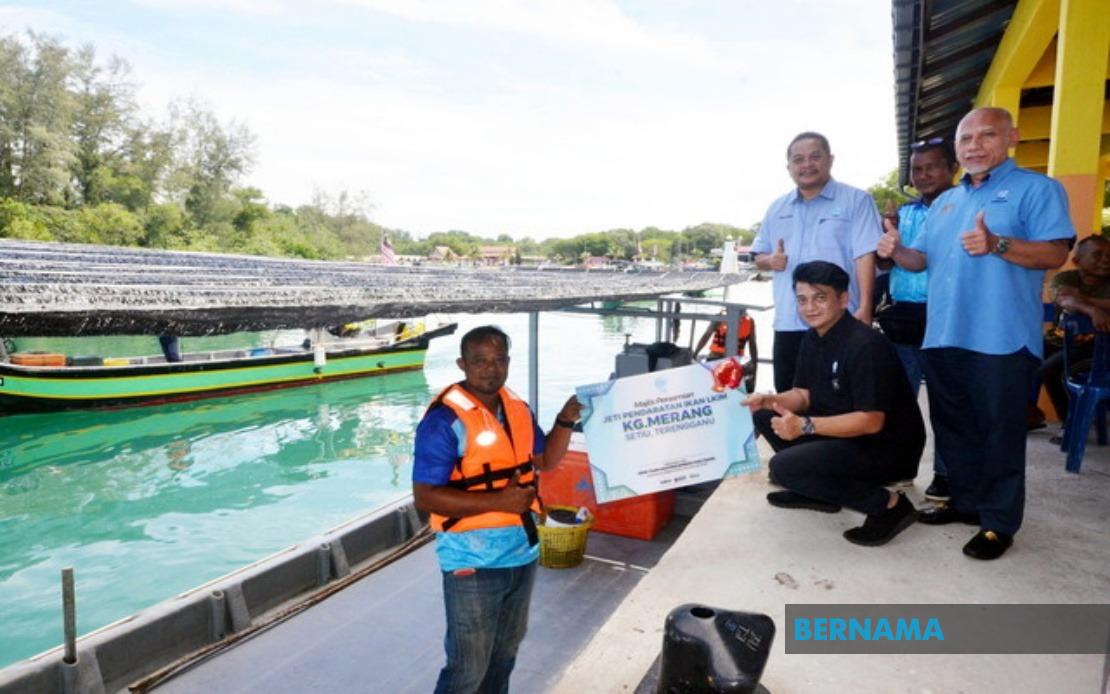
The Malaysian Fisheries Development Authority (LKIM) has committed RM2 million over the past year toward a comprehensive programme to repair, upgrade and construct fish landing jetties across the country, signalling renewed focus on maritime infrastructure that underpins the livelihoods of fishing communities. LKIM chairman Muhammad Faiz Fadzil unveiled this investment strategy at the handover of the newly completed Kampung Merang Fish Landing Jetty in Setiu, Terengganu, highlighting the agency's determination to fortify the nation's fishing sector through tangible infrastructure improvements.
This year alone represents a milestone in the rollout, with LKIM completing construction of a modern jetty in Merang. Two further initiatives—in Perak and Labuan—remain in advanced planning phases, with documentation and tender processes underway. Yet the pace of expansion faces a budgetary ceiling that Muhammad Faiz openly acknowledged, signalling a potential bottleneck in the authority's ambitions. He made an explicit appeal to the federal government to earmark enhanced allocations in the next budget cycle, underscoring the gap between infrastructure demand and current financial capacity. This candid request reflects a broader truth across Southeast Asia's fishing sectors: the scale of upgrading required vastly outpaces available resources.
LKIM's operational remit encompasses a sprawling network of 372 fish landing jetties nationwide, complemented by 48 fisheries complexes and ports. This portfolio illustrates both the complexity of managing coastal infrastructure across Malaysia's three maritime regions and the authority's central role in supporting economic activity among fishing households. The sheer number of facilities under management underscores why targeted, phased investment remains critical to maintaining operational standards and expanding capacity.
The Kampung Merang project exemplifies the tangible gains emerging from this infrastructure push. Built at a cost of RM500,000, the newly operational concrete jetty represents a quantum leap from its predecessor—a structure villagers themselves had constructed and maintained, which by recent times had deteriorated beyond safe operational parameters. This replacement signals a transition from informal, community-managed infrastructure toward professionally engineered facilities meeting contemporary maritime safety and commercial standards. The handover ceremony today formally inducted the facility into LKIM's active inventory.
The economic footprint of this single jetty extension is immediately quantifiable. One hundred and twenty-four registered fishermen operating sixty-eight vessels now have access to a purpose-built landing facility, eliminating the operational constraints and safety hazards that had characterised the old arrangement. For fishing households dependent on daily catch sales for sustenance and income, this shift from precarious to secure landing infrastructure carries profound implications. The efficiency gains alone—smoother offloading, reduced spoilage, faster transaction processing—translate into material improvements to earnings.
Setiu district's fisheries profile provides context for understanding the investment's significance. Annual fish landings in the area currently stand at approximately 243 metric tonnes, a figure LKIM projects will rise meaningfully as fishermen adapt to and exploit the new facility's capabilities. This growth assumption rests not merely on infrastructure availability but on the reality that better landing facilities reduce transaction costs, attract buyers more readily, and enable fishermen to negotiate from positions of greater stability. When landing infrastructure is inadequate, intermediaries and traders hold disproportionate bargaining power; modern facilities shift leverage toward producers.
Muhammad Faiz articulated this supply-chain logic explicitly, framing infrastructure improvements as essential to livelihood enhancement. Better landing facilities streamline the journey from sea to market, reducing time delays and handling costs while maintaining catch quality. For pelagic and demersal fish species that deteriorate rapidly outside refrigeration, even marginal improvements in landing-to-market duration yield substantial value preservation. Fishermen who can offload efficiently and access reliable cold storage move closer to direct buyer relationships, capturing margins previously absorbed by middlemen.
The broader fisheries policy context underpinning this investment reflects Malaysia's positioning within regional aquatic resource management frameworks. Southeast Asian fishing nations increasingly acknowledge that catch volumes alone no longer drive sector prosperity; post-harvest efficiency, product quality assurance, and market access now determine competitiveness. Malaysia's investment in landing infrastructure aligns with this evolution, recognising that small-scale fishing communities require institutional support to compete effectively against industrial operators and foreign imports. By upgrading jetties, LKIM simultaneously addresses safety, sanitation and market-access dimensions of fisheries development.
Yet the acknowledged funding constraint reveals structural tensions in Malaysian fisheries policy. RM2 million annually, spread across nationwide jetty improvements, represents modest per-project allocation. Perak and Labuan initiatives remain trapped in procurement limbo, suggesting that tender processes and bureaucratic procedures can extend timelines materially. For fishing communities, such delays mean continued operation under suboptimal conditions. The explicit plea for budget augmentation suggests LKIM leadership recognises this mismatch and is signalling to Treasury officials and cabinet committees that current allocations systematically underinvest in coastal infrastructure relative to acknowledged demand.
The Terengganu location carries particular significance within Malaysia's maritime geography. The east coast states—Terengganu, Kelantan, Pahang—traditionally support higher densities of small-scale fishing households than peninsular western regions. These communities have historically received less infrastructural attention than urban manufacturing hubs, creating accumulated deficits in port and jetty quality. LKIM's recent focus on this zone represents a deliberate attempt to address geographic imbalances in development investment, though the pace of upgrading remains constrained by fiscal realities.
Looking forward, the Kampung Merang handover establishes a proof-of-concept template that LKIM can reference in advocating for expanded budgets. A RM500,000 investment generating income improvements for 124 fishermen provides quantifiable rationale for scaling. If similar returns track across other proposed jetty projects, aggregate welfare gains could justify substantially larger allocations. This economic case-making will become critical as LKIM competes against other sectoral claims on budgetary resources in forthcoming budget cycles.

