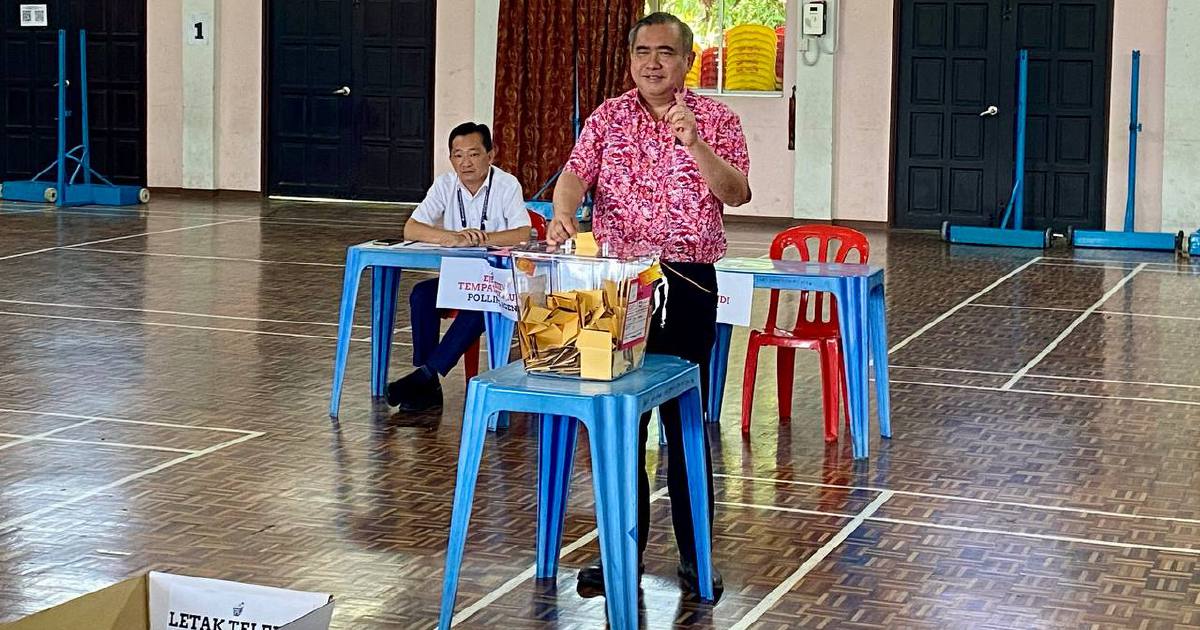
The Democratic Action Party's political leadership has made a pointed statement regarding the significance of public opinion research in electoral forecasting, with party secretary-general Anthony Loke asserting that the genuine arbiters of the Negri Sembilan state election will be the voting population themselves rather than any statistical projections conducted in advance of polling day. Speaking in Seremban, Loke underscored the fundamental principle that democratic outcomes hinge on actual voter participation and choice, not speculative analysis produced by survey organisations.
This intervention arrives at a time when Malaysian politics remains acutely sensitive to the role and reliability of opinion polling. The election industry has experienced considerable scrutiny over recent years, particularly following instances where pre-election surveys have diverged substantially from actual results. Loke's remarks reflect a broader scepticism within political circles about the methodological accuracy and representative value of such exercises, especially in a state-level contest where complex factional dynamics can produce unpredictable outcomes.
Negri Sembilan, located in the strategic Klang Valley periphery, represents a politically contested arena where multiple coalitions compete vigorously for electoral advantage. The state's composition—balancing urban constituencies with rural constituencies, plus significant Chinese and Indian minority populations—creates a challenging landscape for pollsters attempting to model voting behaviour accurately. Historical voting patterns in the state have occasionally surprised political observers, suggesting that structural changes in voter preferences may occur between survey fieldwork and actual voting.
The DAP's emphasis on dismissing survey data holds particular resonance given the party's own electoral fortunes have often confounded pre-election expectations. The party's significant advances during recent electoral cycles have sometimes been underpredicted by opinion research, leading some analysts to question whether polling methodologies adequately capture support for opposition parties. This dynamic proves especially relevant in states like Negri Sembilan, where three-cornered contests between Pakatan Harapan, Barisan Nasional, and splinter movements can significantly fragment votes and destabilise traditional models.
For Malaysian voters considering the Negri Sembilan election, Loke's statement carries an implicit message: the democratic process remains genuinely open and unpredictable, contingent upon actual citizen participation at the ballot box rather than predetermined trajectories suggested by advance analysis. This framing positions the DAP as confident in its grassroots mobilisation capacity and appeals to voters to treat themselves as the determining force rather than passive subjects of pre-determined outcomes.
The timing of Loke's intervention suggests the DAP may have been responding to specific survey releases perceived as unfavourable or potentially demoralising to party supporters. In contemporary Malaysian politics, opposition parties frequently challenge survey credibility when results suggest their prospects have diminished, while government-aligned coalitions sometimes present divergent surveys selectively to bolster narratives about electoral viability. This selective engagement with polling data has become standard practice across Malaysia's political spectrum.
Negri Sembilan's electoral significance extends beyond state-level considerations. As a strategically positioned state neighbouring the federal capital region and containing industrial heartland constituencies, the state's political complexion influences broader national calculations about coalition strength and legislative configurations. National opposition movements therefore invest considerable resources in these state contests, viewing them as testing grounds for policies and campaign strategies that might later apply at federal level.
The state has experienced considerable governance transitions over recent decades. Burgeoning development pressures, economic restructuring around manufacturing and services sectors, and demographic shifts through urbanisation have transformed political dynamics substantially compared to earlier periods. These transformations create electoral volatility that standard polling methodologies sometimes struggle to capture adequately, particularly when voter sentiment shifts occur in the months between survey fieldwork and voting.
From a Southeast Asian perspective, Loke's statement reflects broader patterns evident across the region regarding electoral uncertainty and survey reliability. Thailand's recent elections, Indonesia's complex multi-candidate contests, and the Philippines' presidential races have all demonstrated that sophisticated polling operations do not necessarily produce accurate predictions in culturally and politically complex societies. Malaysian political actors appear to be learning from these regional examples, increasingly questioning the utility of pre-election surveys.
Voter turnout dynamics in Negri Sembilan will likely prove decisive regardless of survey suggestions. Mobilisation capacity, ground-level campaign effectiveness, and contextual issues affecting specific constituencies often determine outcomes more significantly than aggregate survey figures. The DAP's focus on this reality suggests the party has invested substantially in grassroots organising and direct voter engagement rather than relying on top-down messaging strategies that surveys might measure more easily.
For opposition movements throughout Malaysia, Loke's remarks offer a psychological benefit: they reframe the election narrative away from suggestion and toward agency, inviting voters to see themselves as powerful political actors rather than statistical data points supporting predetermined conclusions. This rhetorical strategy proves particularly valuable when survey data appears unfavourable, as it motivates supporters to disregard pessimistic projections and participate actively in electoral processes.

