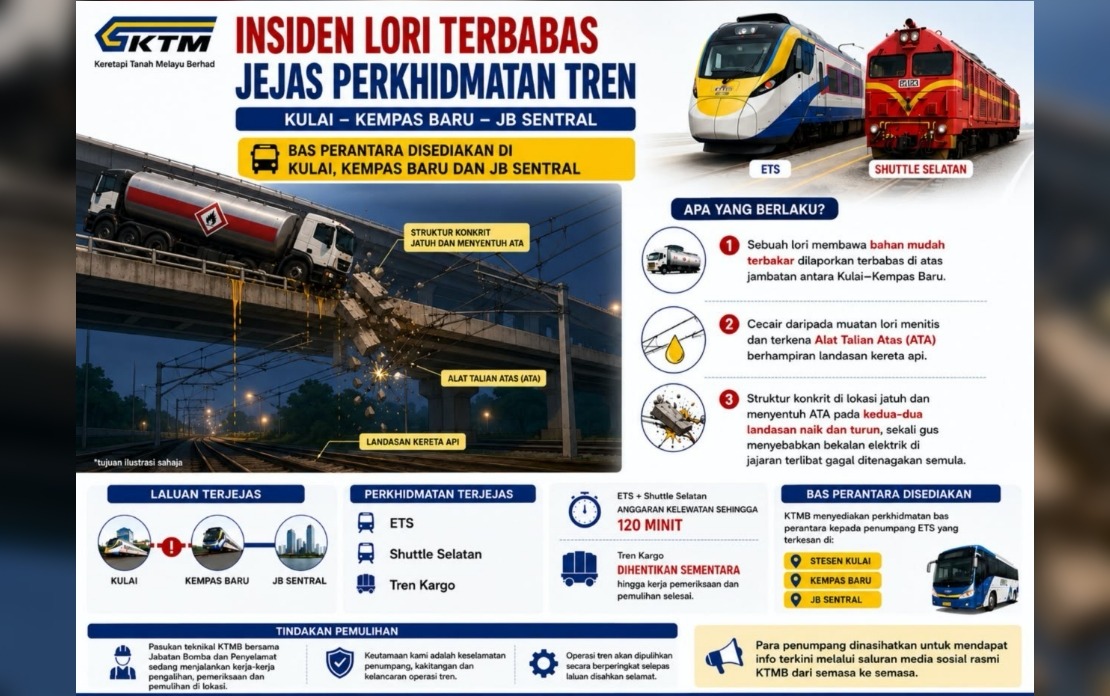
A road accident involving a commercial lorry caused significant disruption to rail commuters in Johor on August 5, halting operations on the Kulai–Kempas corridor served by both the Electric Train Service (ETS) and Shuttle Selatan services. The incident unfolded when the lorry, transporting flammable liquid, skidded off course near the railway tracks, subsequently triggering an electrical power outage that cascaded into service cancellations affecting numerous travellers across the busy southern route connecting Johor Bahru with Kempas and Kulai stations.
Keretapi Tanah Melayu Berhad (KTMB), Malaysia's national railway operator, announced the disruption through social media updates, emphasising that the power supply failure stemmed directly from the lorry incident occurring in proximity to critical railway infrastructure. The state-owned operator immediately mobilised repair and restoration efforts, deploying teams to address both the cleanup operation and the technical work required to reinstate electrical supply to the affected sections of track. Such incidents underscore the vulnerability of railway systems to external hazards, particularly when major thoroughfares run adjacent to or near rail corridors.
The operational impact proved substantial, with the railway company implementing emergency protocols to minimise passenger inconvenience. For ETS commuters stranded by the service suspension, KTMB arranged substitute shuttle bus transport at three major interchange points: Kulai station, Kempas Baru station, and JB Sentral in the city centre. These replacement services represented a practical if imperfect solution, compensating for the loss of the faster, scheduled train movements that regular users depend upon for their daily commutes and longer-distance travel.
Passengers using Shuttle Selatan, the slower regional service operating on the same corridor, faced a different advisory. Rather than offering direct replacement buses, KTMB recommended that these travellers pursue entirely alternative transport options, suggesting reliance on private vehicles, taxis, or intercity bus services. This differential treatment likely reflected the distinction in service positioning—ETS as a higher-speed metropolitan rapid transit option warranting more robust contingency arrangements, whereas Shuttle Selatan serves a slower, potentially more flexible ridership base.
Fare compensation mechanisms were put in place to address passenger grievances arising from the service failure. KTMB committed to providing fare adjustments for all affected travellers, acknowledging that users purchasing tickets for services they could not access deserved financial remedy. This policy demonstrates recognition among Malaysian rail operators that service disruptions carry real costs for commuters who may lose working hours, incur additional transport expenses, or suffer scheduling complications.
At the time of KTMB's evening update, issued at 10:37 pm, specific delays persisted across the network. Train ETS9449 was running 32 minutes behind its published timetable, whilst service ETS9533 experienced substantially greater delays of 55 minutes. These figures, however, carried an important caveat: KTMB noted that ongoing operational conditions meant such delay estimates remained fluid and subject to change as repair work progressed. The company refrained from committing to definitive service restoration timelines, reflecting the uncertainty inherent in managing infrastructure damage from transport accidents.
The geographic context amplifies the significance of this disruption. The Kulai–Kempas–Johor Bahru corridor represents a critical transportation spine in Johor's economic landscape, serving industrial zones, residential areas, and commercial centres. ETS services on this route cater to daily commuters, business travellers, and intercity passengers, making service reliability essential to regional economic function. Suspension of rail capacity forces latent demand onto already-congested road networks, contributing to traffic congestion and air quality challenges throughout the metropolitan area.
This incident reflects broader infrastructure vulnerabilities across Southeast Asia's rapidly developing rail networks. As countries in the region expand and upgrade rail systems to accommodate growing urban populations and support economic development, the interface between road and rail infrastructure requires careful management. The Kulai–Kempas experience demonstrates that despite modern engineering, traditional road vehicles can still compromise rail operations when accidents occur in proximity to critical electrical and signalling systems.
KTMB's response protocol—immediate passenger communication via social media, rapid deployment of alternative transport, and commitment to fare adjustments—represents established best practice for Malaysian rail operators managing service disruptions. However, the incident highlights the importance of preventative infrastructure design, such as better physical separation between major road corridors and railway power supply systems, and improved emergency response coordination between road transport authorities and rail operators.
Station staff were mobilised to assist confused or distressed passengers seeking information or support during the service suspension. The railway company's instruction that passengers approaching station personnel would receive tailored assistance suggests KTMB anticipated that some travellers might require help navigating the changed transport landscape or understanding compensation eligibility.
For Malaysian commuters, this disruption served as a reminder of rail transport's continued dependence on reliable infrastructure and the cascading consequences when single-point failures occur. While ETS services have expanded significantly across the Klang Valley and now into Johor, operational fragility can materialise unexpectedly, reinforcing the value of maintaining diverse, redundant transport networks capable of absorbing such shocks without imposing unmanageable burdens on alternative systems or commuters' schedules.

