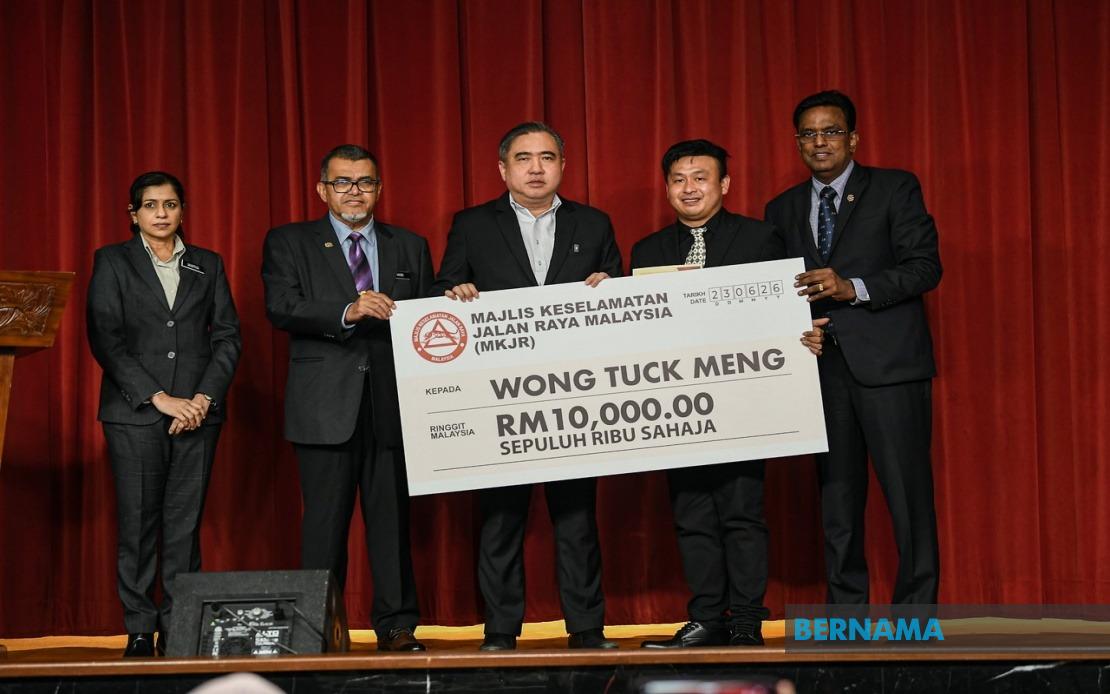
Wong Tak Ming, a lorry driver whose swift thinking and decisive action averted what could have been a catastrophic incident on a Perak highway, was honoured at a special ceremony in Parliament today with a Special Certificate of Appreciation and RM10,000. The recognition, funded by the Malaysian Road Safety Council (MKJR), marks the government's formal acknowledgement of his extraordinary bravery during the June 15 accident involving an express bus near the Menora Tunnel.
Transport Minister Anthony Loke presented the award, describing Wong's intervention as emblematic of the kind of selfless heroism that ultimately saves lives on Malaysian roads. The bus, which had been travelling from Kedah to Kuala Lumpur, encountered a catastrophic technical failure while navigating a steep downhill section of the highway. Unable to brake effectively, the runaway vehicle presented an imminent danger to Wong and countless other motorists in its path.
The critical moment came when Wong, recognising the hazard developing behind him, made a split-second decision that would determine whether the incident ended in tragedy or salvation. Rather than accelerating away to safety, he manoeuvred his lorry to position it as a physical barrier against the out-of-control bus. Through a combination of precise driving and continued pressure, Wong used his vehicle's mass and positioning to gradually decelerate the bus and guide both vehicles towards the guardrail.
Loke, speaking at the Parliament building ceremony, characterised Wong's actions as preventing a potential catastrophe that could have claimed multiple lives. The minister emphasised that Wong had undertaken this dangerous task whilst simultaneously putting himself at considerable risk, a fact that underscores the genuinely heroic nature of his decision-making in those crucial seconds.
When asked about his motivation, Wong revealed a remarkably clear-headed assessment of the unfolding situation. He explained that his overwhelming instinct was not to become a victim himself, but rather to stop the momentum of the collision and create sufficient time for vehicles ahead to take evasive action. Wong noted that the initial distance between his lorry and the descending bus afforded him a brief window to sound his horn repeatedly, alerting drivers further along the road to the danger bearing down on them.
This communicative element of Wong's response—using his horn to warn others even as he was positioning his own vehicle to absorb the impact—reveals a sophistication of crisis management that extended beyond mere self-preservation. He was simultaneously managing his own immediate safety whilst considering the welfare of strangers ahead on the road. All 21 passengers aboard the express bus escaped the incident without serious injury, a direct result of Wong's intervention.
The incident gained considerable public attention when video footage circulated across social media platforms, generating widespread admiration for Wong's composure and quick thinking. Members of Parliament took note of the incident and its viral documentation, recognising it as an exemplary case study in road safety consciousness and communal responsibility. Deputy Speaker Datuk Dr Ramli Mohd Nor conveyed Parliament's formal gratitude to Wong following Transport Minister Loke's tabling of the Road Transport (Amendment) Bill 2025 for its second reading.
The broader context of this recognition reflects Malaysia's ongoing efforts to promote road safety culture across the nation. Road accidents remain a persistent challenge in Malaysia and across Southeast Asia, with human factors—including driver awareness and preparedness for emergency situations—playing crucial roles in determining outcomes. Wong's actions demonstrate that well-trained, attentive drivers can make the difference between a minor incident and a multi-casualty disaster.
The award carries symbolic weight beyond its financial value. The RM10,000 remuneration and official certificate serve as public validation that such actions will be recognised and celebrated by government institutions. This recognition may encourage other road users to consider their own responsibilities during emergencies and to develop situational awareness that could save lives. In a nation where road transport remains vital infrastructure connecting cities and regions, every improvement in safety consciousness translates to tangible protection for millions of daily commuters.
Wong's case also highlights the unpredictability of highway emergencies and the importance of vehicle maintenance standards. The express bus's technical failure, which precipitated the entire incident, underscores why rigorous inspection regimes for public transport vehicles remain essential. However, even with best maintenance practices, unforeseen mechanical failures will occasionally occur, making the human element—represented by drivers like Wong—the final safeguard against tragedy.
The presentation of this award at Parliament signals that the government views road safety not merely as a matter of enforcement and infrastructure, but as a question of civic virtue and public consciousness. By honouring Wong, policymakers send a message that exceptional safety awareness and altruistic action in moments of crisis represent values the nation wishes to cultivate. For Malaysian road users, the incident and its recognition offer a powerful reminder that individual decisions can have life-or-death consequences and that alertness remains one of the most valuable qualities any driver can possess.