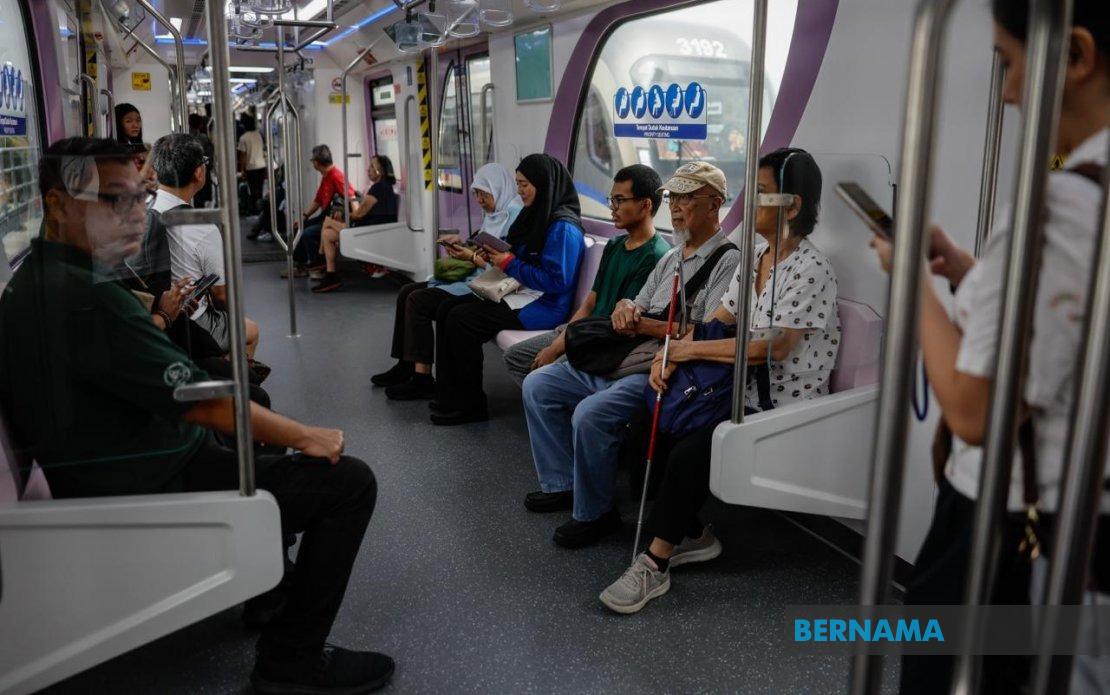
The Light Rail Transit 3 (LRT3) Shah Alam Line commenced operations on June 29 to favourable initial feedback from commuters, who largely endorsed the new service as a welcome addition to Malaysia's expanding public transport network. Early passengers highlighted the line's efficiency in shortening travel durations and improving connectivity across the Klang Valley, though a consensus emerged around the need for specific improvements targeting accessibility and passenger comfort as the service matures.
The RM16.63 billion infrastructure project represents a significant government commitment to modernising the country's rail network and reflects broader ambitions to enhance urban mobility in one of the nation's most congested corridors. The initiative aligns with strategic efforts to reduce vehicular congestion and promote sustainable transport alternatives in the Shah Alam and surrounding areas. Prime Minister Datuk Seri Anwar Ibrahim has incentivised early adoption by declaring free travel for all passengers throughout June and July, a promotional period designed to familiarise commuters with the new route and encourage sustained ridership.
Feedback from disabled passengers provided particularly valuable insights into the service's accessibility framework. Razlan Ibrahim, a 40-year-old visually impaired commuter, undertook a comprehensive trial of the LRT3 from Kajang to Glenmarie 2 station on opening day and emerged broadly satisfied with existing provisions. He identified the tactile pathways installed at several stations—notably Bandar Utama—as exemplary infrastructure that meaningfully facilitates mobility for persons with disabilities. These guiding pathways, he observed, successfully direct users to essential facilities including accessible toilets, prayer rooms segregated by gender, and lift access, demonstrating thoughtful design consideration.
Despite this commendation, Razlan articulated clear recommendations for enhancement, principally advocating for expanded Braille signage at strategic junctures throughout the network. He suggested that directional information at key locations—particularly at disability-accessible facilities, gender-segregated suraus, and lift entrances—warrants Braille notation to enable visually impaired passengers to navigate independently and locate services without requiring assistance from station staff. This observation underscores a distinction between physical accessibility infrastructure and informational accessibility, a nuance that public transport operators frequently overlook when designing inclusive systems.
Young professionals utilising the service similarly reported positive initial impressions centred on operational efficiency. Samantha Fong, a 26-year-old private sector employee, highlighted the line's capacity to eliminate the multi-interchange requirements that characterise existing transport patterns between Bandar Utama and Glelmarie 2. She reported minimal waiting times and described the journey experience as considerably more time-efficient than her previous commuting routines. Her suggestion for future implementation of women-only coaches resonates with a growing trend across Southeast Asian transit systems, where dedicated female compartments have proven effective in enhancing perceived and actual passenger safety, particularly during peak-hour congestion.
Another commuter, Rainchie Lee, also aged 26, reinforced this assessment by characterising her inaugural journey as smooth and operationally sound. She explicitly valued the promotional free-travel period as an opportunity for broader population segments—particularly students and working-age adults—to evaluate whether the service aligns with their long-term commuting requirements. This observation highlights an important marketing dimension: the one-month complimentary period functions not merely as a passenger acquisition mechanism but as an extended trial enabling individuals to assess route suitability and integration with daily routines before committing to regular patronage.
The convergence of positive feedback regarding comfort, speed, and accessibility forms a compelling narrative for the service's acceptance within target demographics. The LRT3 Shah Alam Line appears positioned to capture a meaningful share of commuter traffic currently managed by private vehicles or less efficient multi-modal combinations. However, the specificity of passenger suggestions—ranging from Braille signage to women-only coaches—indicates that user communities have moved beyond basic appreciation toward constructive engagement with the service's development trajectory.
From a broader transportation planning perspective, the feedback mechanisms emerging from the LRT3's launch offer Malaysian transport authorities valuable intelligence regarding the priorities of contemporary urban commuters. The emphasis on accessibility features signals that disability inclusion has transitioned from a peripheral concern to a central consideration in public discourse around transport infrastructure. Similarly, requests for women-only coaches reflect legitimate safety and comfort priorities that warrant serious consideration in future service enhancements and represent a recognition that inclusive transport extends beyond physical infrastructure to encompass experiential comfort and security.
The free-travel promotional period extending through July 31, encompassing feeder bus services operated by Prasarana Malaysia Berhad, provides a finite window for the operator to observe usage patterns, identify bottlenecks, and refine service delivery before transitioning to standard fare collection. The involvement of state-owned Prasarana in coordinating feeder services demonstrates integrated transport planning, a prerequisite for maximising the LRT3's broader economic and social impact across the Shah Alam region and adjacent areas. Effective first-mile and last-mile connectivity through bus services substantially influences overall system utility and can determine whether the LRT3 achieves its potential as a transformative transport corridor.
Looking forward, the balance between maintaining momentum from the enthusiastic initial reception and systematically addressing identified gaps will prove decisive in establishing the LRT3 as a durable component of Malaysian public transport infrastructure. The willingness of early users to articulate specific improvement suggestions rather than offering only generalised praise suggests a user base invested in the service's long-term success. Transport authorities and Prasarana management would be well-advised to prioritise those accessibility enhancements highlighted by disabled passengers, as such improvements generate systemic benefits extending across diverse user demographics while simultaneously fulfilling obligations under Malaysia's disability inclusion frameworks.

