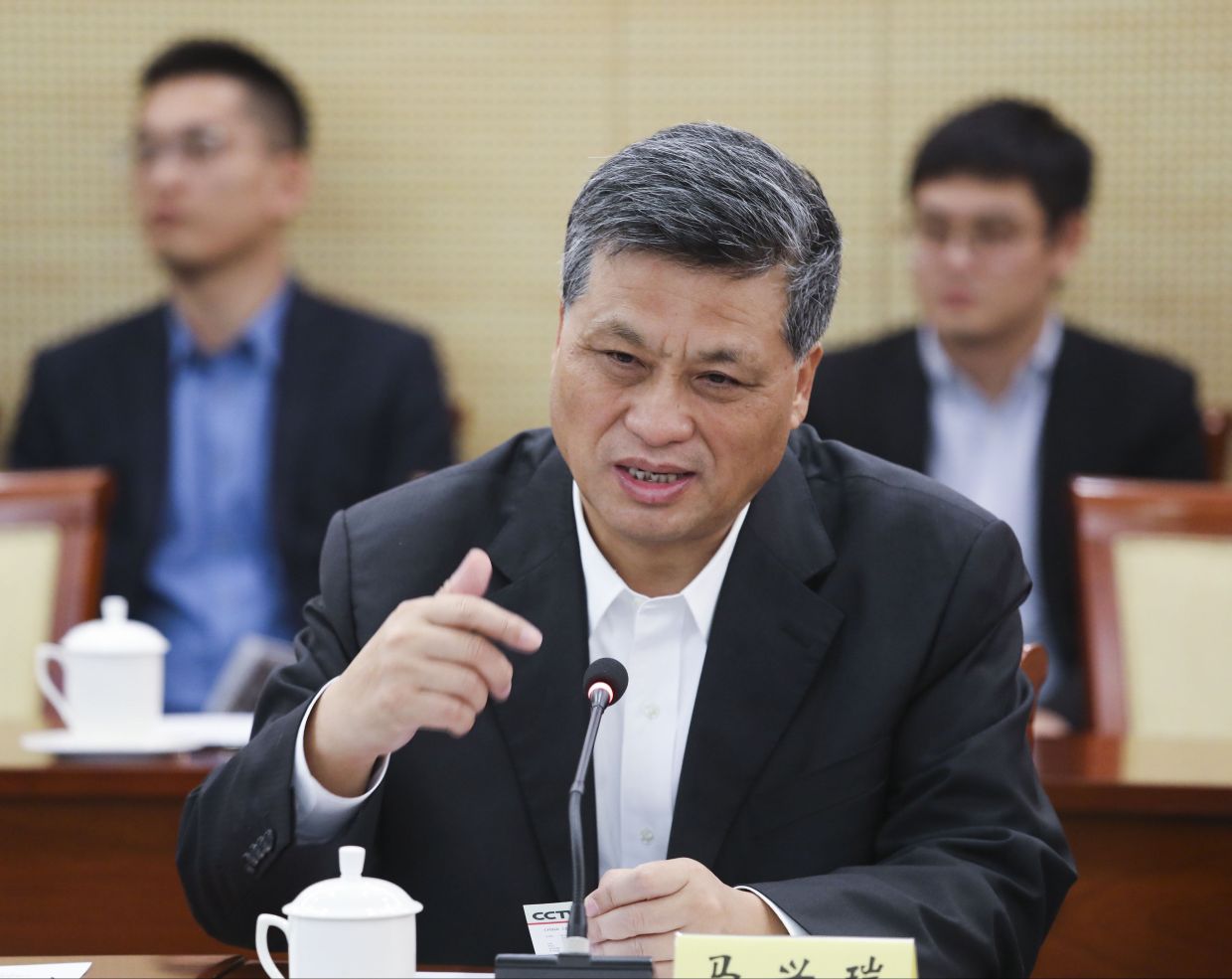
China's political establishment has taken aim at Ma Xingrui, a 67-year-old former member of the Politburo—the Communist Party's most exclusive governing circle—with the Central Commission for Discipline Inspection formally accusing him of systematic corruption involving his family, subordinates, and abuse of official authority. The Politburo itself reviewed and approved the disciplinary body's damning report on June 30, signalling the weight Beijing attaches to his misconduct. This development underscores an accelerating pattern of elite purges at the highest levels of Chinese governance, a phenomenon largely absent from the party's recent history and raising questions about factional struggles within President Xi Jinping's administration.
Ma's trajectory through China's power structure illuminates the intricate pathways to political advancement and the substantial opportunities for malfeasance they present. He initially made his reputation as an aerospace expert, spending nearly two decades at the China Aerospace Science and Technology Corporation, where he ascended to general manager between 2007 and 2013. During this tenure, he simultaneously held the positions of deputy commander-in-chief of China's manned space programme and commander-in-chief of the new-generation carrier rocket project—roles central to the nation's technological and strategic ambitions. His subsequent transition into the political realm proved remarkably swift. In 2013, he shifted to the Ministry of Industry and Information Technology before moving to Guangdong province as its deputy party secretary, then progressing through increasingly senior posts including party secretary of Shenzhen, provincial vice-governor, and ultimately provincial governor.
The allegations against Ma paint a portrait of systematic exploitation of state power for personal enrichment and family advancement. Investigators found that he engaged in accepting improper gifts and financial transfers, facilitated discounted property purchases for family members, and participated in what the disciplinary commission termed "power-for-sex and money-for-sex transactions." More significantly, Ma allegedly created an environment permitting his relatives to leverage his political position for commercial gain, effectively spawning what the commission described as "rampant corruption across his family." This family-centred approach to graft represents a particularly egregious violation of party discipline, as it transforms public office into a hereditary asset and demonstrates systematic rather than opportunistic wrongdoing.
Beyond personal enrichment, Ma weaponised his authority to benefit business associates and political allies. The commission found that he deployed his position to secure lucrative contracts, orchestrate job promotions, and influence personnel appointments—both directly and through intermediaries including family members. Such interventions in cadre selection and appointment constitute a fundamental corruption of the meritocratic principles the party claims to uphold, undermining institutional integrity by subordinating qualification to patronage. His manipulation of the official machinery extended to inadequate oversight of subordinates, permitting staff members to commit serious disciplinary violations and suspected crimes with minimal consequences, thereby institutionalising corruption within his administrative sphere.
Significantly, Ma's resistance to confession during the CCDI's initial interrogations aggravated his culpability. Rather than demonstrating contrition or cooperation, he maintained his defence even as evidence accumulated, suggesting a calculated defiance of party authority. Notably, this obstruction persisted even after the 18th party congress in 2012, when Xi Jinping explicitly launched his defining anti-corruption campaign and instituted strict official conduct regulations. This timing underscores that Ma's violations were not products of an earlier, less-regulated era but rather deliberate transgressions against explicitly established rules under Xi's watch—a particularly damaging narrative for defending against corruption accusations.
Ma's assignment to Xinjiang in 2021 placed him at the helm of one of China's most strategically sensitive and politically fraught regions, where he succeeded Chen Quanguo as party chief. He attained Politburo membership the following year at the 20th party congress in October 2022, cementing his place within the party's elite leadership structure at precisely the moment Beijing was intensifying its grip over the restive western territory. His downfall carries special significance within this context, as Xinjiang has become a focal point of factional scrutiny. The CCDI has recently investigated multiple former Xinjiang officials, including Chen Weijun, the former executive vice-chairman, and Li Xu, the former deputy commander of the Xinjiang Production and Construction Corps, suggesting either systemic corruption within the regional apparatus or targeted factional elimination of a particular political network.
The broader implications of Ma's case extend beyond individual malfeasance. With his removal alongside two senior military leaders—including He Weidong, the former vice-chairman of the Central Military Commission, who was expelled from both the party and military in October—the Politburo has contracted from its prior membership to just 21 members. This represents an unprecedented hemorrhaging of elite personnel in a single leadership cycle, constituting a structural transformation of the Communist Party's highest decision-making body. For regional observers including Malaysia and Southeast Asia, such disruption at China's apex creates uncertainty regarding policy continuity, factional alignments, and the distribution of patronage networks that influence Beijing's regional engagement.
Ma's aerospace background also carries broader significance for understanding the reach of anti-corruption efforts. Several of his former subordinates in the aerospace and space sectors have themselves been ensnared in recent corruption investigations, suggesting that his influence extended through technological and industrial networks that underpin China's strategic capabilities. Whether these investigations reflect actual corruption or serve as convenient mechanisms for removing perceived rivals from these strategically critical domains remains analytically ambiguous, though the pattern warrants careful observation by foreign analysts monitoring technological competition and space capabilities.
The disciplinary commission's characterisation of Ma's conduct as "extremely serious in nature" and of "extremely bad influence" establishes a narrative of egregious wrongdoing designed to justify harsh consequences. Authorities have announced that his ill-gotten gains will be confiscated and that he faces judicial prosecution, though the actual trial outcomes remain pending. For observers in Malaysia and the region, Ma's case illustrates the extent to which political fortunes in contemporary China remain vulnerable to sudden reversal, even at the highest echelons, and demonstrates Xi Jinping's continued willingness to deploy the disciplinary apparatus against established power brokers when political calculations demand such action. The concentration of three Politburo investigations within a single leadership term suggests that elite politics in China under Xi Jinping remain more turbulent and less institutionally stabilised than public narratives of consolidated power might suggest.

