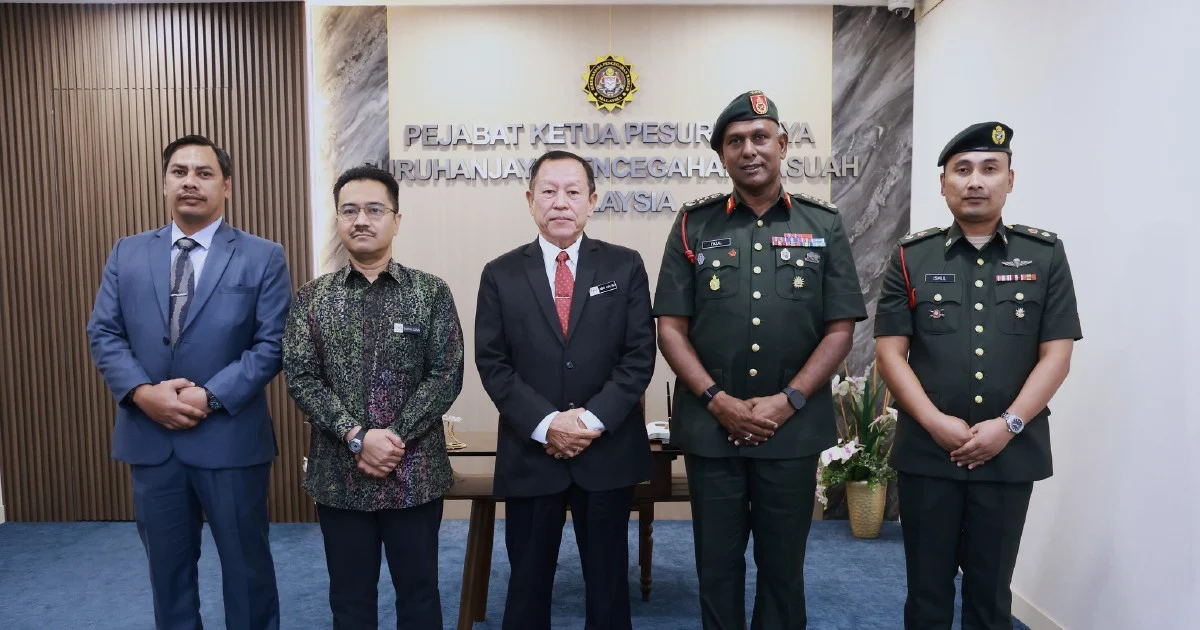
The Malaysian Anti-Corruption Commission and the armed forces have committed to a reinforced strategic partnership aimed at combating corruption more effectively through coordinated intelligence operations and strengthened governance frameworks. The agreement, formalised in Putrajaya, represents a significant institutional alignment in Malaysia's broader anti-corruption mandate, recognising that the military's operational capacity and the MACC's investigative expertise can be more potent when deployed in tandem.
This collaboration addresses a critical vulnerability in Malaysia's corruption control architecture. Historically, anti-corruption agencies and the defence establishment have operated largely in separate spheres, with limited formal mechanisms for sharing intelligence on illicit activities that may span both civilian and military domains. By establishing structured information-exchange protocols, the two institutions can now identify patterns and networks that might otherwise remain invisible to either party working independently.
The partnership carries particular relevance for Malaysia's defence procurement and military logistics operations, sectors historically vulnerable to graft. Corruption within defence procurement not only diverts public funds but also compromises operational readiness and national security. Armed forces personnel, posted across remote bases and training facilities, often possess ground-level intelligence about irregular financial flows or suspicious activities that might indicate larger corruption schemes. Formalising channels for this information to reach MACC investigators accelerates detection and investigation cycles.
Governance enhancement is the third pillar of this arrangement, signalling that both institutions recognise corruption prevention as equally important as detection and prosecution. This reflects international best practice, where integrity frameworks are embedded within organisational structures rather than applied externally. The armed forces, which employ hundreds of thousands of personnel across multiple services, can benefit from MACC's expertise in designing systems that reduce opportunities for corrupt behaviour, from procurement processes to asset management.
For Malaysian readers, the significance extends beyond institutional mechanics. Trust in public institutions remains a fundamental prerequisite for stable governance and economic confidence. When defence budgets—typically substantial in any national accounts—are mismanaged, opportunity costs are severe. Resources diverted to corruption cannot be allocated to personnel welfare, equipment modernisation, or training programmes that enhance Malaysia's regional security posture. The MACC-armed forces alliance therefore carries strategic weight beyond the immediate anti-corruption agenda.
The timing of this strengthened cooperation also reflects Malaysia's evolving security environment in Southeast Asia. As regional tensions fluctuate and strategic competition intensifies, military modernisation becomes increasingly important. Ensuring that defence expenditure reaches its intended purpose—rather than being siphoned through corrupt intermediaries—directly supports Malaysia's capacity to protect its maritime interests and maintain defence capabilities consistent with its regional standing and commitments to regional security frameworks.
Intelligence sharing between these institutions requires carefully calibrated protocols to protect operational sensitivities and individual privacy while maximising transparency. The MACC must maintain independence in its investigative determinations, whilst military commanders must retain confidence that sensitive information shared for anti-corruption purposes will not be misused for political advantage. Successfully navigating these tensions will test the maturity of the partnership and the commitment of both institutions to shared integrity standards.
Sectorally, this cooperation has immediate implications for Malaysia's defence contractors and suppliers. Companies bidding for military contracts now face heightened scrutiny from a dual-agency framework with complementary investigative capabilities. This should, in theory, elevate competitive fairness by reducing advantages that corrupt networks might previously have enjoyed. However, the deterrent effect depends on consistent enforcement and visible consequences for violations.
Regionally, Malaysia's approach may also influence how other Southeast Asian nations structure anti-corruption cooperation between civil and military authorities. Several regional peers have grappled with similar challenges, and successful models often become reference points for institutional reform elsewhere. If the MACC-armed forces partnership yields measurable improvements in corruption detection and prevention within Malaysia's defence sector, it could establish a template for regional adoption.
The broader context here involves Malaysia's standing within international anti-corruption indices and frameworks. Nations that demonstrate systematic commitment to fighting corruption across all sectors, including the historically opaque defence establishment, tend to receive better assessments from organisations like Transparency International and the United Nations. These evaluations influence foreign direct investment decisions and international confidence in Malaysia's institutions.
Looking forward, the success of this alliance will be measured not merely by formal agreements but by concrete outcomes: cases investigated, prosecutions secured, and systemic reforms implemented. Both institutions must demonstrate that intelligence sharing leads to actionable investigation pathways rather than becoming a bureaucratic exercise. Regular public reporting on cooperation achievements, balanced against operational security requirements, will help build confidence that the partnership is delivering on its mandate.
The partnership also suggests broader recognition within Malaysia's leadership that corruption is not merely an ethical failing but a strategic liability. As military modernisation remains a priority for national development, ensuring that defence resources are deployed efficiently and with full accountability becomes integral to Malaysia's competitive positioning in an increasingly multipolar regional environment where capability and credibility both matter.

