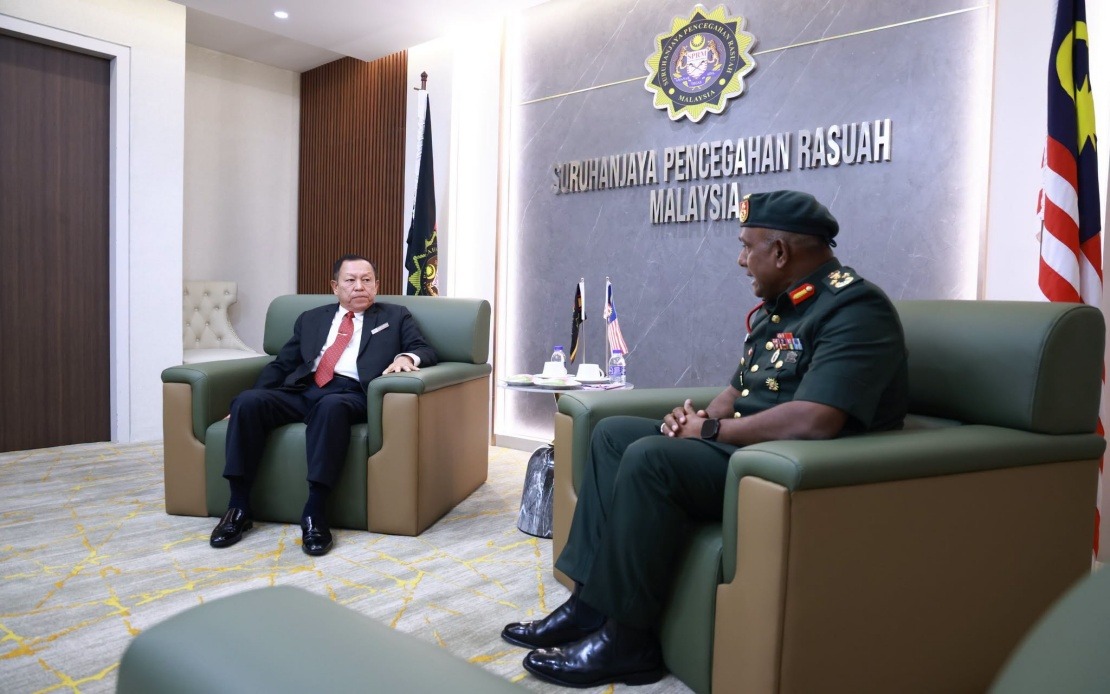
Malaysia's top anti-corruption watchdog and its military establishment have formally recommitted to their partnership in rooting out graft, signalling a more coordinated approach to tackling wrongdoing within defence and security institutions. The Malaysian Anti-Corruption Commission and the Malaysian Armed Forces sealed their renewed resolve during a courtesy visit at MACC headquarters in Putrajaya on July 7, underscoring the strategic importance of inter-agency collaboration in safeguarding public integrity.
The meeting brought together Datuk Seri Abd Halim Aman, the MACC's Chief Commissioner, and Lt Gen Datuk Fazal Abdul Rahman, the newly appointed director-general of the Malaysian Defence Intelligence Organisation, along with senior officials from both organisations. The timing of the courtesy call, coinciding with Fazal's official appointment taking effect on May 21, provided an opportunity to reset expectations and clarify the operational framework for enhanced cooperation between the two bodies.
Abd Halim characterised the existing relationship as longstanding and valuable, reflecting the commission's recognition that the Armed Forces represent a critical constituency for anti-corruption work. The defence and security sectors, by their nature, manage substantial resources and exercise significant authority—factors that demand rigorous oversight. The MACC chief expressed confidence that the partnership would deepen in coming months, particularly through formalised channels for sharing sensitive intelligence and operational information that could reveal corrupt practices within military ranks.
Intelligence sharing between law enforcement and defence agencies carries particular weight in the Malaysian context. Military procurement, defence contracts, and security operations handle budgets running to billions of ringgit annually, creating multiple pressure points where corruption can take root. By establishing clearer protocols for information exchange, both agencies can cross-reference suspicious activity and develop more comprehensive pictures of potential wrongdoing that might otherwise escape scrutiny. This synergy is especially crucial when corruption involves conspiracy across institutional boundaries—cases where a defence official colludes with a civilian contractor, for example.
Fazal, speaking on behalf of the Armed Forces, reaffirmed the military's commitment to maintaining stringent governance standards and emphasising discipline throughout its ranks. His remarks reflected a broader acknowledgement within the defence establishment that public confidence in the institution depends critically on demonstrating zero tolerance for corrupt practices. The armed forces, as custodians of national security, face heightened public expectations around integrity; any perception of widespread graft within the military erodes both institutional credibility and operational effectiveness.
The governance enhancement component of the renewed partnership addresses systemic vulnerabilities. Rather than pursuing only reactive investigations, both agencies can collaborate on preventive measures—reviewing procurement processes, auditing supply chains, and identifying structural weaknesses that enable corrupt officials to operate with impunity. This preventive lens is particularly valuable in defence, where opaque decision-making and limited public scrutiny can shield malpractice from discovery.
For Malaysian readers and regional observers, this alignment carries broader implications. Throughout Southeast Asia, defence corruption remains a persistent challenge, often involving transnational networks and complex schemes spanning multiple jurisdictions. A strengthened MACC-Armed Forces partnership sets a regional precedent for how domestic institutions can pool resources and expertise to confront sophisticated graft. Other regional militaries and anti-corruption bodies may look to Malaysia's model as they calibrate their own inter-agency frameworks.
The presence of supporting officials—MACC's Intelligence Division senior director Datuk Saiful Ezral Arifin and the MAF Security and Counter Intelligence Directorate director Lt Col Muhamad Zainol Md Yusof—underscores that this commitment extends beyond rhetorical endorsement. These operational-level officials are tasked with translating high-level directives into practical mechanisms for intelligence exchange, joint investigations, and shared training programmes. Their involvement signals that implementation structures are already being considered.
Contextually, Malaysia's anti-corruption agenda has gained momentum under recent administrations committed to transparency and institutional reform. The MACC, despite periodic criticism regarding its independence and resource constraints, has pursued high-profile cases involving political and business figures. A more robust military component to this agenda strengthens the overall national effort and demonstrates that no sector—regardless of its strategic importance—sits beyond the reach of anti-corruption scrutiny.
The partnership also reflects evolving international standards around anti-corruption. Donor countries and multilateral development institutions increasingly condition support on demonstrated governance improvements. By formalising cooperation between its anti-corruption commission and armed forces, Malaysia signals to international stakeholders that it takes institutional integrity seriously across all government sectors. This can positively influence foreign investor confidence and Malaysia's standing in global governance rankings.
Moving forward, concrete deliverables will test the sincerity of this renewed partnership. Observers should watch for joint training initiatives, published case studies of successful collaborative investigations, and documented improvements in investigation timelines where military and civilian agencies work in tandem. Transparency regarding the scope and outcomes of intelligence-sharing arrangements, within operational security constraints, will further validate the commitment.

