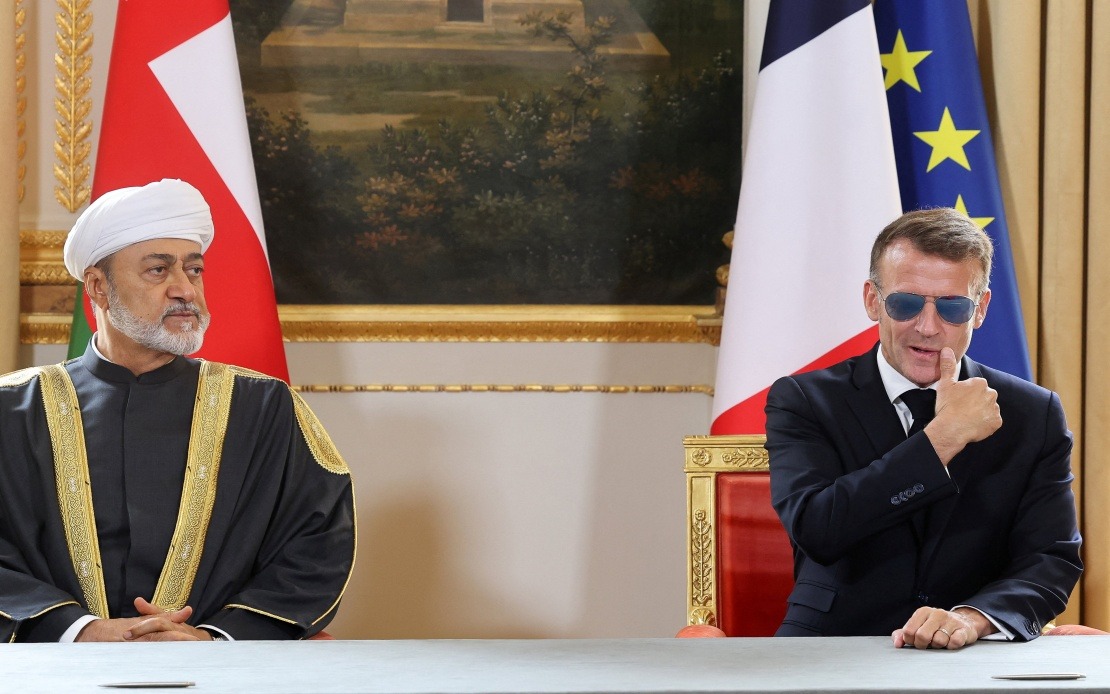
French President Emmanuel Macron arrived at a high-profile diplomatic engagement with the Sultan of Oman wearing his now-recognizable aviator sunglasses, reigniting discussion about the accessory that has become unexpectedly central to international political discourse. During Monday's meeting with Sultan Haitham bin Tariq at the Élysée Palace, Macron maintained the eyewear throughout his interactions with the Gulf state's leader, a decision that French media attributed to a persistent eye condition rather than stylistic preference.
The French government's explanation centred on medical grounds. According to sources close to the presidency, Macron has been managing an eye inflammation that necessitates the protective sunglasses. Earlier this year, in January, French officials had disclosed that the president was dealing with a minor eye condition requiring similar protective measures for approximately two weeks. The current situation suggests that the inflammation either returned or proved more persistent than initially anticipated, extending the timeline for the use of corrective eyewear.
This particular accessory earned international notoriety during Macron's appearance at the World Economic Forum in Davos earlier this year. The decision to wear the sunglasses at that high-profile gathering—typically an indoor event where such eyewear appears incongruous—triggered considerable public commentary. US President Donald Trump took the opportunity to mock the French leader's appearance, while social media in France erupted with comparative jokes likening Macron's look to Hollywood actor Tom Cruise's iconic appearance in the Mission: Impossible film franchise. The fashion-forward president found himself at the centre of unexpected ridicule over an accessory intended for medical necessity.
What emerged most surprising from the Davos incident was the commercial interest generated by Macron's visible eyewear. Henry Jullien, a French luxury eyewear manufacturer, reported a significant surge in customer inquiries specifically about the model worn by the president. The company capitalized on the unexpected publicity by continuing to feature Macron in promotional materials for the sunglasses, transforming an embarrassing international moment into a marketing opportunity. This reflects the peculiar power of presidential visibility in the modern era, where even medical accessories can become coveted consumer products.
For Southeast Asian observers, this episode illustrates the delicate balance international leaders must maintain between personal health considerations and public perception. Macron's decision to prioritize medical necessity over diplomatic optics—despite the inevitable mockery—demonstrates a practical approach to leadership that resonates across cultures. Yet it also highlights how the global media ecosystem instantaneously transforms personal circumstances into international talking points, regardless of context or explanation.
The Oman meeting itself represents important diplomatic continuity for France within the Gulf region. Sultan Haitham bin Tariq, who ascended to power in 2020, has positioned Oman as a strategic mediator in Middle Eastern affairs. France maintains significant economic and defence interests throughout the Gulf, making such bilateral engagements consequential beyond the symbolic realm. The optics of Macron's appearance, whatever the medical justification, inevitably shapes the visual narrative surrounding Franco-Omani relations during a period when Gulf geopolitics remain volatile and diplomatically sensitive.
The persistence of Macron's eye condition raises broader questions about presidential health disclosure in democratic societies. Unlike traditional coronaries or surgical procedures, eye inflammation might seem trivial, yet the public nature of the condition—literally visible on the president's face—creates unprecedented transparency. This contrasts sharply with historical precedent, where leaders routinely concealed significant health issues from public view. Macron's apparent comfort with discussing and visibly managing his medical condition reflects contemporary attitudes toward transparency, though it simultaneously opens the door to public criticism and international mockery.
For Malaysian readers following international affairs, the incident underscores how global media, regardless of geographical distance, instantaneously covers even minor aspects of major leaders' lives. The transformation of medical necessity into international news reflects the compression of distance through digital connectivity. What occurs in Paris instantly becomes available for commentary and analysis in Kuala Lumpur, creating a shared global conversation around previously private matters.
Looking forward, the sunglasses episode illustrates an emerging reality in 21st-century diplomacy: personal circumstances cannot remain shielded from public scrutiny, and leaders must navigate the intersection of medical privacy, personal dignity, and public curiosity. Macron's pragmatic approach—prioritizing health over image—offers a measured response to the inevitable tension between these competing demands. Whether the eye condition remains temporary or becomes chronic will determine whether this becomes merely an amusing anecdote or a recurring element of presidential presentation.

