The MADANI government has reaffirmed its dedication to sustaining Ziarah Kasih, a targeted welfare initiative designed to deliver immediate financial and material support to Malaysians facing severe economic hardship. Speaking during a community engagement event in Mersing, Political Secretary to the Communications Minister Abdullah Izhar Mohamed Yusof outlined how the programme functions as a cornerstone of the administration's commitment to reducing suffering among the nation's most vulnerable populations. The initiative represents a deliberate departure from generic subsidy programmes, instead focusing on personalised interventions that address the specific circumstances of individual households.
The identification and selection of beneficiaries operates through a structured collaboration between the Department of Information and Komuniti MADANI, ensuring that assistance reaches those most in need rather than being distributed indiscriminately. This targeted approach reflects an understanding that vulnerability manifests differently across communities—a retiree facing catastrophic health expenses requires different support than a widow managing household maintenance alone. By localising the identification process, the government attempts to capture nuances that centralised bureaucracies often miss, though questions remain about the consistency of implementation across Malaysia's diverse administrative regions.
The Ziarah Kasih framework aligns with the broader Malaysia MADANI vision, which explicitly prioritises citizen well-being as a central governance objective. This positioning transforms welfare from a reactive mechanism addressing crises into a proactive policy architecture embedded within the government's foundational philosophy. For Malaysian readers, this represents a significant ideological shift—welfare becomes not merely an expenditure line item but an expression of the state's fundamental social contract with its citizens. The regularity of implementation, emphasised by Abdullah Izhar, suggests an intention to move away from one-off charitable gestures toward systematic, predictable support.
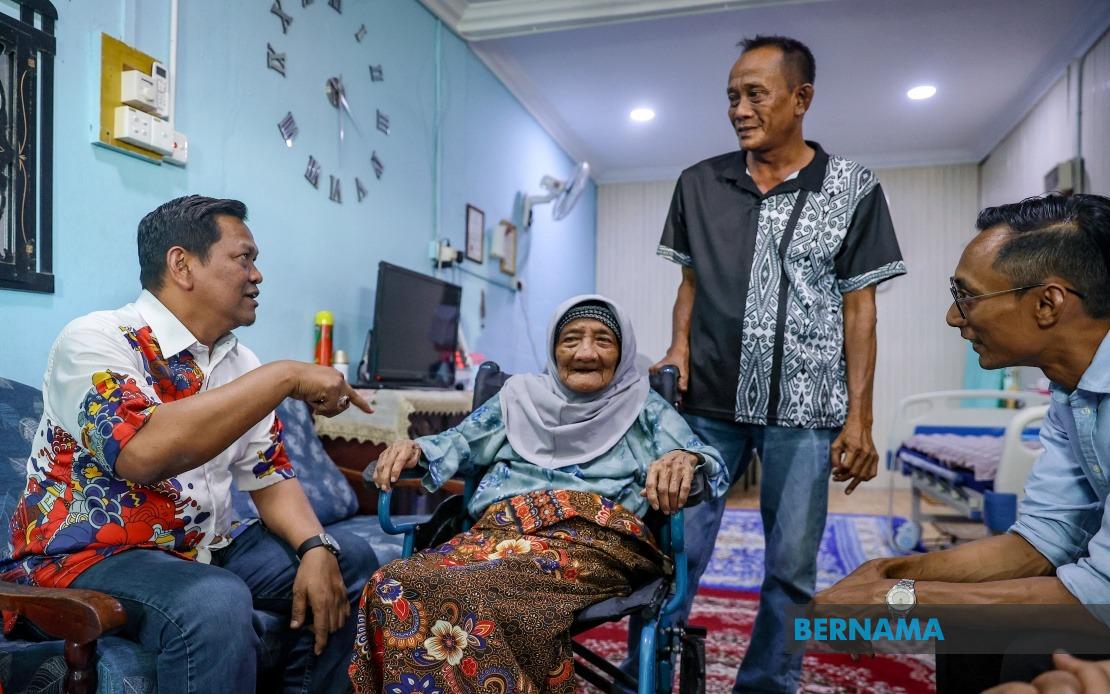
The Mersing programme specifically targeted elderly residents grappling with health complications, distributing both monetary contributions and specialised healthcare equipment. These materials address immediate medical needs while reducing the out-of-pocket expenses that frequently bankrupt households already struggling with subsistence costs. For a region like Mersing, where fishing communities and rural settlements dominate, such targeted equipment can prove transformative—a mobility aid or blood pressure monitor represents not merely comfort but dignity and independence for ageing populations often isolated from urban medical infrastructure.
Among the beneficiaries was Hamdan Abd Latif, a 71-year-old former firefighter whose circumstances illustrate how catastrophic illness can unravel decades of financial stability. His trajectory—a workplace accident mere weeks before retirement eligibility, followed by a brain tumour diagnosis requiring surgical intervention, culminating in a stroke—demonstrates how individual tragedies can cascade into family-wide economic collapse. The tragic irony that his injury occurred while supplementing retirement income through informal fishing underscores how Malaysia's social safety net leaves retirees inadequately provisioned, forcing continued labour even after formal careers end.
Hamdan's wife, Meriam Abd Wahab, has abandoned her own income-generating activities to provide full-time care, a sacrifice that eliminates household earning capacity precisely when medical expenses intensify. Her previous sewing work, though modest in earnings, represented economic independence and dignity alongside financial contribution. This pattern—where caring responsibilities, disproportionately borne by women, become barriers to workforce participation—reflects systemic vulnerabilities that targeted assistance addresses only partially. The Ziarah Kasih contribution offers immediate relief but cannot restore the lifetime earning potential permanently sacrificed to caregiving.
The second featured recipient, Zainon Ibrahim at 91 years old, represents another common vulnerability pattern: elderly individuals whose longevity extends beyond their financial resources. Her son, Jamaluddin Ismail, abandoned formal employment two years ago to provide necessary care, a decision that compounds the household's economic fragility. The family's reliance on sibling support networks, while demonstrating strong kinship bonds, also reveals the precariousness of depending on voluntary arrangements rather than institutionalised welfare mechanisms. When such informal support networks weaken through migration, death, or financial stress, elderly individuals lack adequate backstops.
Jamaluddin's characterisation of Ziarah Kasih assistance as helping meet his mother's basic daily needs suggests that the allocation, while welcome, remains insufficient to address comprehensive requirements. This gap between assistance received and total needs highlights a structural tension within targeted welfare programmes: they can alleviate acute crises but rarely achieve sufficiency. For policymakers, this reveals whether Ziarah Kasih represents a transitional bridge toward more comprehensive social protection or a permanent band-aid solution to systemic inadequacy. The distinction carries profound implications for Malaysian households navigating vulnerability in an era of rising living costs and stagnating wages.
The programme's emphasis on regular implementation distinguishes it from ad-hoc charitable interventions. Predictability allows vulnerable households to plan, reducing the constant anxiety that characterises poverty and enabling recipients to direct scarce resources toward non-emergency needs. However, regularity requires sustained budgetary commitment, political consistency across electoral cycles, and administrative capacity that Malaysia's federal system sometimes struggles to maintain uniformly. Regional disparities in programme implementation could emerge if decentralisation and local ownership insufficiently balance centralised standards.
For Southeast Asian context, Malaysia's Ziarah Kasih approach offers a model relevant to middle-income countries wrestling with welfare expansion amid fiscal constraints. Unlike universal programmes requiring substantial budgetary reallocations, targeted initiatives concentrate resources on demonstrable need, potentially maximising poverty reduction per ringgit expended. Yet targeting introduces its own inefficiencies through identification costs and the political complications of determining who qualifies, potentially creating grievances among those excluded despite similar circumstances. The programme's success ultimately depends not merely on policy design but on community trust and perceived fairness.
The government's reiteration of commitment to Ziarah Kasih reflects both genuine intention and political calculation. For vulnerable communities, tangible assistance from government representatives creates perceived responsiveness and reciprocal loyalty. For the administration, visible welfare engagement demonstrates that Malaysia MADANI represents not merely aspirational rhetoric but concrete actions affecting citizens' material conditions. Whether this programme evolves into a durable, adequately-resourced welfare foundation or remains a supplementary initiative will significantly shape the government's credibility with Malaysia's economically marginalised populations as the nation navigates post-pandemic economic uncertainties and rising household pressures.