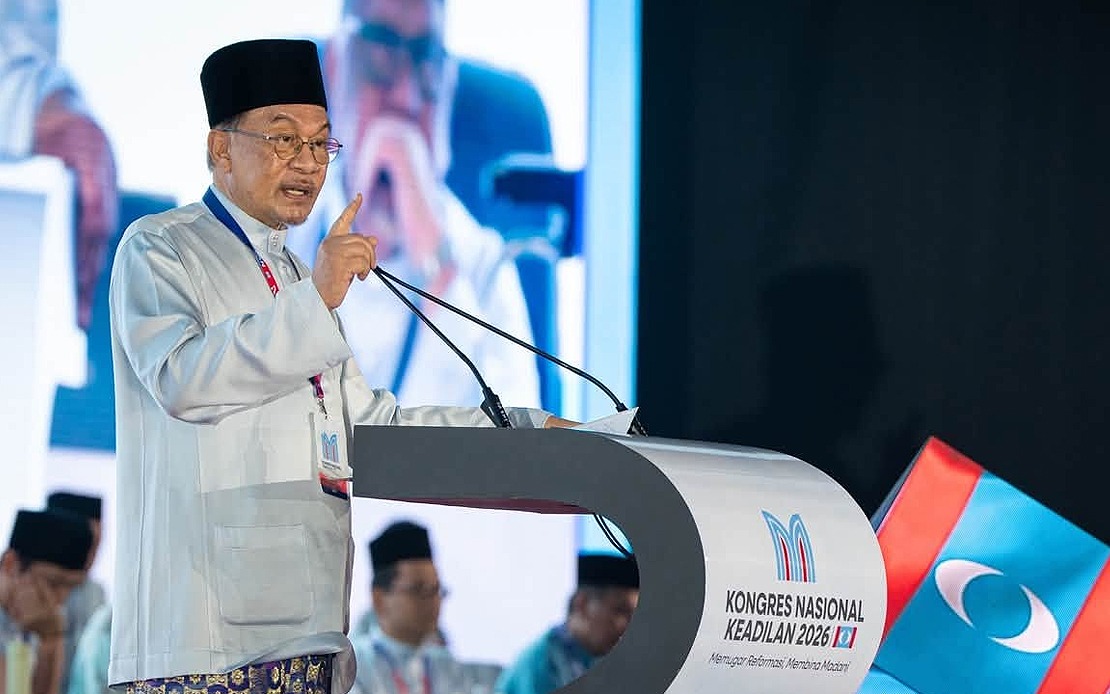
The MADANI Government faces a critical challenge: converting policy announcements into measurable improvements in the daily lives of ordinary Malaysians. This reality underscored remarks from Prime Minister's Senior Political Advisor Tengku Datuk Seri Zafrul Tengku Abdul Aziz during the 2026 PKR National Congress in Melaka, where he emphasised that reform rhetoric must ultimately yield tangible results that citizens can experience firsthand.
Tengku Zafrul's intervention at the two-day gathering, held at the Melaka International Trade Centre (MITC) under the theme "Reviving Reform, Building MADANI", highlighted a persistent governance gap: the distance between impressive macroeconomic indicators and household-level prosperity. While the Malaysian economy expanded by six percent—a performance that confounded analysts' expectations—the advisor acknowledged that this headline achievement rings hollow unless ordinary families witness corresponding improvements in their circumstances. The comment reflects growing recognition within government circles that numerical success on balance sheets does not automatically translate to electoral goodwill or public satisfaction.
PKR President Datuk Seri Anwar Ibrahim's policy address to congress delegates outlined an array of proposed initiatives, from abolishing the Universities and University Colleges Act (AUKU) to rehabilitating the Federal Land Development Authority (FELDA), alongside budgetary economic measures still in development. These proposals ostensibly demonstrate governmental intent to address structural deficiencies and modernise institutions. Yet Tengku Zafrul's candid assessment suggested that the MADANI coalition recognises a fundamental communications deficit: citizens remain largely unaware of these programmes, or fail to perceive their relevance to pressing household concerns including employment stability, housing affordability, and educational quality.
This communications challenge carries particular weight in Malaysia's fractured political landscape, where opposition parties stand ready to amplify voter disaffection. The government cannot assume that policy implementation automatically generates public awareness or credit. Instead, the MADANI coalition must develop sophisticated messaging strategies that connect specific initiatives to concrete benefits experienced by diverse demographic groups—young workers, rural communities, small traders, and retirees alike. Tengku Zafrul's frank assertion that communication failures represent "our own delivery shortcoming" rather than public apathy signals at least rhetorical acceptance of this responsibility.
The emphasis on FELDA rehabilitation carries particular significance for Malaysia's political geography. The authority, historically central to rural development and Bumiputera economic participation, has suffered years of financial strain and governance challenges. Meaningful revival could bolster MADANI support among rural constituencies, particularly Malay-Muslim communities in Peninsular Malaysia. Similarly, AUKU abolition addresses long-standing student activist and intellectual community demands, potentially energising younger urban voters who have gravitated toward opposition movements. Critically, however, these initiatives must deliver observable improvements—whether campus freedoms expand meaningfully or FELDA smallholders experience genuine income growth—rather than remaining symbolic gestures.
The six percent economic growth figure, while commendable by regional and global standards, masks uneven distribution of prosperity across income groups and regions. Manufacturing sectors and urban commercial hubs may thrive while rural agricultural zones stagnate; formal sector employees enjoy rising incomes while gig workers remain precarious. Tengku Zafrul's insistence on "spillover effects felt by all citizens" implicitly acknowledges this inequality, demanding that growth strategies explicitly target disadvantaged populations rather than assuming prosperity cascades automatically downward. Without such targeted interventions, headline GDP figures will continue fuelling public cynicism about whom the government truly serves.
PKR's internal dynamics also merit consideration. The party has positioned itself as the reform vanguard within Malaysia's ruling coalition, but maintaining that identity requires demonstrable policy victories and grassroots engagement. Congress delegates' debate sessions appear to have aligned reasonably well with Anwar's keynote themes, suggesting party unity around reform objectives—yet unity at leadership level differs fundamentally from mobilised party machinery effectively communicating achievements to voters. Tengku Zafrul's call for strengthened party mechanisms and improved inter-party coordination reflects recognition that coalition governance requires far more disciplined execution than opposition politics.
The advisor's confidence in future electoral success explicitly conditions future support on delivering tangible reform dividends coupled with enhanced organisational capacity. This framing establishes clear performance benchmarks against which the MADANI Government will be judged. Voters are unlikely to extend patience indefinitely for initiatives whose benefits remain theoretical or delayed. The next general election cycle will provide an unforgiving assessment of whether government communications improve, whether policy benefits become visible across diverse communities, and whether public trust in the coalition's reform project strengthens accordingly.
For Malaysian businesses and investors, the MADANI Government's ability to translate policy promises into results carries direct implications. Economic confidence depends partly on investor perception that government programmes will function effectively and achieve stated objectives. Policy uncertainty or implementation failures undermine the business environment, while successful policy delivery enhances investor confidence. The initiatives outlined at PKR congress—particularly those with economic dimensions—must therefore demonstrate clear execution pathways and measurable progress indicators.
Regionally, Malaysia's governance trajectory influences Southeast Asia's broader political trajectory. As democracies across the region grapple with democratic backsliding concerns, institutional capacity building, and public trust deficits, the MADANI Government's success or failure in converting reform rhetoric into institutional improvement carries symbolic weight. A Malaysian government capable of rehabilitating previously dysfunctional institutions while expanding democratic space would signal that regional democracies can successfully navigate contemporary governance challenges.
Ultimately, Tengku Zafrul's remarks expose the fundamental MADANI Government challenge: the gap between policy ambition and implementation capacity. An array of well-intentioned initiatives gathering dust in bureaucratic pipelines benefits no one. Conversely, effective execution of even modest programmes can generate public confidence and electoral momentum. The coming months will determine whether the MADANI coalition can close this execution gap.

