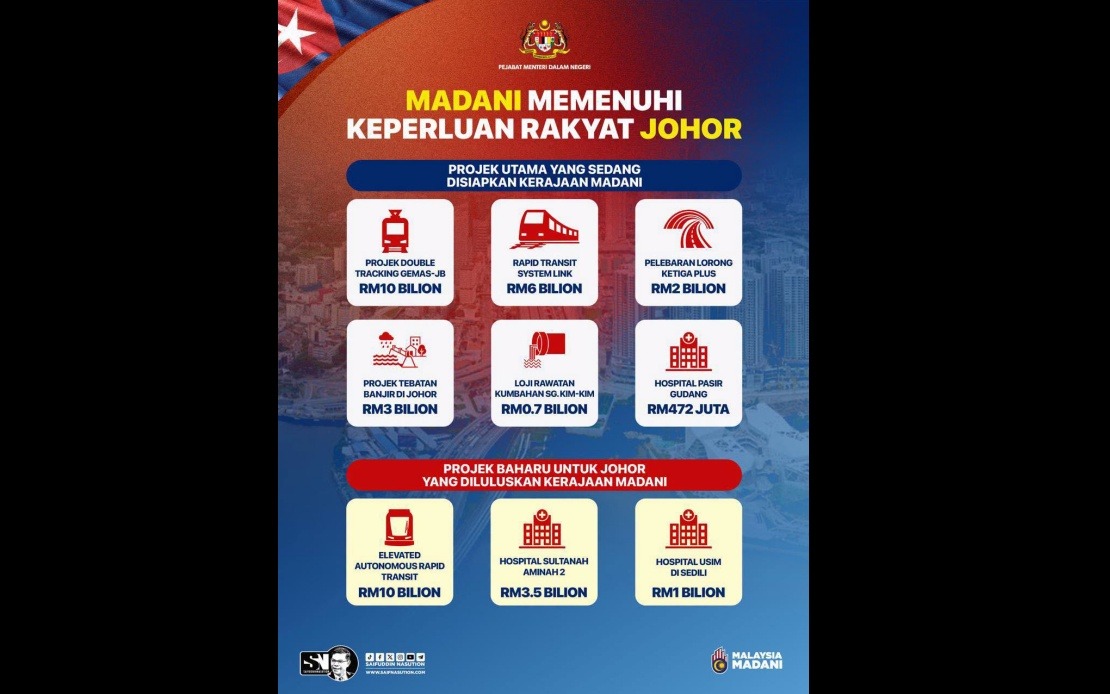
The federal government is doubling down on its pledge to ensure equitable and sustainable development reaches every corner of Malaysia, with Johor positioned as a key focus area for transformative projects that will reshape the state's economic landscape and improve citizen welfare. Pakatan Harapan secretary-general Datuk Seri Saifuddin Nasution Ismail, speaking in his capacity as Home Minister, outlined an ambitious portfolio of initiatives designed to position Johor on a trajectory of robust long-term expansion while prioritising the tangible benefits experienced by ordinary Malaysians rather than abstract growth metrics.
Under Prime Minister Datuk Seri Anwar Ibrahim's administration, the government has established a clear strategic priority around four interconnected pillars: substantial capital allocation toward transportation networks, substantial capital allocation toward healthcare infrastructure, comprehensive flood management systems, and targeted health sector improvements. This integrated approach reflects recognition that sustainable development cannot be compartmentalised—infrastructure gains mean little without corresponding health facilities, and economic opportunities remain inaccessible without reliable transport connections linking communities to employment and services.
Johor's development agenda encompasses several major undertakings that exemplify this holistic philosophy. The Gemas-Johor Bahru Electrified Double Tracking Project represents a critical railway modernisation initiative that will enhance freight and passenger capacity along a vital economic corridor. Complementing this is the Rapid Transit System Link, designed to alleviate congestion and provide commuters with faster, more sustainable transit options. The expansion of the PLUS Highway through third-lane widening addresses immediate capacity bottlenecks on one of Malaysia's most heavily utilised toll corridors, facilitating smoother goods movement and reducing travel times for millions of daily users.
Flood mitigation emerges as an increasingly pressing investment category, reflecting both historical vulnerabilities and climate change considerations affecting the region. The dedicated Johor flood mitigation project addresses recurrent inundation challenges that have disrupted economic activity and compromised public safety during monsoon periods. Complementing this watershed-level initiative is the Sungai Kim Kim Sewage Treatment Plant, which addresses environmental quality alongside flood prevention by managing stormwater and wastewater more effectively. This dual benefit—environmental protection combined with climate resilience—demonstrates how modern infrastructure projects must serve multiple purposes.
Healthcare infrastructure receives particular emphasis through the approval of three major hospital projects. Pasir Gudang Hospital expansion will extend coverage to a rapidly urbanising industrial corridor, while the Elevated Autonomous Rapid Transit system promises to revolutionise how residents access these facilities by providing swift, elevated connections across congested areas. Sultanah Aminah Hospital 2 and USIM Hospital in Sedili represent significant capital commitments indicating that Johor's healthcare capacity will expand substantially to accommodate growing population demands and reduce existing service bottlenecks.
The government's framing of development success deliberately shifts emphasis from headline investment figures to tangible outcomes affecting daily life. Job creation emerges as the primary metric—projects of this scale generate employment across construction phases and operational periods, creating pathways for Johor residents to transition into skilled roles within expanded economic sectors. Improved transportation efficiency translates directly into reduced commute times, lower fuel costs, and expanded geographic labour markets where workers can access opportunities beyond immediate localities.
Enhanced healthcare accessibility represents perhaps the most consequential dimension for ordinary Malaysians, particularly in underserved regions where travel to tertiary hospitals currently represents both financial and logistical barriers to receiving specialised treatment. The cumulative effect of these projects—when measured through employment statistics, healthcare wait times, traffic congestion indices, and flood severity records—provides a more meaningful assessment of governmental effectiveness than aggregate spending announcements.
For Southeast Asian observers, Johor's development trajectory carries regional significance beyond state boundaries. As Malaysia's southern anchor and primary gateway to Singapore, Johor's infrastructure quality, flood resilience, and healthcare capacity influence regional supply chains, cross-border economic flows, and bilateral relations. Investments in transportation connectivity strengthen Singapore-Malaysia economic integration while flood mitigation protects regionally significant industrial facilities in Pasir Gudang and surrounding areas. Healthcare expansion reduces cross-border medical tourism pressures on Singapore facilities and advances Malaysia's position as a regional healthcare destination.
The MADANI Government's explicit commitment to translating capital allocations into measurable quality-of-life improvements reflects lessons learned from previous development cycles where infrastructure creation occasionally outpaced service delivery capacity or failed to generate expected employment multipliers. By anchoring rhetoric around employment, transportation efficiency, healthcare access, and safety improvements, policymakers establish accountability metrics against which subsequent performance can be evaluated.
The concentration of high-impact projects within a defined geographic area also suggests a deliberate strategy of achieving critical mass in infrastructure modernisation—where transportation improvements unlock benefits from healthcare expansion, flood mitigation reduces disruptions affecting newly created employment corridors, and transit systems connect residents to both hospital facilities and job opportunities. This integrated clustering approach differs markedly from scattered, isolated projects that generate limited spillover effects.

