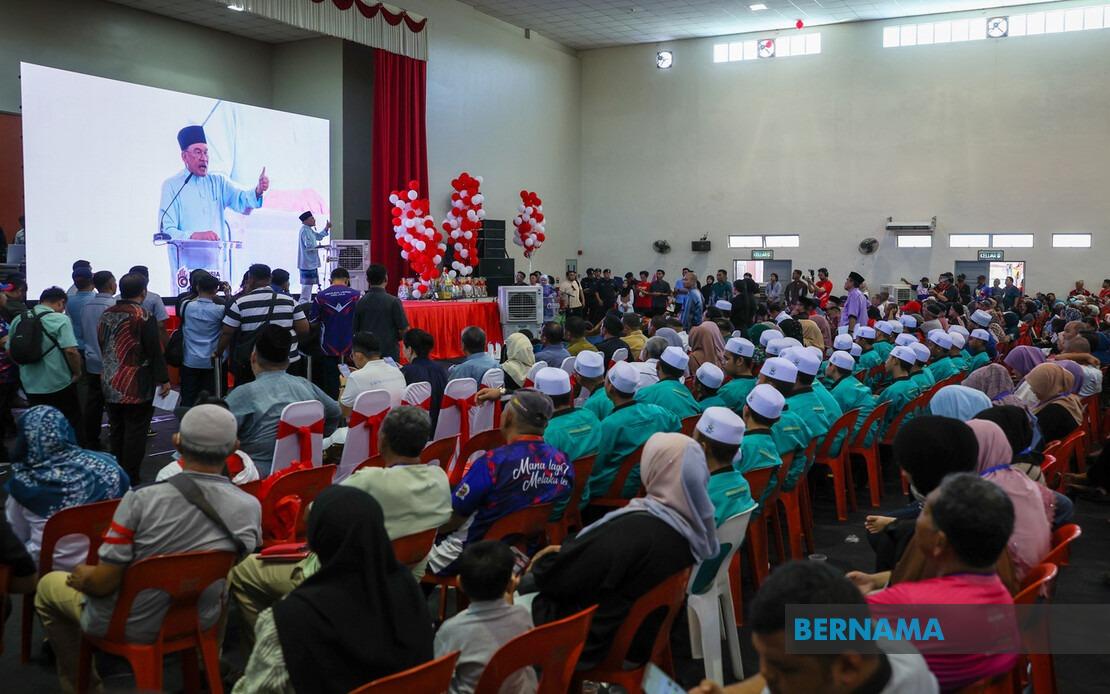
Prime Minister Datuk Seri Anwar Ibrahim has underscored the government's determination to provide equitable assistance across Malaysia's diverse education sector, responding to concerns that heightened funding for Islamic schools might disadvantage other educational streams. Speaking at the Gelombang MADANI Carnival in Alor Gajah on August 7, Anwar emphasised that the administration recognises the needs of all communities and learning institutions without marginalising any constituency. The statement reflects broader efforts by the MADANI coalition to navigate the delicate balance required in managing educational policy within Malaysia's multicultural landscape.
The Prime Minister clarified that strengthened support for Islamic educational institutions—particularly pondok schools and tahfiz centres—does not signal governmental neglect of vernacular education. He stressed that dedicated allocations for Chinese and Tamil schools have already been determined and would be formally unveiled in Kuala Lumpur within approximately two weeks. This sequencing appears designed to demonstrate methodical and comprehensive planning rather than ad-hoc policy adjustments, though the staggered announcement approach itself reflects the politically sensitive nature of education funding decisions in Malaysia's plural society.
Anwar explained that many Islamic educational institutions had historically been deprived of systematic government assistance, a gap the MADANI administration began addressing following its formation in 2022. The government initiated restoration of funding in 2023 and substantially increased allocations in 2024, demonstrating a recalibration of priorities after what Anwar characterised as years of insufficient support for religious schools. This reorientation acknowledges a constituency that felt marginalised under previous administrations while the government worked to prevent corresponding perceptions of abandonment among vernacular school stakeholders.
The philosophical underpinning of this approach rests on Anwar's interpretation of societal cohesion and balanced development. Drawing on Islamic theological concepts, particularly the notion of 'ummatan wasatan' from Surah Al-Baqarah, he articulated a vision of a harmonious society where different communities coexist through mutual respect. This framing attempts to position educational equity not merely as a budgetary exercise but as foundational to Malaysia's stability and international standing as a successful plural democracy. The rhetoric suggests that education policy operates at the intersection of practical governance and cultural identity management.
In concrete terms, Anwar announced RM1.29 million in infrastructure upgrades distributed among 13 Islamic educational institutions across Melaka state. Recipients included Madrasah Tahfiz Al-Quran Wal Qiraat Kota Melaka, which received RM250,000, and Sekolah Rendah Arab Jabatan Agama Islam Melaka (JAIM) Pernu, allocated RM200,000. Additional beneficiaries encompassed Sekolah Menengah Arab JAIM Al-Ahmadiah Al-Syafi'iyah Sayyidina Khadijah in Jasin (RM160,000), Sekolah Agama Rakyat JAIM Durian Tunggal (RM140,000), and Sekolah Agama Rakyat JAIM Taman Maju (RM100,000), among others. These disbursements represent targeted investment in institutional capacity-building rather than operating expenditure, suggesting emphasis on long-term modernisation of religious school infrastructure.
The modernisation agenda extends beyond infrastructure repair and encompasses curricular innovation. Anwar highlighted government initiatives to introduce artificial intelligence and computer training at pondok schools, positioning these institutions to compete educationally with better-resourced vernacular schools. This technological integration reflects recognition that Islamic institutions require contemporary skill development to remain educationally competitive and relevant to student career prospects. The approach implicitly acknowledges that equitable support means more than proportional funding; it encompasses ensuring that all education streams provide comparable quality and future-oriented learning opportunities.
Anwar's broader commentary on Malaysian society emphasised the distinctive achievement of maintaining harmony across religious, ethnic, and linguistic divides. He drew contrasts with other jurisdictions where suspicion, hatred, and distrust undermine social stability, positioning Malaysia's educational pluralism as a demonstrable strength rather than a challenge to be managed through exclusionary policies. This framing responds to tensions that periodically surface regarding educational preferences among different communities and attempts to recast equitable funding as mutually reinforcing rather than zero-sum competition.
The theological and philosophical language employed by Anwar—invoking Islamic concepts of balance and moral exemplarity—serves dual communicative functions. For Muslim constituencies, it positions support for Islamic education within a broader framework of spiritual and ethical development rather than mere resource allocation. For non-Muslim audiences, it articulates a vision where such support coexists with protection for alternative educational traditions. This rhetorical strategy reflects the complexity of communicating education policy decisions in a society where such choices carry symbolic weight beyond their immediate fiscal implications.
The presence of accompanying officials, including Melaka Chief Minister Datuk Seri Ab Rauf Yusoh and Deputy Higher Education Minister Adam Adli Abdul Halim, underscores governmental coordination on education matters across federal and state levels. This attendance signals shared commitment to the stated policies and potentially indicates that resource distribution mechanisms have been negotiated across administrative layers. For Malaysian readers, such visual representation of government unity on education carries significance in contexts where education policy occasionally becomes flashpoint for inter-coalition disputes.
The timing and location of these announcements merit consideration regarding broader political communications strategy. The carnival setting in Alor Gajah provided an accessible public venue for policy articulation rather than formal parliamentary or ministerial settings, potentially enabling more direct messaging to diverse audiences. Anwar's choice to detail specific funding recipients alongside broader principles suggests an attempt to balance abstract commitment statements with tangible resource evidence, addressing persistent scepticism about whether policy pronouncements translate into actual disbursement.
For the Southeast Asian regional context, Malaysia's approach to balancing religious and secular education systems offers a comparative case study. Other ASEAN nations grapple with similar tensions regarding educational pluralism and state support allocation. Malaysia's stated model—attempting to provide substantially equivalent resources across streams while maintaining distinct institutional identities—contrasts with approaches emphasizing religious nationalism or complete secularisation. The success or perceived failure of this balancing act carries implications for regional discussions about education, identity, and coexistence in multicultural societies.
The upcoming announcement of Chinese and Tamil school allocations will represent a crucial test of whether the administration's balancing rhetoric translates into proportionate resource commitment. Educational stakeholders across communities will likely scrutinise the announced figures against Islamic institution allocations, assessing whether equity has been meaningfully achieved or whether disparity persists. This forthcoming disclosure therefore represents the crucial verification moment for Anwar's assurances, with significant implications for government credibility on education policy among non-Malay constituencies.

