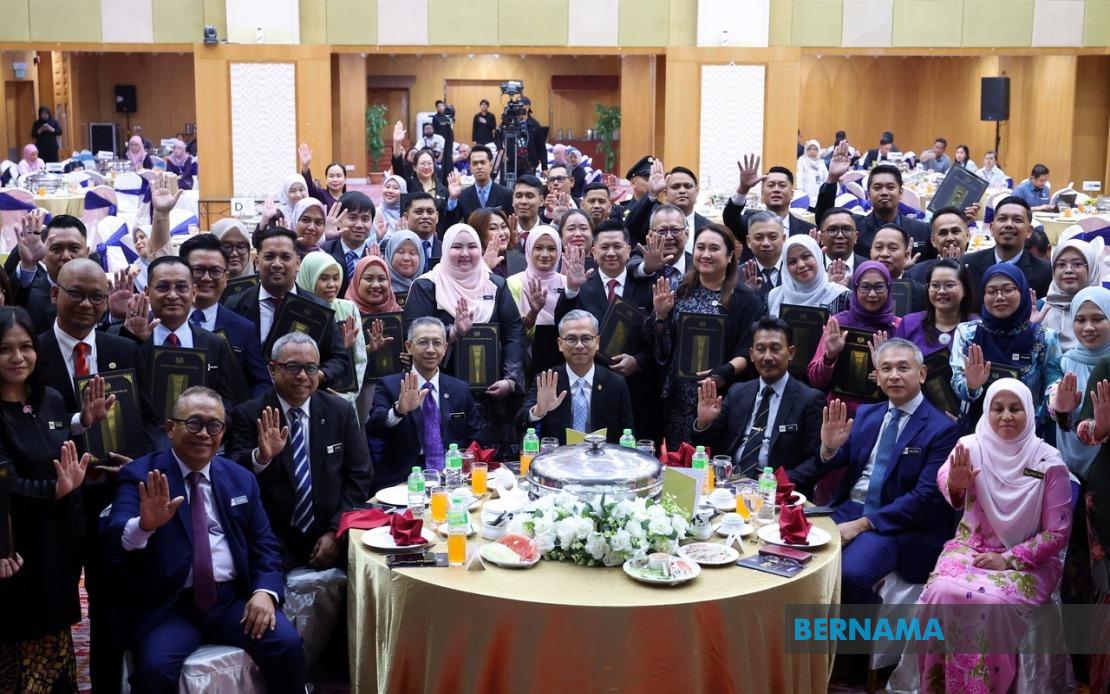
The MADANI Government has reaffirmed its dedication to what it describes as the 'people's economy'—an approach that measures economic success not merely through headline figures but by assessing how prosperity reaches the everyday wallet of the average Malaysian. Speaking at an official ceremony in Kota Kinabalu, Communications Minister Datuk Seri Fahmi Fadzil outlined how the administration views its economic mandate as fundamentally rooted in improving material conditions for all layers of society, rather than concentrating on abstract statistical achievements divorced from lived experience.
While national and state-level indicators have demonstrated satisfactory trajectories across multiple metrics—investment inflows, government revenue, foreign reserves, gross domestic product expansion, and international trade volumes—Fahmi emphasised that these figures matter only insofar as they materialise into perceptible improvements in how Malaysians manage their household budgets and access essential services. This distinction underscores a philosophical shift in how the current administration frames economic governance, moving beyond the traditional focus on GDP growth rates and balance sheet metrics towards a more populist articulation of fiscal responsibility.
The minister cited the diesel subsidy retargeting programme, branded as BUDI MADANI, as a concrete example of how macroeconomic policy intersects with ground-level reality. This initiative demonstrates the government's awareness that economic policy cannot adopt a one-size-fits-all approach, particularly across the geographically dispersed regions of Sabah and Sarawak, where the considerable distances between district centres create unique logistical and economic challenges. Residents in these states must frequently undertake substantial journeys to access services or markets, rendering transportation costs and fuel availability critical factors in household expenditure—considerations that centralised policymaking in Kuala Lumpur might overlook.
Fahmi indicated that Prime Minister Datuk Seri Anwar Ibrahim and the Cabinet maintain active focus on these regional particularities, suggesting that the highest levels of government remain cognisant of how generalised policies function differently across Malaysia's diverse geography and demographic landscape. This acknowledgment reflects a recognition that economic management in a federal system spanning peninsular Malaysia, Sabah, and Sarawak demands sensitivity to local conditions and the devolved nature of certain economic realities. The MADANI framework, as articulated by its communications steward, thus positions itself as attentive to the heterogeneous character of Malaysian economic life.
The minister stressed that effective governance requires translating national-level excellence into tangible outcomes that citizens can observe, experience, and measure through changes in their financial circumstances. When people perceive that national economic achievements produce discernible improvements in their capacity to pay for fuel, groceries, utilities, and transportation, public confidence in government economic stewardship strengthens considerably. Conversely, when macroeconomic indicators improve while household purchasing power stagnates or declines, citizens become sceptical of official pronouncements regarding economic performance, potentially eroding political legitimacy regardless of technical economic competence.
Beyond subsidy design and implementation, Fahmi identified a broader governmental responsibility to ensure clear, comprehensive communication regarding economic policies and their underlying rationale. The minister argued that administrative agencies and sectoral ministries must shoulder accountability for preventing public misinterpretation or confusion around major policy initiatives. This emphasis on transparent communication reflects an implicit acknowledgment that previous governments have sometimes struggled with public messaging around economic measures, allowing misconceptions to proliferate and undermine policy effectiveness. When citizens misunderstand why subsidies are structured as they are, or how targeted programmes operate, they may fail to benefit from available support or develop resentment based on misinformation.
The relevance of Fahmi's remarks extends beyond Sabah and Sarawak to broader Southeast Asian and Malaysian development challenges. As a middle-income country aspiring to upper-income status, Malaysia must navigate the delicate balance between maintaining fiscal discipline and macroeconomic stability while ensuring that growth benefits reach working families and lower-income households. Regional peers including Thailand, Vietnam, and the Philippines face analogous pressures to demonstrate that development translates into improved living standards, particularly amid persistent inflation pressures and rising costs of living that have characterised post-pandemic economic environments across Southeast Asia.
The MADANI administration's articulation of a 'people's economy' framework also responds implicitly to critiques that previous economic management, while technically sound by conventional metrics, failed to produce proportionate improvements in median household incomes or reduce poverty and inequality sufficiently. By explicitly privileging lived economic experience over abstract indicators, the current government seeks to establish different metrics for evaluating its economic performance—a strategic reframing that acknowledges public frustration with the gap between official statistics and personal financial circumstances that many Malaysians report experiencing.
Implementing this philosophy requires coordination across multiple government agencies, from the Communications Ministry's role in public messaging to sectoral ministries responsible for executing subsidies, social assistance programmes, and development initiatives. Regional variations in economic structure, demographics, and geographic characteristics demand that implementing agencies possess flexibility to adapt centrally-designed programmes to local contexts without entirely abandoning national equity principles. Sabah and Sarawak's unique position as considerably more remote and sparsely populated regions compared to the peninsula necessitates differentiated approaches to transportation subsidies, pricing mechanisms, and service delivery modalities.
For Malaysian readers evaluating government economic policy, Fahmi's emphasis on the 'people's economy' signals a deliberate effort to shift discourse from technical macroeconomic management towards kitchen-table financial pressures affecting ordinary households. Whether this rhetorical repositioning translates into substantively different policy outcomes—including more substantial household income growth, reduced cost-of-living burdens, and more equitable distribution of development benefits—will ultimately determine public perception of MADANI's economic stewardship. The government's explicit prioritisation of this framing suggests awareness that electoral legitimacy and public confidence depend significantly on demonstrable improvements in everyday economic circumstances, particularly for constituencies in less-developed regions where economic opportunities remain constrained and service access remains challenging.

