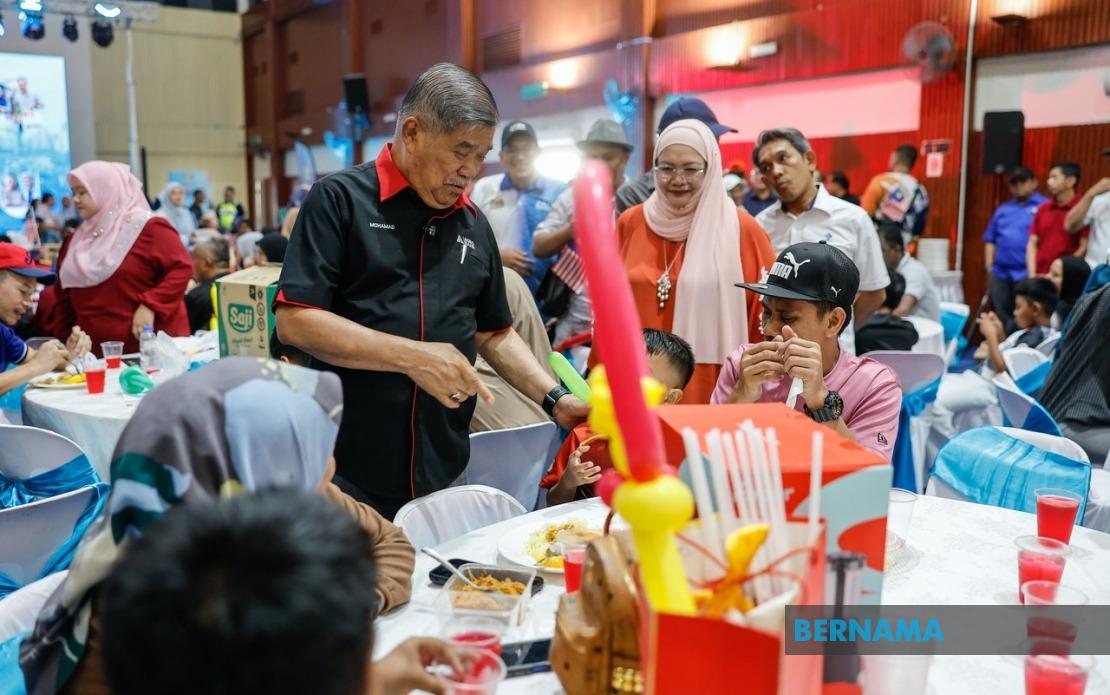
The MADANI Kita programme has emerged as a vital instrument for bridging the gap between government institutions and ordinary Malaysians, serving purposes that extend far beyond conventional service delivery. Speaking at an inaugural PMK gathering in Shah Alam, Agriculture and Food Security Minister Datuk Seri Mohamad Sabu articulated how the initiative functions as an official government channel for clarifying contentious matters and building public comprehension of policy decisions. The programme represents a deliberate strategy to consolidate multiple government functions within accessible community spaces, allowing residents to interact with various agencies simultaneously while receiving consistent, officially-endorsed explanations of government actions.
A particular focus of Mohamad's remarks centred on the programme's role in contextualising complex institutional matters within public discourse. He referenced the Royal Commission of Inquiry into Lembaga Tabung Haji, suggesting that PMK events provide appropriate venues for translating technical findings into digestible narratives for ordinary Malaysians. By emphasising that inquiry members operate independently of political influence, he attempted to position government communications as impartial rather than partisan, addressing longstanding public scepticism about official statements. This distinction matters significantly for Malaysia's information environment, where trust in government messaging remains contested across demographic and political lines.
The structural innovation underlying MADANI Kita involves collating federal and state-level services under unified event frameworks, theoretically streamlining bureaucratic friction that typically characterises citizen engagement with government. Rather than requiring individuals to navigate separate ministry offices, the programme delivers representatives from diverse departments to single locations, reducing time investments and transaction costs for service seekers. For Selangor residents particularly, this approach addresses frustrations associated with fragmented administrative systems where obtaining approvals or information often demands multiple visits to dispersed office locations. The efficiency gains, though potentially modest, signal a shift toward citizen-centric governance design.
Communications Ministry Deputy Secretary-General Datuk Bahria Mohd Tamil complemented these accessibility arguments by highlighting digital safety priorities, specifically child protection in online environments. Her remarks underscored how MADANI Kita events function as public education platforms regarding cybersecurity responsibilities and rights, extending government engagement into areas where private sector activities require regulatory oversight. The Communications and Multimedia Commission's documented removal of 1,550 harmful online contents involving children through June 2024 demonstrates tangible enforcement outcomes, though absolute numbers remain difficult to contextualise without baseline data regarding total problematic content circulation. The technical cooperation mechanisms Bahria described—involving licensed service providers, forensic analysis, and information sharing—represent sophisticated multi-agency coordination that rarely receives public visibility.
The cultural dimension of PMK events deserves particular attention given Malaysia's multicommunal composition and periodic tensions regarding national cohesion. Mohamad explicitly referenced the Kota Raja gathering's incorporation of football competitions, esports contests, and culturally diverse performances as deliberate strategies for fostering inter-ethnic solidarity. This approach treats community events as laboratories for practising harmonious coexistence, moving beyond purely transactional service provision toward explicitly nation-building objectives. For Malaysian policymakers navigating ongoing sensitivities around religious expression, language rights, and cultural representation, these events offer safe spaces for demonstrating commitment to pluralistic values without triggering the political controversies that frequently accompany formal policy announcements.
The attendance figure of approximately 2,000 visitors at the Kota Raja event, distributed across 27 government agency booths, reflects modest but meaningful community participation. This scale suggests that PMK has penetrated local consciousness sufficiently to draw crowds exceeding typical government programme attendance in smaller municipalities. Repeat programming across different constituencies indicates sustained institutional commitment rather than episodic experimentation. For Malaysian journalists and analysts tracking government effectiveness, PMK participation rates merit ongoing monitoring as potential indicators of whether decentralised service delivery genuinely improves accessibility or primarily serves public relations objectives.
The programme's emphasis on information clarity carries significance beyond immediate explanatory functions. Malaysia's post-2018 political transitions generated public appetite for transparent government operations, particularly regarding institutional failures and financial mismanagement that had accumulated under previous administrations. MADANI Kita's framing as a transparency mechanism responds to this demand, though sustained credibility requires demonstrating that uncomfortable truths receive adequate explanation rather than selective presentation. The Lembaga Tabung Haji example chosen by Mohamad specifically addresses an institution that had become synonymous with governance shortcomings, suggesting political awareness that public trust necessitates candid engagement with institutional failures rather than defensive communication.
From a regional perspective, Malaysia's experience with community-centred government programming offers instructive lessons for neighbouring Southeast Asian democracies grappling with similar challenges around institutional trust and administrative fragmentation. The MADANI Kita model, prioritising simultaneous access to multiple agencies whilst providing coordinated messaging, represents one template for improving citizen-government relationships without requiring wholesale bureaucratic restructuring. Countries including Indonesia and the Philippines have experimented with comparable one-stop service centres, yet Malaysia's explicit integration of cultural engagement and digital safety communications suggests evolving sophistication in understanding governance as encompassing more than functional service delivery.
Cybersecurity consciousness, which Bahria foregrounded in her address, reflects growing recognition across Southeast Asia that digital threats increasingly structure everyday vulnerabilities for ordinary citizens. The MCMC's enforcement cooperation model, combining technical analysis with investigative support, represents best-practice inter-agency coordination addressing challenges that transcend traditional sectoral boundaries. For Malaysian businesses and families navigating increasingly digitalised economies, visible government attention to online child safety provides reassurance that institutional frameworks address contemporary risks rather than concentrating solely on legacy concerns.
Moving forward, MADANI Kita's trajectory depends substantially on whether participants perceive tangible outcomes from their engagement. Events generating 2,000 attendees require investment in infrastructure, coordination, and personnel; sustained participation necessitates demonstrating that booth interactions produce meaningful results rather than ceremonial encounters with poorly-informed officials. The programme's emphasis on breaking down complex policy matters into accessible language presupposes adequate training for frontline government representatives, a requirement that demands ongoing institutional investment. Success metrics extending beyond attendance figures—such as service application completion rates or follow-up contact rates—would better assess whether PMK genuinely closes gaps between government institutions and communities.
The integration of diverse activities including sports, gaming competitions, and cultural performances within governance programming reflects understanding that public engagement encompasses emotional and social dimensions beyond rational policy discourse. This approach potentially amplifies reach beyond civic-minded participants toward individuals attending primarily for recreational value, incidentally exposing them to government messaging. However, research regarding whether such incidental exposure translates into improved policy comprehension or institutional trust remains limited. Malaysian government communicators would benefit from systematic evaluation of whether MADANI Kita attendees subsequently demonstrate improved understanding of government operations or merely enhanced familiarity with government personnel.
The programme ultimately represents a middle-ground governance strategy, moving beyond traditional centralised bureaucratic engagement whilst avoiding wholesale devolution of authority to community organisations. This positioning allows government to maintain institutional control over messaging whilst claiming responsiveness to decentralisation demands. Whether MADANI Kita meaningfully improves Malaysian citizens' relationships with their government institutions, or primarily functions as sophisticated public relations, depends critically on implementation consistency and participant outcomes across the multiple constituencies the programme targets.

