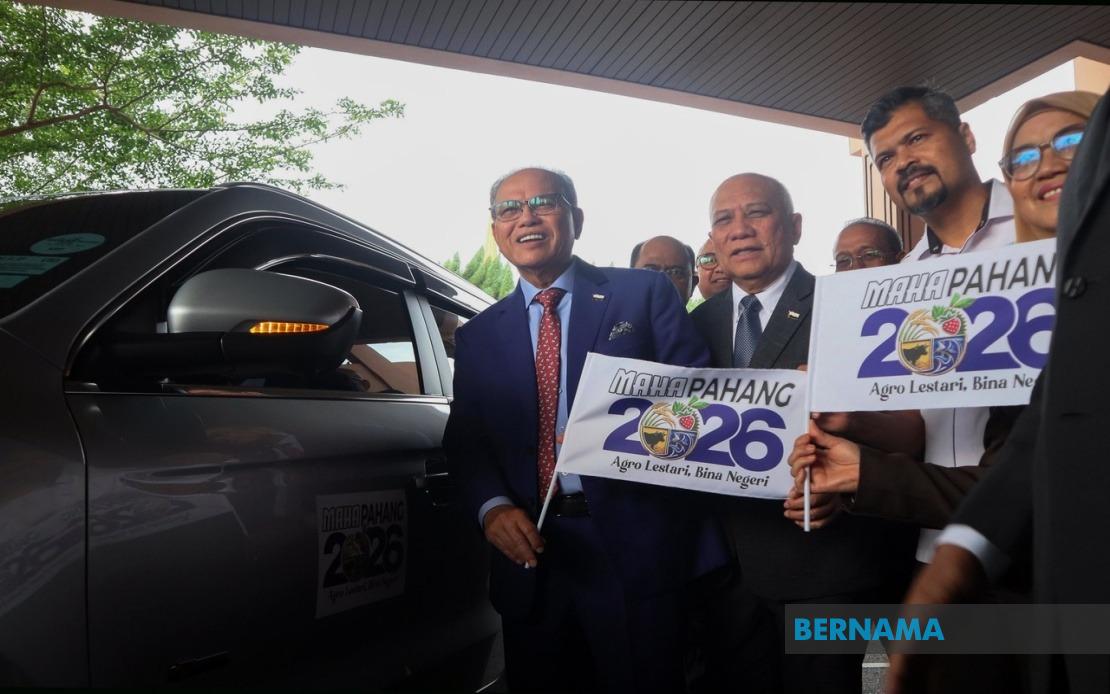
The Pahang state government is banking on significant foot traffic and commercial activity for MAHA Pahang 2026, an agricultural showcase scheduled to run from July 30 to August 2 at Dataran Raub. Menteri Besar Datuk Seri Wan Rosdy Wan Ismail revealed the event's ambitious projections during remarks made at the Bera District and Land Office, where he formally sent off a convoy of 20 vehicles from multiple government departments and agencies to kick off promotional activities.
Organisers anticipate welcoming more than 100,000 visitors across the four-day programme, with around 100 entrepreneurs expected to exhibit their products and services. The economic target of RM1.3 million in sales reflects confidence in both attendance levels and visitor purchasing intent at what officials describe as a premium showcase of Pahang's agricultural sector. This performance goal carries significance for participating smallholders and businesses, many of whom see state-sponsored exhibitions as vital platforms for direct consumer engagement and market development.
To sweeten the visitor experience and drive attendance, the Pahang administration is rolling out an attractive raffle system. The headline prize is a Wagyu cow, reflecting growing interest in high-value livestock farming throughout Malaysia. A Perodua Bezza vehicle sits as the second major incentive, with additional prizes distributed to create multiple winning opportunities across the visitor base. Such promotional mechanisms have proven effective in driving footfall at previous agricultural expos across the region, particularly when combined with substantive exhibition content.
Wan Rosdy publicly credited Agriculture and Food Security Minister Datuk Seri Mohamad Sabu and the event's committee chairman for their instrumental roles in bringing MAHA Pahang 2026 to fruition. This acknowledgment underscores the multi-level governmental coordination required to stage a major agricultural event, involving federal agricultural leadership alongside state infrastructure and promotional resources. The partnership reflects how Malaysia's agricultural development agenda increasingly depends on seamless collaboration between federal and state authorities.
The exhibition promises extensive product displays and educational components designed to showcase Pahang's agricultural capabilities. Visitors will encounter information on emerging crop varieties alongside established farming practices, positioning the event as both a commercial marketplace and an educational platform. Such dual-purpose programming aligns with broader Malaysian efforts to professionalise the farming sector and encourage younger generations to view agriculture as a viable career path with modern, science-backed opportunities.
Pahang's positioning of MAHA 2026 reflects the state's ongoing commitment to diversifying its economic base beyond traditional resource extraction. Agricultural development has become increasingly central to state government strategy, particularly as climate concerns and market dynamics reshape commodity demand. The exhibition format allows policymakers to demonstrate tangible investment in farmer support infrastructure while creating visibility for state-level agricultural initiatives among both urban and rural constituencies.
From a regional perspective, major agricultural exhibitions across Malaysian states serve as barometers for sector health and consumer appetite for locally produced goods. MAHA Pahang 2026 enters a competitive landscape where neighbouring states regularly host similar events, necessitating distinctive programming and promotional investment to capture market attention. The event's scale and prize structure suggest state officials view it as strategically important for Pahang's agricultural brand positioning.
The July-August timing places MAHA Pahang 2026 in the post-monsoon planting season when agricultural activity peaks and farming communities typically engage most actively with sector-wide initiatives. This scheduling consideration reflects careful planning to align exhibition timing with natural cycles of agricultural production and farmer availability. The four-day duration provides sufficient time for substantive engagement while remaining manageable for farming families balancing exhibition attendance with on-farm responsibilities.
For Southeast Asian observers monitoring Malaysian state-level economic development, MAHA Pahang 2026 exemplifies how subnational governments leverage public administration capacity and modest financial resources to stimulate sectoral growth. The exhibition model distributes promotional costs across multiple stakeholders whilst creating platforms for thousands of micro and small agricultural enterprises to access consumers directly. Such mechanisms prove particularly valuable in Malaysia's federal context, where state governments possess limited direct revenue sources and must maximise impact through efficient programme design.
The vehicle convoy flagging-off ceremony itself carries symbolic weight, transforming agricultural promotion into a visible government initiative with public resonance. By mobilising departmental resources for promotional activities, state authorities signal institutional commitment to event success whilst building public awareness across the extended pre-event period. This approach creates cumulative promotional momentum leading into the July 30 opening, potentially translating into stronger opening-week attendance patterns.
Looking beyond immediate commercial objectives, MAHA Pahang 2026 offers planners valuable data on consumer preferences, emerging crop interest, and farmer networking dynamics. Insights gathered during the exhibition can inform subsequent agricultural policy refinements and support programme design within Pahang's broader agricultural development agenda. This feedback loop between exhibitions and policy represents an underappreciated mechanism through which state governments identify sectoral opportunities and challenges requiring policy attention.

