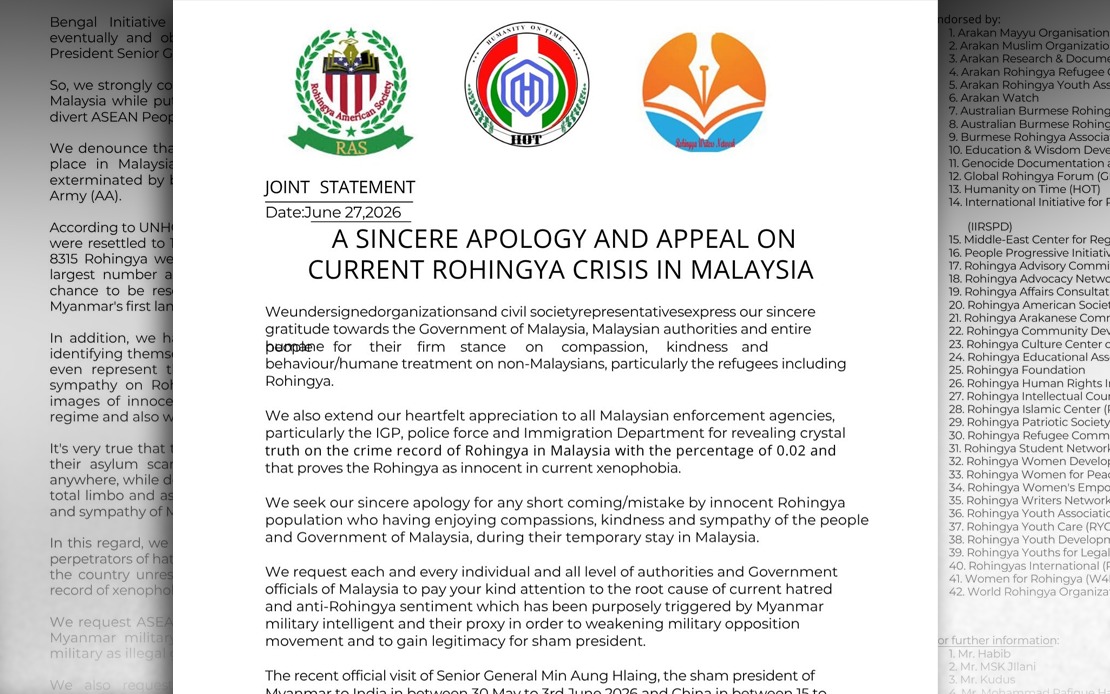
Malaysian Humanitarian Aid and Relief (MAHAR) has responded positively to an apology issued by 40 Rohingya non-governmental organisations, viewing the gesture as evidence of organisational accountability and a foundation upon which more substantive collaborative work can be built. The acceptance of this apology, however, comes with clear expectations that the Rohingya community groups will substantially broaden their operational scope and deepen their engagement with both Malaysian authorities and local populations.
The humanitarian organisation's statement reflects a nuanced position on refugee assistance in Malaysia. Rather than limiting aid distribution to essential provisions like food and shelter, MAHAR contends that genuinely transformative humanitarian work must encompass civic and cultural education. This approach recognises that sustainable coexistence between refugees and host communities depends not merely on meeting immediate material needs but on fostering mutual understanding and shared commitment to lawful conduct.
In this framework, MAHAR argues that the 40 Rohingya NGOs bear significant responsibility for educating members of their own communities about the expectations and norms governing life in Malaysia. This includes inculcating respect for local laws, traditions, and cultural values. By taking on this educative role, the organisations would position themselves as bridges between their constituents and the broader Malaysian society, potentially mitigating friction that sometimes emerges from cultural or legal misunderstandings.
Parallel to domestic integration efforts, MAHAR has emphasised that the Rohingya NGOs should intensify their international advocacy work. The organisation views addressing the underlying drivers of the Rohingya crisis—primarily the persecution occurring in Myanmar—as integral to genuine humanitarian progress. Without sustained pressure on the international stage to resolve the persecution in Myanmar, MAHAR suggests that temporary assistance in Malaysia amounts to treating symptoms rather than addressing the disease. This dual emphasis on local integration and international advocacy reflects a sophisticated understanding that refugee crises require multilayered responses.
Jismi Johari, MAHAR's president, has articulated a position that prioritises the safety concerns of both refugee populations and Malaysian host communities. This framing is significant in a Malaysian context where public sentiment regarding refugee communities remains mixed, with documented incidents involving individuals from refugee backgrounds sometimes fuelling broader anxieties about security and social cohesion. Rather than dismissing such concerns outright, Johari's approach acknowledges their legitimacy while cautioning against inflammatory generalisations.
The president's emphasis on preventing blanket characterisations of entire communities based on isolated incidents reflects a sophisticated understanding of social psychology and intercommunal dynamics. He has pointed out that misconduct and criminal behaviour exist across all demographic groups and that fairness demands that refugee communities not face disproportionate scrutiny or stigmatisation. This perspective is particularly relevant in Malaysia, where rapid demographic changes and refugee presence have occasionally generated political rhetoric that risks scapegoating vulnerable populations.
Johari has framed the path forward as requiring empathy, reciprocal respect, and genuine dialogue among all stakeholders. This triangulation—acknowledging legitimate safety concerns while resisting stereotyping, supporting refugee welfare while upholding Malaysian interests—represents the balance that organisations like MAHAR believe is necessary for sustainable coexistence. The emphasis on constructive engagement rather than confrontation suggests a belief that misunderstandings can be resolved through improved communication and relationship-building.
The broader context for MAHAR's statement is Malaysia's role as one of the primary hosts of Rohingya refugees in Southeast Asia, with an estimated 180,000 registered individuals and many more undocumented. This substantial population has created both humanitarian obligations and legitimate practical challenges regarding resource allocation, public services, and social integration. MAHAR's framing acknowledges both the moral imperatives underlying refugee protection and the practical realities facing a developing nation absorbing displaced populations.
MAHAR has reaffirmed its foundational commitment to humanitarian action that integrates justice, security, and human dignity as mutually reinforcing rather than competing values. This statement implicitly criticises approaches that treat refugee welfare and host community security as zero-sum propositions. Instead, the organisation suggests that genuine humanitarian work must satisfy the needs and legitimate interests of both groups simultaneously, which demands thoughtful programming, community engagement, and sophisticated advocacy at multiple levels.
The organisation's response to the Rohingya NGOs' apology also signals expectations for accountability and continuous improvement within the refugee community sector. Rather than viewing the apology as a concluding moment, MAHAR treats it as an opening for elevated collaboration and more ambitious goals. This approach—accepting responsibility while setting higher standards—may serve as a template for how Malaysia's broader refugee management framework evolves in coming years, balancing compassion with pragmatism.

