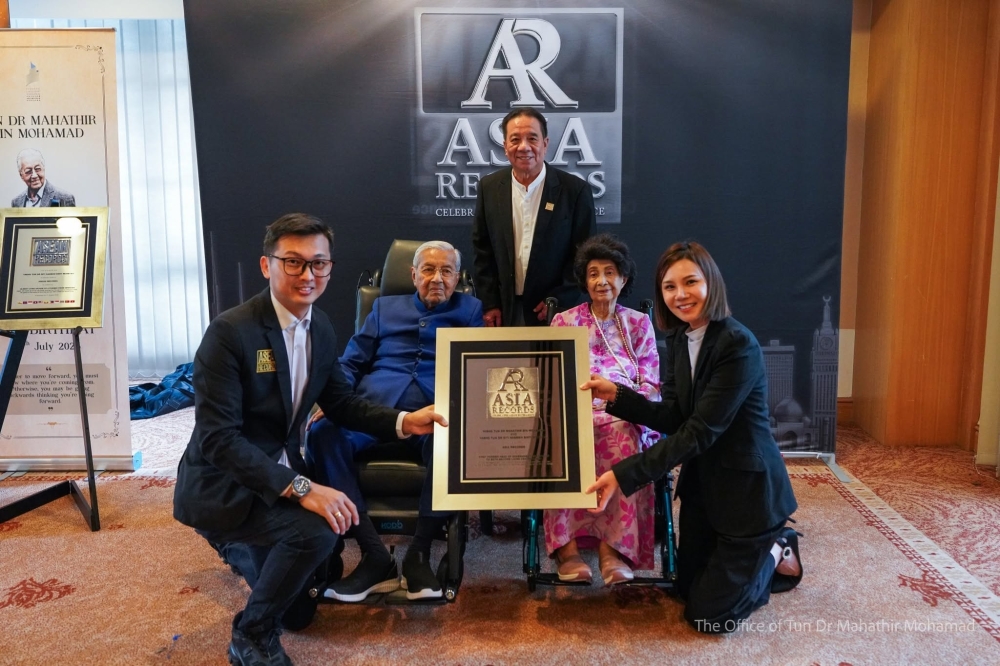
Malaysia's longest-serving Prime Minister Tun Dr Mahathir Mohamad and his wife Tun Dr Siti Hasmah Mohd Ali have been formally acknowledged by Guinness World Records with three historic designations following their arrival at the centenary milestone, a distinction that underscores both the couple's remarkable longevity and their enduring prominence in the nation's political and social landscape.
The recognition comes as the couple, whose partnership has spanned decades of Malaysian public life, individually achieved the age of 100 years, an uncommon accomplishment that has drawn international attention and reinforced their status as elder statesmen and stateswomen of Southeast Asia. The Guinness certifications reflect not only their personal achievement but also the broader significance of their contributions to the country's development and governance over an extraordinarily lengthy period.
For Dr Mahathir specifically, the records acknowledge his extensive tenure in Malaysia's highest office and his continued engagement in public discourse well into his second century of life. His career, marked by transformative economic policies and infrastructural megaprojects, remains a defining chapter in modern Malaysian history. The centenarian has maintained an active public presence, regularly commenting on contemporary political developments and offering perspectives shaped by his unique vantage point across different eras of the nation's evolution.
Tun Dr Siti Hasmah's recognition carries equal significance, particularly as it highlights the contributions of the spouses of political leaders, whose roles often remain understated in historical narratives. As a trained medical professional with her own distinguished background, she has embodied a particular model of accomplished womanhood in Malaysian society, combining professional credentials with the demands of high-profile public life. Her century milestone represents both a personal achievement and a representation of evolving opportunities and roles for women in the nation.
The couple's simultaneous crossing of the centenary threshold represents an extraordinary statistical rarity on the global stage. Such achievements become increasingly noteworthy in the context of life expectancy trends and healthcare development, serving as indicators of improved living standards, medical advancement, and quality of life within Malaysia. Their longevity extends across periods of dramatic social, economic, and technological transformation, allowing them unique perspectives on the arc of national development.
Guinness World Records' formal recognition carries implications beyond mere ceremonial acknowledgement. The certification process involves rigorous verification of biographical and historical details, lending official credibility to claims of achievement. For Malaysia, such international recognition provides a platform for highlighting the nation's capacity to nurture and sustain the health and vitality of its citizens, particularly among older populations—a demographic consideration gaining increasing importance across Southeast Asia as birth rates decline and populations age.
The timing of these recognitions occurs against a backdrop of evolving discussions about elder care, healthy ageing, and the integration of senior citizens into contemporary society. Malaysia, like regional neighbours, faces demographic shifts that will shape healthcare policy, pension systems, and social support frameworks across coming decades. The example of active centenarians like Dr Mahathir and Tun Dr Siti Hasmah contributes to broader conversations about productive longevity and the potential contributions of older citizens to national discourse.
From a political perspective, Dr Mahathir's continued visibility and engagement at the age of 100 illustrates the manner in which Malaysian political culture extends significant platforms to its elder statesmen. His occasional interventions in contemporary debates, while sometimes controversial, reflect a political ecosystem that values historical experience and institutional memory. This dynamic differs markedly from political cultures where retirement from public life is more strictly observed, offering insights into Southeast Asian approaches to political succession and generational transfer of power.
The three Guinness designations represent recognition across multiple categories, reflecting the multifaceted nature of the couple's achievements and their relevance to different international benchmarking criteria. Such specific categorisation, rather than a single generic recognition, underscores the exceptional nature of their accomplishments and the various dimensions through which their century-long lives merit acknowledgement.
Beyond the statistical and ceremonial aspects, the couple's milestone invites reflection on the sweeping historical span they have witnessed. From Malaysia's early post-independence years through to the contemporary digital era, they have occupied vantage points allowing observation of transformations that would have seemed inconceivable at their birth. This historical consciousness, combined with their continued engagement with public matters, positions them as living bridges between Malaysia's recent past and its unfolding future.
The Guinness recognition also resonates within the broader context of Malaysian cultural values that traditionally accord respect and authority to elders, even as the nation modernises and urbanises. The formal international validation of their status provides a contemporary framework for honouring these traditional values within a globalised context, demonstrating that respect for longevity and experience remains compatible with international modernity.
For the wider region, the recognition of a Malaysian couple achieving these simultaneous centenary milestones and subsequent Guinness acknowledgement contributes to Southeast Asian visibility on the international stage regarding quality of life and longevity outcomes. It positions Malaysia within global health and demographic conversations while simultaneously affirming national pride in the couple's achievements and their continuing significance to Malaysian society.

