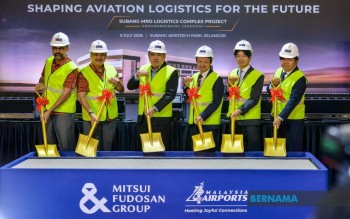
Malaysia Airports Holdings Bhd (MAHB) has joined forces with Mitsui Fudosan Group to construct a RM80 million air cargo logistics complex at Subang Airport, marking a significant milestone in the nation's freight handling infrastructure. Under the partnership, MAHB will retain a 30 per cent stake while the Japanese developer, Mitsui Fudosan, will hold the remaining 70 per cent ownership. The groundbreaking ceremony for the Subang maintenance, repair and overhaul (MRO) Logistics Complex Project took place on Thursday, with Transport Minister Anthony Loke Siew Fook presiding over the official launch.
The strategic partnership reflects MAHB's broader approach to maximising returns from its airport real estate portfolio by collaborating with experienced international operators. Rather than developing logistics facilities entirely on its own, the airport operator has opted to inject capital alongside a partner whose track record spans multiple continents. This arrangement allows MAHB to benefit from development expertise while sharing financial exposure, a prudent strategy given the competitive dynamics of aviation infrastructure investment in the region.
Mitsui Fudosan brings considerable experience to the venture, having successfully developed and managed logistics complexes at Haneda Airport in Tokyo, one of Asia's busiest aviation hubs. The Japanese company's operational knowledge of airport-adjacent logistics networks will prove invaluable as Malaysia strengthens its position in regional air cargo markets. Transport Minister Loke acknowledged this advantage directly, noting that Mitsui Fudosan's established expertise would significantly help mitigate operational risks for Malaysia Airports, a critical consideration when entering specialised segments of the cargo handling sector.
The project is being executed through MFMA Industrial Sdn Bhd, a joint venture entity established specifically for this development. The entity combines the strengths of Mitsui Fudosan (Asia) Malaysia Sdn Bhd and Malaysia Airports (Subang) Sdn Bhd, creating a dedicated vehicle to oversee construction, management, and long-term operations of the complex. Situating the facility within Subang Aerotech Park positions it as part of an integrated aerospace ecosystem rather than an isolated logistics operation, enabling synergies with existing aviation businesses and supporting infrastructure.
The timing of this development is strategically sound, given Malaysia's ambitions to strengthen its foothold in regional air cargo networks. As Southeast Asia continues to emerge as a manufacturing and logistics hub, air freight capacity has become increasingly valuable. Subang Airport, historically a secondary facility compared to Kuala Lumpur International Airport, has repositioned itself as a specialised centre for aerospace maintenance and light cargo operations. This new complex will enhance that positioning by providing dedicated facilities for cargo consolidation, handling, and storage.
Mitsui Fudosan's involvement also signals confidence among major Japanese investors in Malaysia's aviation sector trajectory. The company's willingness to commit capital and operational resources to the Subang project demonstrates faith in the long-term viability of air cargo markets in the region. For Malaysian investors and policymakers, this foreign direct investment serves as validation of the government's infrastructure policies and regulatory framework governing airport operations and logistics development.
The MRO focus of the facility deserves particular attention, as maintenance, repair, and overhaul operations represent one of the most value-intensive segments of aviation services. By developing dedicated logistics infrastructure for MRO businesses, MAHB is positioning Subang to capture higher-margin activities rather than competing solely on general cargo volumes. This vertical integration—combining MRO capabilities with first-rate logistics support—creates competitive advantages difficult for rivals to replicate and supports the growth of aerospace manufacturing clusters in Malaysia.
For Malaysia's economy more broadly, the project contributes to efforts to develop high-skilled employment opportunities and technology transfer within the aviation sector. The complex will require specialised workforce development in cargo handling, customs clearance, and logistics management. As operations ramp up, opportunities will emerge for local businesses to participate in the supply chain, from transportation providers to customs brokers and warehousing operators. The RM80 million investment thus extends benefits beyond the direct operator to encompass a broader ecosystem of supporting enterprises.
The partnership model employed here offers lessons for other Malaysian state-owned enterprises considering infrastructure development. Rather than pursuing greenfield projects independently, cooperating with experienced international partners allows faster execution, reduced risk exposure, and access to global best practices. As Malaysia continues to upgrade its logistics infrastructure to support regional competitiveness, similar collaborative approaches may prove increasingly attractive for projects spanning ports, rail facilities, and distribution centres.
Transport Minister Loke's emphasis on risk mitigation reflects practical realities of logistics development. Air cargo facilities require precise operational synchronisation with airline schedules, customs agencies, and trucking networks. Missteps in facility design or management can quickly erode competitive advantages. By partnering with Mitsui Fudosan, MAHB gains access to proven operational playbooks that have succeeded at one of the world's most demanding airport environments, substantially improving the probability of successful outcomes at Subang.
Looking ahead, the success of this complex could catalyse additional investment in Subang's broader ecosystem. If the facility proves operationally efficient and financially viable, other Japanese logistics operators may follow Mitsui Fudosan's lead, gradually transforming Subang into a regional logistics hub with characteristics distinct from KLIA's mass-market approach. This specialisation would be healthy for Malaysia's overall aviation infrastructure, creating distinct competitive identities for different facilities rather than having them cannbalise each other's markets.

