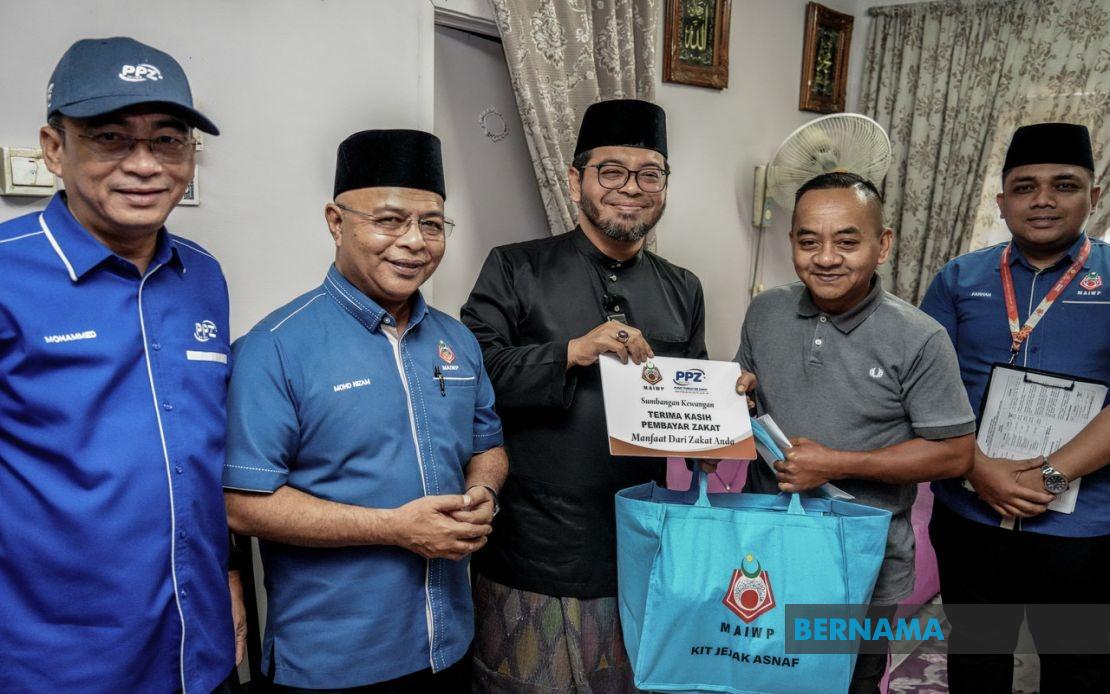
The Federal Territories Islamic Religious Council (MAIWP) has announced a comprehensive assistance package for a widow managing five children ranging from six to fifteen years old after her husband's death earlier this month. The initiative underscores a broader commitment by Malaysia's Islamic welfare apparatus to address the immediate crises faced by families who have lost their primary income earners, particularly in urban centres where living costs remain formidable. The multilayered support structure reflects growing recognition among religious authorities that bereaved families require more than symbolic aid to navigate the profound economic disruption that follows the loss of a breadwinner.
Minister in the Prime Minister's Department (Religious Affairs) Senator Datuk Dr Zulkifli Hasan emphasised that understanding beneficiaries' actual circumstances proved essential to delivering effective support. He underscored MAIWP's field-based methodology, which involves direct engagement with recipient families to assess their genuine requirements rather than applying standardised, one-size-fits-all solutions. This approach represents a departure from more bureaucratic welfare distribution models, enabling the council to calibrate assistance according to each family's specific vulnerabilities and circumstances. For the widow's household, MAIWP has designed an assistance scheme encompassing monthly living expenses, rental support, and educational funding—recognising that schooling continuity remains critical for children's long-term prospects during periods of family disruption.
The widow's family had previously benefited from MAIWP's General Schooling Aid programme, but the council recognised that post-bereavement circumstances demanded expanded intervention. The newly proposed assistance addresses the three most pressing domains affecting bereaved households: sustenance, shelter, and education. This coordinated approach acknowledges that poverty rarely manifests as a single problem; rather, losing household income typically triggers cascading difficulties across multiple domains simultaneously. Without intervention on all fronts, families frequently spiral into deepening vulnerability, with children withdrawn from school to assist with income-generation, rental arrears accumulating, and nutritional standards declining.
Beyond the widow's case, MAIWP's welfare operations extend across numerous other vulnerable household configurations within the Federal Territories. The council visited a family consisting of a married couple raising eight school-age children, where the father works as a Kuala Lumpur City Hall driver while the mother remains a full-time homemaker. Despite employment, this family's income proves insufficient to meet their children's medical and educational requirements. MAIWP has provided monthly General Medical Assistance covering essential supplies including diapers and diabetic medications, alongside wheelchair support and schooling assistance. This scenario typifies the predicament facing many Malaysian working-poor families—individuals in formal employment who nonetheless struggle to provide adequately for large households.
The council also supports a divorced single mother who has independently raised three school-going children since 2018. Her situation exemplifies the sustained vulnerabilities facing women navigating family breakdown without spousal or extended family financial support. MAIWP's assistance package for this household encompasses monthly cost-of-living allowances, basic necessities, and targeted schooling support. These interventions recognise that single mothers frequently face discrimination in employment markets and wage penalties relative to male counterparts, compounding the income shortfall created by household dissolution.
MAIWP's expansive welfare operations reflect the substantial resources channelled through Islamic institutional frameworks to address poverty and hardship within Malaysia's Muslim population. As of August 12, 2026, the council had distributed RM699.57 million cumulatively, demonstrating the scale of financial commitment directed toward vulnerable communities. This figure highlights how Malaysia's religious establishments function not merely as ceremonial or spiritual institutions but as substantial welfare providers operating parallel to government social safety nets. For many households, MAIWP support often proves more accessible and responsive than formal government assistance schemes, which frequently involve complex application procedures, lengthy processing timelines, and bureaucratic gatekeeping.
The targeting approach emphasised by Datuk Dr Zulkifli Hasan reflects broader trends within Malaysian social policy toward more sophisticated poverty diagnostics. Rather than categorical assistance based on simple demographic criteria, contemporary welfare programming increasingly attempts to identify intersecting vulnerabilities—disability, sudden income loss, chronic illness, family breakdown—and construct assistance bundles addressing multiple deprivations simultaneously. This represents conceptual progress beyond older models that treated poverty as essentially a money problem susceptible to simple cash transfers.
For Southeast Asian policymakers observing Malaysia's experience, MAIWP's approach offers instructive lessons regarding welfare delivery through religious institutions. Many governments in the region have historically relegated religious bodies to marginal welfare roles, yet Malaysia's experience demonstrates that Islamic councils can function as sophisticated social policy implementers capable of field assessment, needs analysis, and targeted programme design. The integration of religious legitimacy with effective administration creates welfare mechanisms that communities often trust more readily than purely secular bureaucracies.
The cases highlighted by MAIWP illustrate recurring vulnerabilities within Malaysian urban societies that resist easy resolution through economic growth alone. A widow with five dependents, a working-poor family with eight children, and a divorced single mother all represent situations where individual misfortune intersects with structural economic constraints—insufficient wages, inadequate childcare provision, limited spousal support enforcement, and housing unaffordability. These families operate at the margin where any additional shock threatens catastrophic descent into destitution. MAIWP's interventions function as crucial stabilisation mechanisms preventing such household crises from cascading into longer-term social dysfunction.
Moving forward, MAIWP's demonstrated capacity to identify and support vulnerable households positions it as a potential partner in broader poverty-reduction strategies. The council's field presence and community trust represent assets that government agencies attempting to expand social protection coverage might strategically leverage. However, integrating religious welfare provision with state social policy requires careful institutional design to ensure consistent eligibility criteria, transparent resource allocation, and accountability mechanisms that satisfy both beneficiaries and public stakeholders.

