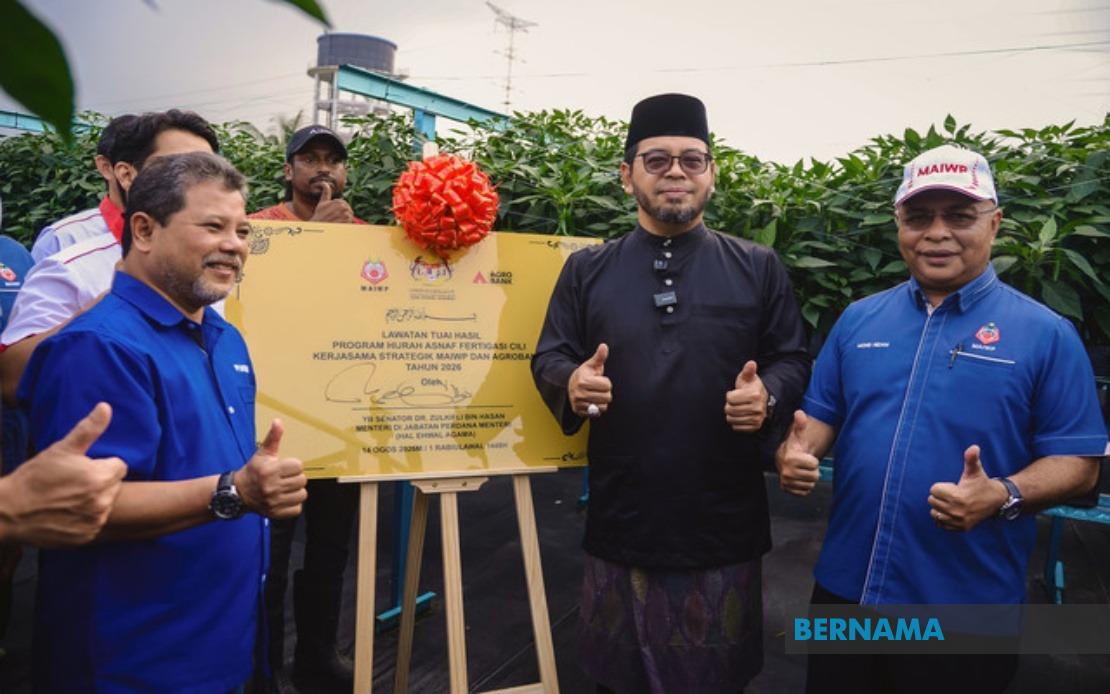
Malaysia's Islamic Welfare and Philanthropic Department (MAIWP) is scaling up its innovative chilli cultivation project for asnaf participants, extending operations to five acres as the programme demonstrates remarkable commercial viability and social impact. The expansion represents a significant endorsement of the fertigation—or drip irrigation with integrated fertilisation—methodology that has proven transformative for economically disadvantaged Muslim families seeking sustainable income sources.
The project's maiden harvest alone produced more than 16.7 tonnes of chillies, translating into revenues surpassing RM207,000 for participating asnaf households. These figures underscore the commercial potential of combining modern agricultural techniques with targeted assistance for those eligible to receive zakat support. Minister in the Prime Minister's Department (Religious Affairs) Dr Zulkifli Hasan highlighted the initiative's success as evidence that strategic skills development and infrastructure investment can genuinely catalyse self-sufficiency among vulnerable populations.
Dr Zulkifli's comments reflect a broader philosophical shift within Malaysia's Islamic social welfare framework, moving beyond passive cash transfers towards active economic empowerment. By equipping asnaf beneficiaries with technical agricultural knowledge and providing the necessary infrastructure—drip irrigation systems, quality seeds, and ongoing advisory support—MAIWP is creating pathways for participants to transition from welfare dependency to productive entrepreneurship. This approach aligns with Islamic principles emphasising dignity, self-reliance, and the productive use of community resources.
The programme's expansion to five acres signals confidence in scaling what has proved successful on smaller plots. Larger operations improve economies of scale, allowing participants to negotiate better prices with bulk purchasers and potentially access commercial distribution channels currently inaccessible to small-scale producers. The expansion also creates employment opportunities within the supply chain, from cultivation management to harvest logistics, benefiting broader asnaf communities beyond direct farming participants.
A particularly compelling dimension emerges through participant testimonials. Alinda Rosely, a 49-year-old single mother, illustrates the human dimension underlying these statistics. Her experience recovering financial stability through the programme—earning RM40,000 within six months during a period of favourable chilli prices—demonstrates how technical skills and market access can transform individual circumstances. For divorced or widowed women managing households independently, such income-generating opportunities address both immediate financial pressures and long-term economic security.
Beyond primary production, MAIWP is actively encouraging participants to venture into value-added activities, recognising that processed chilli products command premium prices and access broader consumer bases. Chilli paste, dried chilli flakes, chilli sauce, and specialty condiments represent higher-margin opportunities than fresh produce alone. This downstream diversification protects participants against price volatility in fresh chilli markets and creates additional skills development opportunities within communities.
The timing of this expansion coincides with structural shifts in Malaysia's agricultural sector, where younger generations increasingly migrate to urban employment, creating labour shortages and opening niches for intensive, mechanised farming systems. The chilli fertigation model—water-efficient, scalable, and requiring less physical labour than traditional cultivation—positions asnaf producers competitively within this evolving landscape. The technology also addresses environmental sustainability concerns by minimising water usage, increasingly critical across Southeast Asia as water scarcity intensifies.
MAIWP's broader financial commitments underscore the institutional weight behind such initiatives. As of August 12, 2026, the department distributed RM699.57 million in zakat support through 38 distinct welfare assistance schemes, indicating that chilli fertigation represents one element within a comprehensive ecosystem of asnaf support. This diversified portfolio approach—combining immediate welfare assistance with skills development, asset creation, and market linkage programmes—reflects sophisticated understanding of poverty's multidimensional nature.
For Malaysia's policy landscape, the chilli project offers important lessons regarding Islamic financing and development. Rather than viewing zakat purely as charitable redistribution, MAIWP demonstrates how religious endowments can function as development capital, generating sustainable returns while simultaneously fulfilling philanthropic obligations. This model potentially holds relevance for other Southeast Asian nations with significant Muslim populations seeking to maximise development impact of Islamic social institutions.
The programme's expansion also carries implications for agricultural policy more broadly. Government support for smallholder producer groups using modern techniques could be significantly enhanced through religious financing mechanisms, historically underutilised in development programming. The success of MAIWP's chilli project suggests potential for substantially scaling similar high-value, water-efficient crop initiatives targeting economically marginalised farming communities throughout Malaysia.
Looking forward, the chilli programme's trajectory will likely influence MAIWP's strategic direction across coming years. Success breeds institutional confidence in innovative approaches, potentially catalysing expansion into other high-value agricultural commodities, aquaculture, or value-added food processing ventures. The five-acre expansion represents not merely agricultural growth but institutional validation of poverty-reduction strategies grounded in productive asset creation rather than subsistence-level welfare support.
For participating asnaf households, the expansion offers tangible hope that economic marginalisation need not be permanent. Through access to modern farming knowledge, reliable infrastructure, and market connections, individuals previously dependent entirely on zakat transfers can envision themselves as commercial producers contributing to household food security and national agricultural output. This psychological and economic empowerment ultimately constitutes the programme's most significant achievement, suggesting that Malaysia's Islamic institutions possess underutilised capacity to drive meaningful, dignity-enhancing development outcomes across vulnerable communities.

