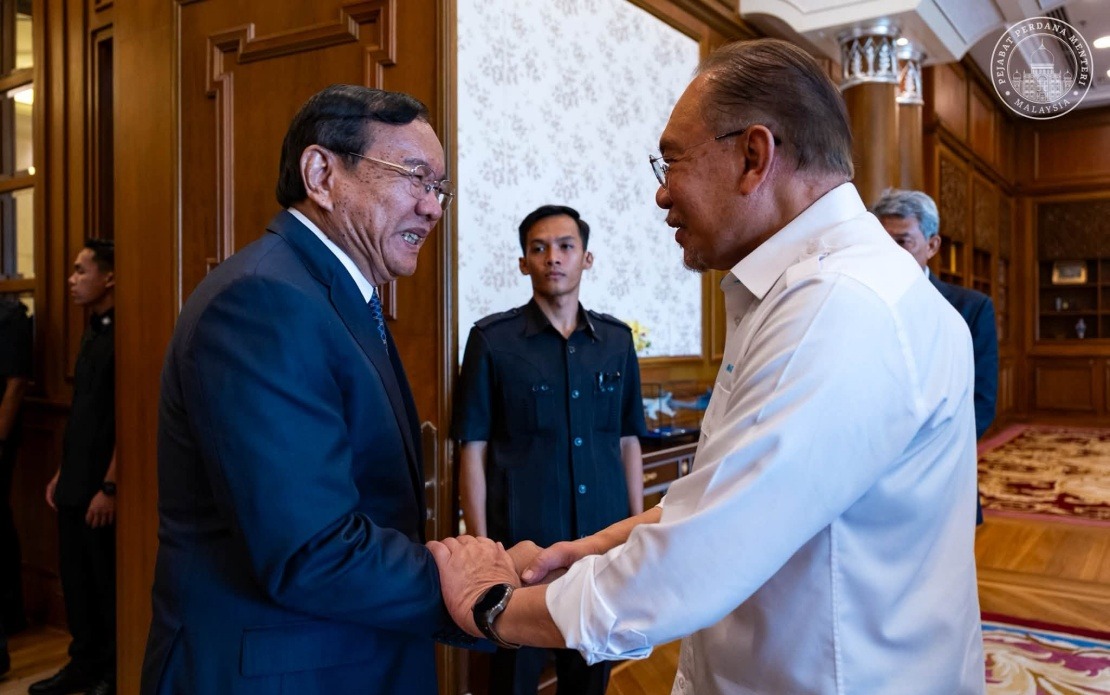
Prime Minister Datuk Seri Anwar Ibrahim has signalled an ambitious expansion of Malaysia-Cambodia bilateral ties, with both nations committing to strategic partnerships spanning emerging technologies, traditional industries and critical regional challenges. The pledge came during a courtesy call from Cambodian Deputy Prime Minister and Minister of Foreign Affairs and International Cooperation Prak Sokhonn, who arrived in Malaysia to commence a two-day official visit designed to deepen institutional cooperation between the two Southeast Asian neighbours.
The scope of the planned collaboration reflects evolving priorities within the region. Beyond conventional trade and security frameworks, Malaysia and Cambodia are now positioning themselves to jointly pursue opportunities in the digital economy and artificial intelligence—sectors increasingly central to national competitiveness across Asia. The inclusion of digital economy and AI cooperation signals recognition that technological advancement is no longer peripheral to bilateral relationships but foundational to long-term prosperity. For Malaysia, where the Digital Economy Blueprint remains a cornerstone of national policy, partnership with Cambodia on these fronts could facilitate knowledge transfer and create downstream investment opportunities in a neighbouring economy.
The halal industry represents another significant pillar of the emerging partnership. As the world's largest halal market by some measures, Malaysia holds particular expertise in certification, production standards and value-chain development—sectors where Cambodia, with a Muslim minority population and growing food export ambitions, stands to benefit substantially. Closer cooperation in this domain could position both nations more competitively in global halal trade, which continues to expand beyond traditional Middle Eastern markets into Africa and parts of Europe. Food security coordination is equally telling, reflecting shared concerns about supply chain resilience in an era of climate volatility and geopolitical uncertainty affecting agricultural production across Southeast Asia.
Combating cross-border crime emerged as a practical security priority, underscoring shared vulnerabilities along the Malaysia-Cambodia frontier. Trafficking in drugs, weapons and persons remains a persistent challenge across the Mekong region, and bilateral mechanisms to enhance intelligence sharing and coordinated enforcement operations carry tangible implications for public safety in both nations. This dimension of cooperation demonstrates that strategic partnership extends beyond high-profile sectors into the unglamorous but essential work of border management and criminal justice coordination.
The visit by Prak Sokhonn provides the immediate context for these commitments, but the substantive work will occur during the Third Malaysia-Cambodia Joint Commission for Bilateral Cooperation, scheduled for August 4. The JCBC represents the formal institutional machinery through which cooperation frameworks are negotiated, implemented and reviewed. By anchoring these sectoral commitments within an established multilateral structure, both governments signal seriousness beyond rhetorical flourish, moving discussions from diplomatic courtesy into technical working groups and implementation schedules.
Looking ahead, the timing carries symbolic weight. Malaysia and Cambodia will commemorate seventy years of diplomatic relations in 2027, a milestone that provides both an opportunity and a deadline for substantive advancement of bilateral ties. Rather than waiting for that anniversary, current initiatives suggest both nations wish to demonstrate meaningful progress—new agreements, joint ventures, and institutional innovations—that give concrete form to their stated commitment to friendship and partnership. For Malaysian policymakers, building stronger ties with Cambodia also serves broader strategic objectives within ASEAN, where collective unity and prosperity remain stated priorities despite periodic tensions.
The invocation of ASEAN Community Vision 2045 in Anwar's remarks places the Malaysia-Cambodia relationship within a larger regional architecture. Both nations carry responsibility not merely for their bilateral relationship but for advancing the broader ASEAN agenda of regional integration, economic cooperation and political stability. This framing acknowledges that Malaysia-Cambodia ties do not exist in isolation but contribute to or potentially detract from the collective success of Southeast Asia as a geopolitical and economic entity. In an era when external powers vie for influence across the region, deepening intra-ASEAN cooperation becomes a means of reinforcing regional autonomy and cohesion.
For Malaysian businesses and investors, the expansion of cooperation frameworks creates tangible opportunities. Companies operating in digital technologies, food processing, halal certification and agricultural production may find new markets or partnership possibilities in Cambodia. Conversely, Cambodian enterprises could gain access to Malaysian expertise, capital and distribution networks. The institutional strengthening of bilateral ties thus translates into commercial reality for the private sector, multiplying the benefits of diplomatic engagement beyond government circles.
The human capital development dimension mentioned in Anwar's statement deserves particular attention. Educational exchanges, technical training programmes and professional mobility between the two nations can facilitate knowledge transfer and build personal networks that endure beyond any single government administration. Investment in people-to-people connections, particularly among younger professionals and entrepreneurs, creates constituencies within both societies with vested interests in sustained cooperation, anchoring bilateral ties in civil society rather than relying solely on government commitment.
Amid broader geopolitical currents reshaping Southeast Asia, Malaysia's deliberate cultivation of deeper ties with Cambodia reflects pragmatic statecraft. Rather than choosing sides in great-power competition, Malaysia advances cooperation with fellow ASEAN members across practical domains where mutual benefit is demonstrable. This approach preserves strategic autonomy while building relationships that serve both economic and security interests. As regional powers continue manoeuvring for advantage, the quiet deepening of Malaysia-Cambodia cooperation through institutional mechanisms and sectoral partnerships represents a distinctly Southeast Asian approach to prosperity and stability.

