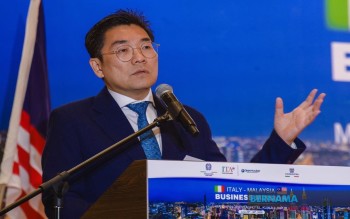
Malaysia and the European Union are making steady progress towards a comprehensive free trade agreement, with negotiators completing work on five key chapters and eyeing final completion by 2027. The fourth round of talks, concluded in Kuala Lumpur earlier this month, saw both delegations wrap up Customs and Trade Facilitation, Trade Remedies, and Good Regulatory Practices. Investment, Trade and Industry Deputy Minister Sim Tze Tzin confirmed that the Transparency chapter had been concluded during the second round of negotiations, whilst the Small and Medium Enterprises chapter was finalised in the third round. The two sides plan to resume formal discussions in Brussels on September 21 to 25, maintaining momentum on what Malaysia views as a transformative economic partnership.
The Malaysia-European Union Free Trade Agreement (MEUFTA) holds considerable strategic weight for the region's largest economy. At present, the EU represents the world's single largest integrated market, encompassing 27 member states with a combined population exceeding 440 million people. Sim characterised the anticipated deal as a potential "game-changer" that would position Malaysia as a more deeply integrated player within European supply chains whilst simultaneously creating fresh opportunities across high-technology services, renewable energy, and digital commerce. For a nation seeking to diversify its economic relationships beyond traditional Asia-centric partnerships, a comprehensive EU trade framework would strengthen Malaysia's hand in an increasingly multipolar global economy.
Malaysia's relationship with Europe, particularly southern Europe, is strengthening on multiple fronts. The bilateral trade relationship with Italy, Malaysia's fifth-largest European trading partner, expanded by 14.2 per cent year-on-year to approximately RM17 billion in 2025. Malaysian exports to Italy, valued at RM7.6 billion and growing at 12.7 per cent annually, are predominantly concentrated in palm oil and palm oil derivatives, ferrous and non-ferrous metals, electrical and electronics components, and industrial machinery. These exports underscore Malaysia's established role as a supplier of commodities and mid-value manufactured goods to the European continent. Concurrently, Italian imports to Malaysia—primarily high-specification machinery, optical and precision instruments, fine chemicals, and jewellery—reflect a complementary trade dynamic wherein European partners provide capital-intensive and technology-embedded products.
Investment flows from Europe into Malaysia further illustrate deepening economic integration. Over 80 manufacturing projects initiated by Italian firms, collectively valued at US$442 million, now operate across Malaysian territory. These ventures span food processing, specialty chemicals, machinery manufacturing, and advanced aerospace components. Italian investors remain attracted to Malaysia's comprehensive industrial ecosystem, particularly its well-established supply chains and manufacturing infrastructure that enable efficient production and distribution to the broader Southeast Asian market. The nation's geographic position, skilled workforce, and mature port facilities continue to position it favourably for firms seeking to establish regional manufacturing hubs.
The electronics and semiconductors sector represents a particular area of mutual interest. Malaysia possesses a mature, vertically integrated electrical and electronics (E&E) industry that has evolved over several decades and now encompasses design, assembly, and testing operations. Italy maintains comparable strengths in precision machinery and advanced manufacturing techniques. Sim indicated that collaborative potential exists across both jurisdictions, particularly in higher-value semiconductor manufacturing and integrated circuit design. These sectors align closely with Malaysia's stated objective of climbing the manufacturing value chain rather than remaining confined to low-cost assembly operations.
The Malaysian government has signalled its determination to attract investment in advanced manufacturing through its New Investment Incentive Framework, which commenced operations in March 2025. This reformed incentive structure channels tax benefits towards enterprises engaging in front-end semiconductor production, advanced circuit design, and sophisticated manufacturing processes. Importantly, Sim stressed that incentive structures apply uniformly to domestic and foreign investors, contrary to occasional perceptions that Malaysia favours overseas corporations. The framework's explicit design prioritises moving Malaysian companies upstream, enabling domestic enterprises to capture greater value and develop technological capabilities that previously concentrated in foreign multinationals.
The timing of these trade negotiations carries geopolitical significance for Malaysia and broader Southeast Asia. The region faces an increasingly complex international environment characterised by strategic competition between established powers and rising economic poles. A comprehensive trade agreement with the European Union would diversify Malaysia's trading relationships and reduce economic dependence on any single region or partnership framework. For a nation situated along critical sea lanes and subject to competing geopolitical influences, such equilibrium proves strategically valuable. Additionally, the agreement would provide Malaysian companies with preferential access to one of the world's largest and most affluent consumer markets, potentially stimulating exports of value-added manufactured goods rather than primary commodities.
Prime Minister Anwar Ibrahim's working visit to Italy in July 2024, at the invitation of Italian Prime Minister Giorgia Meloni, catalysed the broader bilateral engagement now extending through the trade mission framework. This high-level diplomatic foundation demonstrates commitment from both governments to deepening economic partnerships beyond conventional diplomatic protocols. Such exchanges establish personal relationships among senior policymakers and create momentum for commercial negotiations. The Italy-Malaysia Business Mission referenced in these talks reflects this top-down political commitment translating into concrete commercial engagement, bringing together private sector representatives capable of identifying specific business opportunities.
The bilateral trade relationship between Malaysia and Italy is notably balanced relative to many of Malaysia's partnerships with developed economies. Malaysia's exports to Italy represent meaningful value creation rather than bulk commodity sales, reflecting the nation's progression towards manufacturing sophistication. Italian machinery and precision instruments flowing into Malaysia support local manufacturing operations, creating a genuine complementarity wherein both economies benefit from specialisation. This equilibrium stands in contrast to relationships where significant trade imbalances or dependency dynamics emerge, suggesting sustainable long-term partnerships.
The completion of five negotiating chapters within roughly 18 months of formal talks demonstrates reasonable progress, though major frameworks such as intellectual property, government procurement, and labour provisions remain unresolved. These final chapters often prove most contentious as they engage fundamental differences in regulatory philosophy and domestic policy priorities. The European Union typically insists on robust environmental standards, labour protections, and intellectual property enforcement, potentially necessitating Malaysian legislative adjustments. Conversely, Malaysia will likely seek flexibility on sensitive sectors and investment protections for state-owned enterprises. The 2027 completion target appears achievable but represents an ambitious timeline for comprehensive negotiations addressing such divergent interests.
For Malaysian exporters and investors, a finalised MEUFTA would eliminate tariffs and non-tariff barriers affecting Malaysian goods entering EU member states, potentially expanding markets for palm oil products, electronics, and industrial equipment. Conversely, EU firms would gain improved access to Malaysian markets and enhanced investment protections. The agreement would also establish regulatory harmonisation frameworks allowing manufacturers to achieve certifications and approvals in one jurisdiction applicable across all EU member states. Such streamlining reduces compliance costs and facilitates cross-border production networks. For smaller Malaysian enterprises, tariff elimination and standards alignment would lower entry barriers into European markets previously accessible only to larger, better-resourced companies.
The strategic weight of these negotiations extends beyond bilateral commerce. Within Southeast Asia, Malaysia's engagement with the European Union signals the region's continued importance to non-Asian powers and reinforces ASEAN's broader trading relationships beyond Asia-Pacific frameworks. A successful EU-Malaysia FTA could establish precedents and institutional frameworks applicable to subsequent EU negotiations with other ASEAN members, gradually creating a more interconnected trading architecture. For Malaysian policymakers, securing favourable terms with the EU while simultaneously maintaining relationships through the Comprehensive and Progressive Agreement for Trans-Pacific Partnership (CPTPP) and various other regional arrangements represents successful portfolio diversification in trade policy.
The ongoing negotiations occur amid broader conversations regarding global trade patterns and regionalism. Some observers question whether proliferating bilateral and regional agreements fragment the global trading system or whether they represent pragmatic responses to the challenges of negotiating within the World Trade Organization framework. Malaysia's approach of engaging simultaneously through multiple regional mechanisms suggests a pragmatic strategy: maintaining WTO participation whilst securing preferential arrangements with economically significant partners. The MEUFTA, if completed, would complement rather than replace Malaysia's existing trade relationships, adding another layer to an increasingly complex international commercial architecture.
As negotiations resume in Brussels, Malaysian negotiators will likely focus on final details concerning agricultural products, services trade, and investment protection clauses. The European Union typically seeks access for its cheese, wine, and specialty agricultural products, areas where Malaysian tariffs remain relatively protective. Malaysia conversely will seek maximal liberalisation for palm oil whilst protecting sensitive sectors and securing investment safeguards for state enterprises. Finding equilibrium across these competing interests within a 2027 timeframe requires sustained political commitment from both sides and pragmatic willingness to compromise on secondary issues. The completion of five chapters suggests such commitment exists, though the ultimate test will arrive when negotiators must address the most politically sensitive remaining provisions.

