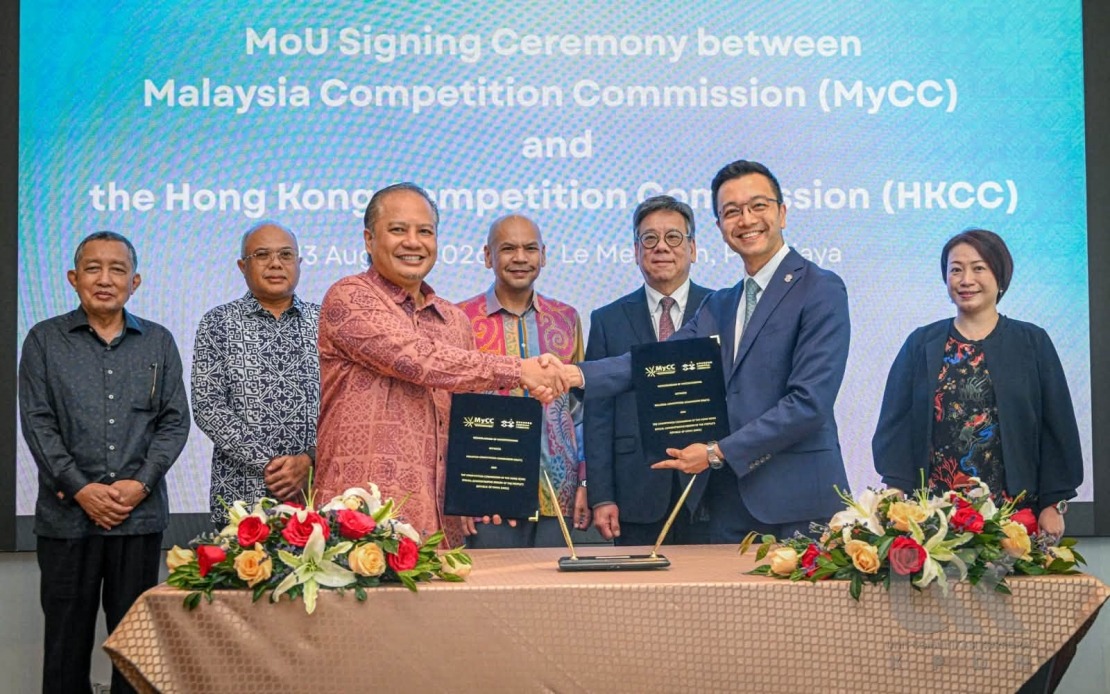
Malaysia's competition authority has taken another step towards deepening regional regulatory cooperation by formalising ties with Hong Kong's competition watchdog. The Malaysia Competition Commission (MyCC) and the Hong Kong Competition Commission (HKCC) signed a Memorandum of Understanding on August 13, cementing a commitment to coordinate enforcement efforts across the increasingly complex landscape of cross-border business activity in Asia.
Domestic Trade and Cost of Living Minister Datuk Armizan Mohd Ali positioned the agreement as a natural evolution of Malaysia's multilateral competition strategy. This latest accord represents the fourth bilateral arrangement MyCC has established with foreign competition authorities, following comparable frameworks negotiated with the Türkiye Competition Authority, Korea Fair Trade Commission and the Philippine Competition Commission. The expanding network underscores a strategic approach to building enforcement capacity across diverse jurisdictions and economic systems.
The minister emphasised that the agreement reflects broader policy objectives around preserving competitive market conditions. In a statement, he noted that contemporary business structures routinely transcend national borders, creating regulatory challenges that no single authority can effectively manage in isolation. This reality has transformed competition enforcement from a purely domestic concern into a transnational imperative that demands coordinated responses and mutual understanding among regulators.
Operationally, the partnership will facilitate systematic exchange of information concerning significant developments in each jurisdiction's competition laws, including legislative amendments and regulatory reforms. This intelligence-sharing dimension proves particularly valuable for Malaysia's regulatory framework, which continues to evolve alongside economic policy priorities. By maintaining parallel awareness of Hong Kong's regulatory movements, MyCC gains early insight into emerging enforcement trends and policy innovations that may carry relevance for Malaysian market conditions.
Beyond information exchange, the two bodies will collaborate extensively on investigative methodology and enforcement practice. This encompasses direct transfer of investigative experience between agencies, enabling MyCC officers to learn from Hong Kong's enforcement successes and challenges. The arrangement specifically contemplates formal secondment of officers between the commissions, allowing personnel to embed temporarily within counterpart organisations and absorb practical enforcement techniques that can be repatriated and adapted for Malaysian conditions.
Capacity-building features prominently in the cooperation framework. Both authorities will jointly conduct training programmes, workshops and research initiatives aimed at enhancing the technical competence of their respective enforcement teams. These initiatives address not only conventional competition matters but also emerging issues at the intersection of competition law and digital markets, a domain where both Hong Kong and Malaysia continue developing regulatory responses.
The agreement specifically targets cross-border competition challenges that neither jurisdiction can resolve unilaterally. Anticompetitive conduct that spans the Hong Kong and Malaysian economies—whether involving cartels, abuse of dominance or restrictive agreements—requires coordinated investigation and enforcement to prevent regulatory gaps that sophisticated actors might otherwise exploit. This bilateral framework now establishes formal mechanisms for such coordination, complementing MyCC's participation in broader regional and multilateral enforcement networks.
For Malaysian consumers and businesses, the implications extend beyond abstract regulatory cooperation. Strengthened enforcement capability reduces opportunities for firms to engage in anticompetitive practices that exploit fragmentation across different jurisdictions. Companies operating throughout the region face heightened regulatory scrutiny and reduced scope for playing authorities against one another. This convergence in enforcement standards enhances predictability for compliant businesses whilst raising costs for those inclined towards anticompetitive conduct.
Armizan signalled that this partnership represents an ongoing trajectory rather than a terminal achievement. The ministry intends to continue systematically deepening relationships with other regional and international competition authorities, progressively expanding the network of bilateral and multilateral enforcement frameworks. This approach reflects recognition that Malaysia's competition ecosystem increasingly depends on its integration into global networks of regulatory cooperation.
The strategic value of such arrangements proves particularly acute for Malaysia given its position as a significant trading hub and investment destination. Hong Kong's status as a global financial centre and major trading node means that Malaysian businesses engaged in international commerce routinely interface with Hong Kong-based competitors and counterparties. Clear lines of communication between regulatory authorities help prevent misunderstandings, reduce enforcement inconsistencies and create more transparent operating conditions for the Malaysian business community.
The timing of the agreement also reflects evolving global consciousness concerning competition policy's role in broader economic governance. As digital markets, supply chain concentration and cross-border e-commerce reshape competitive dynamics, competition authorities worldwide recognise that isolated enforcement proves increasingly ineffective. Malaysia's willingness to institutionalise cooperation with Hong Kong demonstrates alignment with these global trends and commitment to participating fully in the emerging architecture of transnational regulatory governance.
Looking forward, the MyCC-HKCC partnership will likely serve as a template for deepening cooperation with other major financial centres and trading hubs throughout Asia. The framework established through this MoU—encompassing information exchange, investigative collaboration, capacity-building and coordinated cross-border enforcement—creates a replicable model that can be extended to other relationships. This incremental expansion of Malaysia's competition enforcement networks represents a pragmatic response to the reality that fair competition transcends borders.

