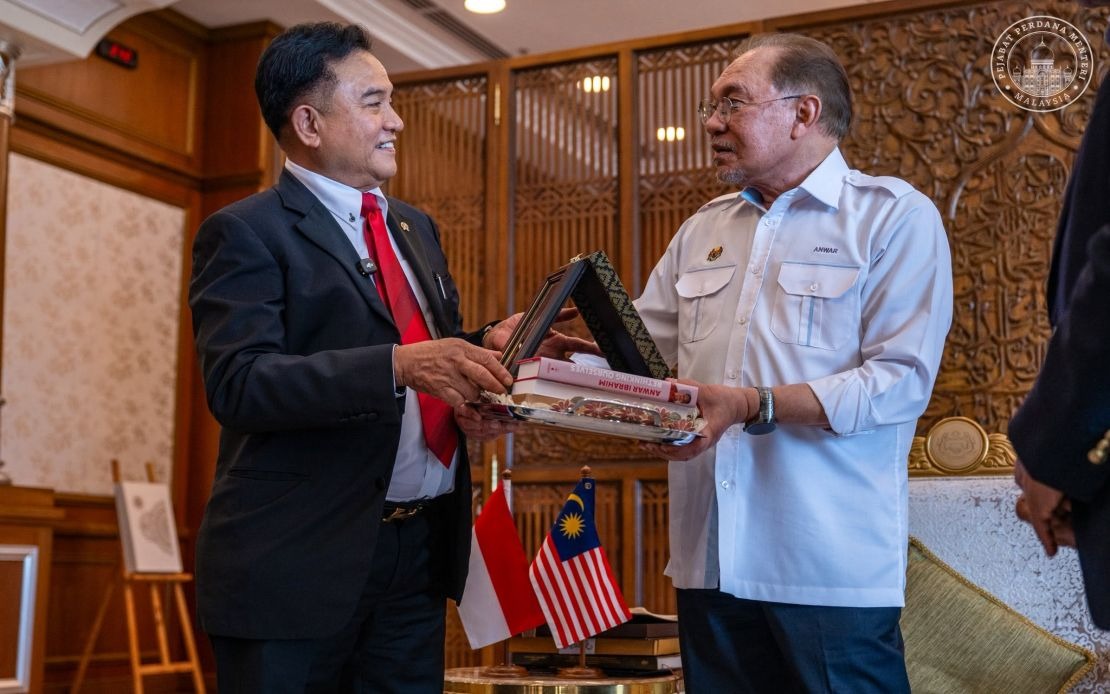
Malaysia and Indonesia are poised to deepen their institutional partnership, with both nations prioritising enhanced cooperation across legislative frameworks, governance structures, and a range of strategically important sectors. Prime Minister Datuk Seri Anwar Ibrahim underscored this commitment following a high-level engagement with Indonesia's Coordinating Minister for Legal, Human Rights, Immigration and Correction, Prof Dr Yusril Ihza Mahendra, who visited the Prime Minister's Office in Putrajaya on June 29.
The bilateral meeting reflects an ongoing effort to strengthen the administrative and legal foundations that underpin Southeast Asian regional stability. Given the geographical proximity and shared cultural heritage of Malaysia and Indonesia, institutional cooperation serves as a critical mechanism for addressing transnational challenges, harmonising regulatory approaches, and facilitating smoother governance interactions between the two nations. The visit by Mahendra, who oversees a portfolio spanning legal affairs, human rights protections, immigration administration, and correctional systems, signals Jakarta's serious engagement with legislative harmonisation and legal modernisation efforts.
During their discussions, Anwar—who holds dual responsibility as Prime Minister and Finance Minister—and Mahendra exchanged substantive views on mechanisms to reinforce bilateral cooperation across their respective administrative domains. The breadth of Mahendra's portfolio suggests conversations likely encompassed judicial reform, cross-border legal frameworks, immigration policy coordination, and potentially penal system alignment. For Malaysia, such exchanges carry particular significance given the country's ongoing efforts to modernise its legislative architecture and strengthen governance mechanisms.
The timing of this engagement is noteworthy. Both nations have recently signalled renewed commitment to regional institutional frameworks, including ASEAN mechanisms and bilateral development initiatives. Malaysia's push to enhance legislative cooperation with a neighbouring major Southeast Asian economy reflects broader strategic thinking about regional integration and the creation of complementary legal ecosystems that facilitate trade, investment, and people-to-people mobility.
Cooperation in legislation and governance between Malaysia and Indonesia traditionally covers areas including mutual legal assistance, extradition protocols, immigration procedures, and increasingly, digital governance standards. The involvement of Indonesia's human rights coordinating ministry suggests that contemporary dialogue now encompasses rights protection, civil liberties frameworks, and potentially anti-corruption initiatives—reflecting global governance trends toward transparency and accountability.
For Malaysian stakeholders, including businesses, civil society organisations, and individual citizens, enhanced bilateral legislative cooperation could yield tangible benefits. Harmonised standards in commercial law, intellectual property protection, and employment regulations could reduce friction in conducting cross-border operations. Improved immigration processes would facilitate legitimate travel and professional mobility. Strengthened judicial cooperation could accelerate resolution of cross-border disputes and criminal cases involving nationals of both countries.
The exchange also holds implications for broader ASEAN cohesion. Malaysia and Indonesia, as the region's second and third-largest economies respectively, set important precedents through their bilateral initiatives. Closer legislative alignment between these neighbours creates positive spillover effects, encouraging other ASEAN members to pursue similar governance partnerships and contributing to a more integrated regional framework.
Indonesia's role as the ASEAN chair and a key player in regional institution-building makes its legislative and governance initiatives particularly influential. By prioritising engagement with Malaysia on these foundational matters, Jakarta demonstrates commitment to strengthening the institutional architecture that underpins the broader regional order. For Malaysia, reciprocating this commitment reinforces its position as a stable, institutionally mature partner capable of contributing meaningfully to regional governance advancement.
The reference to "close fraternal relations" in Anwar's statement carries symbolic weight beyond diplomatic courtesy. Malaysia and Indonesia share historical ties and cultural commonalities that distinguish their bilateral relationship. This foundation, combined with contemporary strategic interests, provides solid ground for institutionalised cooperation that transcends short-term political cycles. The emphasis on "progress, peace, and well-being of the people" reflects a people-centred approach to governance cooperation—suggesting that legislative and administrative improvements are ultimately intended to enhance quality of life and security for ordinary citizens.
Moving forward, the substantive outcome of this engagement will depend on translating political commitment into concrete institutional mechanisms. This might include joint legislative working groups, regular administrative consultations, harmonised standards in specific sectors, and potentially new bilateral agreements addressing emerging governance challenges such as cybersecurity, digital commerce, and environmental protection.
The broader context of Malaysia-Indonesia cooperation extends beyond government-to-government channels. Private sector engagement, academic exchanges, and civil society dialogue all contribute to deepening mutual understanding and identifying areas for productive collaboration. Recent years have witnessed expanding economic ties, with two-way trade and investment flows growing steadily. Governmental commitment to legislative and governance cooperation provides the regulatory foundation necessary to sustain and accelerate this economic momentum.
As both nations navigate contemporary challenges ranging from digital transformation to climate action, institutional cooperation becomes increasingly valuable. Shared learning on governance innovations, particularly in areas where either country has developed strong institutional capacity, can benefit both populations. The meeting between Anwar and Mahendra represents an investment in the institutional scaffolding that enables effective bilateral and regional governance in an increasingly complex global environment.

