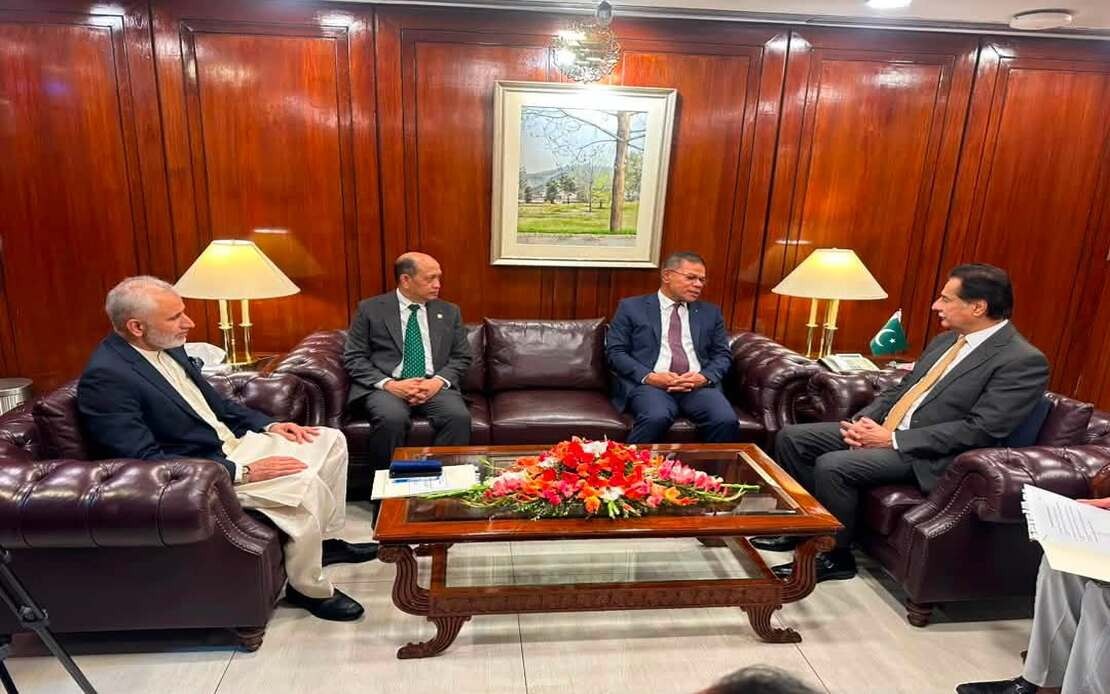
Malaysia and Pakistan have reaffirmed their commitment to resolving geopolitical tensions through dialogue and peaceful engagement, with Home Minister Datuk Seri Saifuddin Nasution Ismail emphasising the shared conviction during his recent official visit to Islamabad on August 21. The bilateral discussions, held at the highest parliamentary levels, reflect both nations' determination to pursue constructive solutions amid widening regional security concerns affecting South Asia and the broader Indo-Pacific.
During the second day of his visit, Saifuddin Nasution held substantive meetings with Sardar Ayaz Sadiq, Speaker of Pakistan's National Assembly, and Syed Yousaf Raza Gilan, Chairman of the Senate of Pakistan. These engagements went beyond ceremonial courtesy, instead focusing on concrete mechanisms through which Malaysia and Pakistan can deepen institutional cooperation. The Malaysian delegation used the platform to articulate ASEAN's broader philosophy of conflict prevention, which has allowed the Southeast Asian bloc to maintain regional peace despite competing interests and strategic rivalries among member states.
Central to the discussions was Malaysia's experience in channelling diplomatic efforts through multilateral frameworks, particularly ASEAN. Saifuddin Nasution highlighted how the regional bloc has successfully managed tensions through dialogue mechanisms, confidence-building measures, and the principle of non-interference in internal affairs. This model holds particular relevance for Pakistan, which faces complex security challenges in South Asia and seeks to demonstrate its commitment to international norms of peaceful dispute resolution. The Malaysian approach offers lessons for nations navigating geopolitical complexities without sacrificing sovereignty or strategic autonomy.
The bilateral relationship between Malaysia and Pakistan rests on foundations deeper than contemporary diplomatic convenience. Both nations share historical ties rooted in Islam, shared Commonwealth heritage, and complementary strategic interests in the Indian Ocean region. Beyond government-to-government relations, people-to-people connections have flourished through educational exchanges, business partnerships, and cultural programmes. These grassroots connections provide resilience to the official relationship, ensuring that diplomatic ties withstand international pressures and shifting regional alignments.
Particularly noteworthy was the emphasis placed on parliamentary diplomacy and institutional exchanges. Saifuddin Nasution stressed the importance of strengthening connections between Malaysia's Dewan Rakyat and Pakistan's National Assembly, as well as between the respective upper chambers. Parliamentary diplomacy operates at a different register than foreign ministry channels, often permitting more candid discussions and building personal relationships among legislators who shape their nations' policies. By investing in these institutional links, Malaysia and Pakistan are creating multiple layers of communication and understanding.
The Malaysian delegation's visit to Pakistan's Parliament Museum served a symbolic purpose beyond its superficial tourism value. By studying Pakistan's constitutional evolution and parliamentary traditions, the Malaysian representatives demonstrated respect for Pakistan's democratic institutions and acknowledged the nation's struggle to entrench democratic governance. This gesture carries weight in a region where democratic backsliding remains a persistent challenge, signalling Malaysia's investment in Pakistan's institutional stability as a foundation for reliable bilateral relations.
For Malaysia, the visit represents a calibrated effort to maintain its traditional partnerships while navigating contemporary regional tensions. As a Southeast Asian power with significant Muslim populations and Islamic institutional frameworks, Malaysia has both capability and interest in serving as a bridge between different regions and civilisations. The emphasis on dialogue and peaceful solutions reflects Malaysia's broader foreign policy orientation, which privileges inclusive multilateralism over confrontational bloc-building. This approach distinguishes Malaysia's diplomacy in an era of intensifying great-power competition.
The timing of Saifuddin Nasution's visit is significant given the deteriorating security environment in South Asia. Pakistan faces persistent terrorist threats, border tensions with India, and internal security challenges requiring careful calibration of regional relationships. Malaysia's reiteration of commitment to dialogue and peaceful solutions provides diplomatic reassurance at a moment when military buildups and nationalist rhetoric dominate headlines. By showcasing how ASEAN has maintained peace among diverse members, Malaysia implicitly suggests that dialogue-based frameworks can succeed even where superficial incompatibilities appear insurmountable.
Expanding parliamentary and institutional ties offers practical benefits beyond symbolic gestures. Enhanced legislative exchanges can facilitate knowledge-sharing on governance challenges, legislative procedures, and policy implementation. Pakistani legislators increasingly look to successful Asian democracies for insights into institutional effectiveness, and Malaysia's parliamentary system offers relevant lessons. Similarly, Malaysian policymakers benefit from understanding Pakistan's experiences in managing religious diversity, provincial autonomy, and security governance.
The bilateral discussions also reflect Malaysia's interest in deepening economic and people-to-people connections. Enhanced institutional linkages often precede expanded trade relationships and investment flows. Pakistani diaspora communities in Malaysia, coupled with Malaysian business interests in Pakistan, suggest significant potential for economic cooperation. Stronger parliamentary ties can remove bureaucratic obstacles and create policy certainty that attracts investors.
Saifuddin Nasution's assertion that exchanges at leadership and institutional levels are vital for relationship growth acknowledges a fundamental truth about diplomacy. Personal relationships among senior officials, developed through repeated engagement and genuine dialogue, create trust that survives policy disagreements and political transitions. These human connections, multiplied across dozens of officials and legislators, form the sinews holding bilateral relationships together.
Looking forward, Malaysia's diplomatic outreach to Pakistan exemplifies how middle powers can contribute to global stability without pursuing hegemonic ambitions. By championing dialogue, respecting sovereignty, and promoting multilateral cooperation, Malaysia positions itself as a responsible stakeholder in regional order. For Pakistan, receptiveness to such engagement signals its own commitment to constructive international relations, despite internal security pressures and external challenges. The shared emphasis on peaceful solutions and diplomatic problem-solving, articulated during these high-level meetings, provides a foundation upon which both nations can build increasingly resilient bilateral ties.

