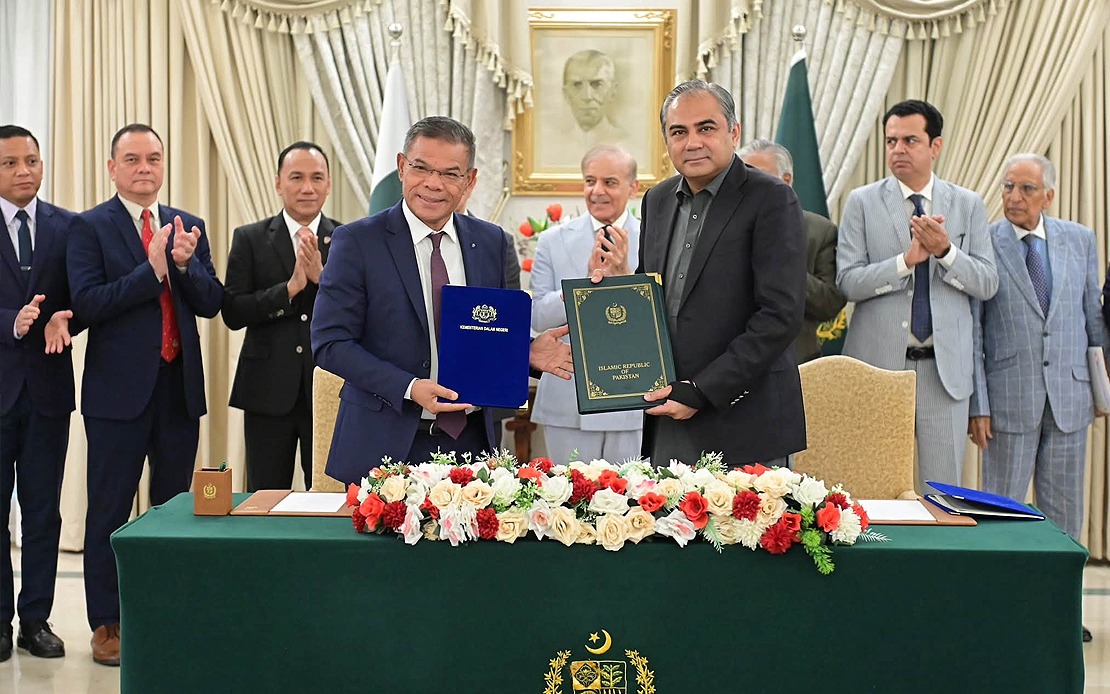
Malaysia and Pakistan have formalized a landmark agreement on prisoner transfers, with Home Minister Datuk Seri Saifuddin Nasution Ismail signing the International Transfer of Prisoners (ITOP) Treaty alongside Pakistan's Interior and Narcotics Control Minister Syed Mohsin Raza Naqvi. The signing ceremony took place at Pakistan's Prime Minister's Office and was witnessed by Prime Minister Muhammad Shehbaz Sharif, underscoring the diplomatic significance of the accord in strengthening institutional ties between Islamabad and Kuala Lumpur.
The treaty represents a substantial advancement in the two nations' longstanding relationship, particularly in the realm of judicial and security cooperation. According to Saifuddin Nasution, the agreement emerged after five rounds of intensive negotiations beginning in September 2025, involving multiple Malaysian agencies including the Home Ministry, Foreign Ministry, Attorney General's Chambers, the Malaysian Prisons Department, and the Royal Malaysia Police. The Malaysian Cabinet formally approved the framework on May 13, signalling broad governmental support for the initiative across different ministerial portfolios.
At its core, the ITOP treaty establishes a reciprocal mechanism whereby Malaysian nationals currently detained in Pakistani correctional facilities can be transferred back to Malaysia to complete their remaining sentences. Conversely, Pakistani citizens imprisoned within Malaysia's penal system may be repatriated to Pakistan to serve out the remainder of their custodial terms. This bilateral arrangement addresses a practical humanitarian concern that has long affected the families and communities of imprisoned nationals on both sides of the border.
Beyond the mechanics of prisoner repatriation, the treaty carries significant rehabilitative dimensions. Officials emphasize that transferring prisoners to their home countries enables them to access rehabilitation and reintegration programmes specifically designed around their cultural contexts and social frameworks. A prisoner returning to their native country can access programmes delivered in their mother tongue, engage with counselling services attuned to their cultural background, and maintain stronger family connections during incarceration—all factors that criminological research suggests enhance successful reintegration upon release.
The achievement of this treaty builds upon Malaysia and Pakistan's extensive history of bilateral engagement. Both nations share Islamic heritage, maintain strong people-to-people connections through diaspora communities, and have collaborated on various regional security initiatives within the Organisation of Islamic Cooperation and other multilateral forums. The ITOP treaty thus represents a natural extension of existing cooperation frameworks into the specialized domain of criminal justice administration.
From a Southeast Asian perspective, Malaysia's conclusion of this treaty reflects broader regional trends toward institutionalizing transnational cooperation on law enforcement and prisoner management. As mobility of people across the region increases, countries face mounting practical challenges in managing nationals held abroad. The Malaysia-Pakistan model may serve as a template for similar bilateral arrangements among other ASEAN nations and their trading partners, particularly as the region grapples with managing incarcerated nationals in foreign jurisdictions.
The treaty's signing carries particular relevance for Malaysia given the country's significant Pakistani expatriate community, estimated at several thousand workers, students, and businesspeople. Pakistani nationals have occasionally found themselves entangled in Malaysia's criminal justice system, and the new framework provides a structured pathway for addressing such cases with dignity and efficiency. Similarly, Malaysian citizens imprisoned in Pakistan now have a legal instrument ensuring their potential repatriation, reducing uncertainty and enhancing consular protections.
For Pakistan, the treaty addresses similar concerns regarding its nationals held in Malaysian prisons. Pakistan's Interior and Narcotics Control Minister's participation underscores Islamabad's prioritization of this cooperation, particularly given Pakistan's ongoing challenges with narcotics trafficking and organized crime—areas where bilateral intelligence sharing and coordinated prisoner management become valuable tools in broader security strategies.
The institutional architecture supporting this agreement demonstrates sophisticated diplomatic coordination. The involvement of the Attorney General's Chambers, prisons departments, and police forces on both sides indicates that the treaty rests on solid legal foundations and practical implementation capacity. Both nations appear committed to ensuring the framework functions smoothly, with proper protocols for prisoner transfers, documentation, and ongoing administrative cooperation.
Looking ahead, the ITOP treaty may catalyze further judicial and legal cooperation between Malaysia and Pakistan. Successful prisoner transfer mechanisms often lead to expanded collaboration on extradition requests, mutual legal assistance in criminal investigations, and harmonized approaches to organized crime. As regional stability increasingly depends on coordinated responses to transnational crime, such frameworks gain strategic importance beyond their immediate humanitarian objectives.
The treaty also reflects evolving international standards regarding prisoners' rights and rehabilitation. Major international instruments, including UN conventions on the treatment of prisoners, increasingly recognize that rehabilitation succeeds best when prisoners maintain cultural and linguistic connections to their home societies. By formalizing this principle in bilateral law, Malaysia and Pakistan position themselves as progressive actors in global criminal justice discourse.
Saifuddin Nasution's characterization of the treaty as marking "another important milestone" in Malaysia-Pakistan relations acknowledges that this represents one component of a comprehensive partnership rather than an isolated agreement. The steady accumulation of such bilateral instruments—spanning trade, defence, education, and now criminal justice—gradually deepens institutional interdependence and mutual understanding between the nations.
As the treaty enters implementation phase, both governments will need to establish operational procedures, designate liaison officers, and develop protocols for handling transfer requests. The success of these administrative arrangements will determine whether the treaty achieves its humanitarian and rehabilitative potential, ultimately benefiting prisoners, their families, and the broader criminal justice systems of both Malaysia and Pakistan.

