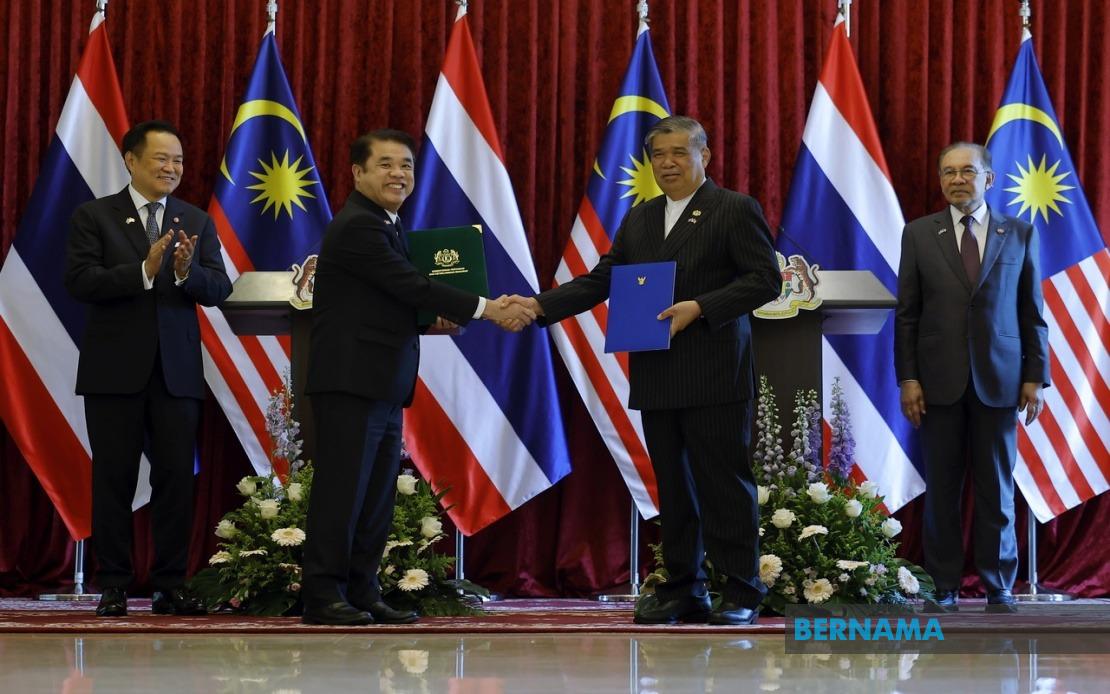
Thailand's Prime Minister Anutin Charnvirakul and Malaysian Prime Minister Datuk Seri Anwar Ibrahim have inked a significant memorandum of understanding designed to fortify agricultural cooperation between the two Southeast Asian neighbours. The agreement, finalised during bilateral talks held at the Malaysian Prime Minister's Office in Putrajaya, represents a strategic pivot toward deeper integration of their agricultural sectors and marks a turning point in resolving trade frictions that have complicated their relationship.
The accord encompasses a broad spectrum of agricultural domains, including crop production, livestock management, fisheries, research and development initiatives, and the critical area of food security. Beyond these baseline commitments, both governments have pledged to facilitate technology transfer between their agricultural institutions and invest in human resource development programmes designed to enhance skills and productivity across their farming communities. This multifaceted approach recognises that sustainable agricultural growth requires simultaneous advances in knowledge, infrastructure, and human capacity.
A particularly significant achievement embedded within the framework involves the resolution of long-standing market access impediments that have hindered bilateral trade in two economically important commodities. Thailand and Malaysia have finally cleared obstacles affecting shrimp and barramundi exports, disagreements that had festered between the nations and created friction for their respective fishing and aquaculture industries. The removal of these barriers unlocks substantial commercial opportunities for producers on both sides of the border, potentially expanding the regional seafood supply chain and improving price competitiveness in global markets.
Thai Government spokesperson Ratchada Thanadirek confirmed that both countries have assigned their respective agriculture ministers with accelerating the implementation of these agreements and expediting additional measures to address farmers' immediate concerns. This delegation of authority to ministerial level ensures that the high-level political commitment will translate into concrete administrative action. The involvement of agriculture ministers signals that both governments view these matters with sufficient priority to demand regular monitoring and swift problem-solving at the operational level.
The bilateral relationship extends considerably beyond agriculture. Thailand and Malaysia have committed to strengthening cooperation across multiple dimensions including conventional trade and investment flows, tourism promotion, infrastructure development, and security matters. By broadening the scope of partnership, both nations aim to generate expanded economic opportunities that benefit their populations comprehensively rather than through isolated sectoral gains. This holistic approach mirrors contemporary regional thinking about deepening economic integration.
Most ambitiously, the two governments have reaffirmed their shared objective of achieving US$30 billion in bilateral trade volume within the foreseeable future. This target reflects both nations' recognition that their combined economic potential remains substantially underutilised despite geographical proximity and historical ties. To realise this aspiration, the countries have specifically identified supply chain cooperation in food security, energy sectors, and advanced technology industries as priority areas deserving intensified collaboration. The emphasis on these three domains suggests a deliberate effort to move beyond traditional commodity trade toward higher-value-added economic partnerships.
Anutin's visit to Malaysia represents his inaugural bilateral trip to the country since his reappointment to office in March 2026, underscoring the renewed momentum in bilateral relations under his leadership. The timing and substance of the visit indicate that Thailand's government has prioritised the relationship with Malaysia as part of its broader regional engagement strategy. The personal participation of both prime ministers in witnessing the exchange of the memorandum demonstrates the political weight each government assigns to these arrangements.
Looking ahead, both governments have tasked relevant agencies with expediting implementation of the agreements reached during these talks. Anutin has additionally directed Thai bureaucracies to conclude pending bilateral memoranda of understanding, signalling his administration's intention to complete the architectural framework of bilateral cooperation before Thailand and Malaysia mark the 70th anniversary of their diplomatic relations in 2027. This timeline creates natural momentum for the two countries to cement their evolving partnership with a slate of formalised arrangements.
On the practical level, the partnership will receive tangible expression through a joint initiative scheduled for July 10. Both leaders plan to visit Bukit Kayu Hitam in Kedah to officially inaugurate a newly constructed road connection linking the Immigration, Customs, Quarantine and Security Complex in Bukit Kayu Hitam with its Thai counterpart, the Customs, Immigration and Quarantine Complex in Sadao. This infrastructure investment exemplifies how the two nations are translating political commitments into physical assets designed to facilitate smoother trade flows and people movement across their shared border.
The timing of these developments assumes particular relevance for Southeast Asia. As regional economies navigate volatile global commodity markets and grapple with climate-related threats to agricultural productivity, enhanced cooperation between major producers like Thailand and Malaysia can strengthen food security across the Association of Southeast Asian Nations. The emphasis on technology transfer and human resource development suggests that both countries recognise that sustainable competitive advantage derives not from exploiting natural resources alone but from building technical capacity and institutional knowledge.
For Malaysian stakeholders, the resolution of shrimp and barramundi trade disputes holds immediate commercial significance. These sectors employ substantial numbers of farmers, fishermen, and processing workers across multiple states. Removing market access barriers enables domestic producers to expand exports while potentially benefiting Malaysian consumers through improved supply chain efficiency. Additionally, the commitment to technology transfer creates opportunities for Malaysian agricultural enterprises to adopt Thai innovations and vice versa, fostering competitive gains throughout the sector.
The broader geopolitical context amplifies the significance of deepening Thailand-Malaysia ties. Both nations share interests in maintaining stability in the Strait of Malacca, counteracting transnational criminal networks, and advancing prosperity across the border regions where their respective populations are most densely concentrated. Agricultural cooperation, while seemingly narrowly sectoral, functions as a trust-building mechanism that creates institutional linkages and personal relationships between officials, facilitating collaboration in more sensitive domains including security and defence matters.

