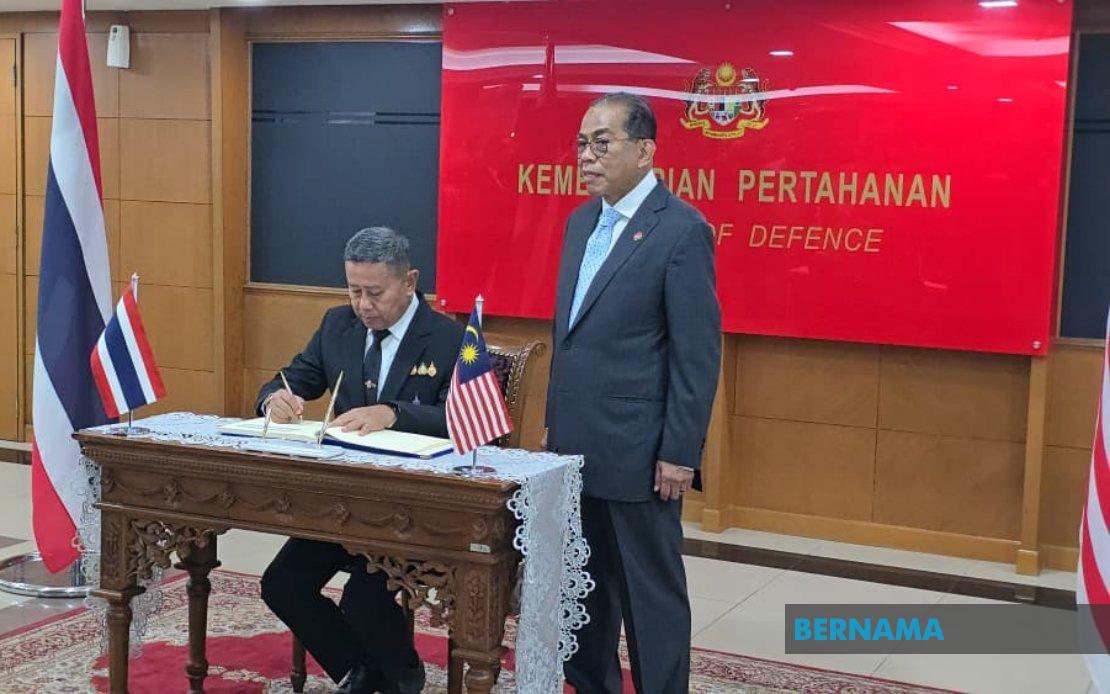
Malaysia and Thailand have reinforced their commitment to deepening defence collaboration and jointly addressing security challenges across Southeast Asia, following a high-level meeting between Defence Minister Datuk Seri Mohamed Khaled Nordin and his Thai counterpart Lieutenant General Adul Boonthumjaroen in Kuala Lumpur. The engagement, which took place at Wisma Pertahanan, underscores the strategic importance both nations place on maintaining stability in a region navigating complex geopolitical dynamics and transnational threats.
The visit represents Adul's inaugural engagement since assuming his position as Thailand's Defence Minister, signalling Bangkok's intent to prioritise military-to-military relationships with key ASEAN partners. During the discussion, Mohamed Khaled extended formal congratulations on Adul's recent appointment and voiced Malaysia's confidence in Thailand's defence trajectory under Prime Minister Anutin Charnvirakul's administration. Such diplomatic courtesies, while ceremonial in nature, reflect the broader pattern of institutional continuity that underpins Southeast Asian security architecture despite periodic changes in political leadership.
The bilateral dialogue illuminated both nations' shared vision for fostering peace and stability throughout Southeast Asia, a principle that resonates across ASEAN at a time when regional tensions—from maritime disputes to terrorism concerns—demand coordinated responses. Malaysia and Thailand have long recognised that unilateral security measures prove insufficient in addressing transnational challenges ranging from human trafficking and drug smuggling to maritime piracy and cyber threats. Their renewed commitment signals an acknowledgment that prosperity and security in the region depend fundamentally on multilateral cooperation frameworks.
A notable dimension of the meeting involved Thai recognition of Malaysia's diplomatic efforts in mediating the longstanding border conflict between Thailand and Cambodia. This acknowledgment carries particular weight given the sensitivity surrounding cross-border tensions in mainland Southeast Asia. Malaysia's proactive engagement in facilitating dialogue between Bangkok and Phnom Penh reflects Kuala Lumpur's broader regional role as an honest broker capable of building consensus among ASEAN members with competing interests. By publicly endorsing Malaysia's stabilising influence, Thailand strengthens the legitimacy of such mediation efforts and encourages continued constructive engagement.
Beyond high-level diplomatic exchanges, the visit encompassed substantive discussions on operational cooperation between defence establishments. Adul's tour of the National Aerospace and Defence Industries Group of Companies provided a practical platform for exploring concrete collaboration opportunities in defence technology, procurement, and manufacturing. Such industrial partnerships can yield tangible benefits for both nations, fostering knowledge transfer, reducing costs through economies of scale, and building indigenous defence capabilities aligned with regional requirements.
The NADI facility visit underscores Malaysia's growing role in the regional defence industrial ecosystem. As Southeast Asian nations gradually reduce their reliance on distant suppliers and seek to develop domestic capabilities, collaborative ventures with Malaysian defence contractors offer Thailand pathways to advanced technology while supporting local industry growth. This approach aligns with broader ASEAN aspirations for technological self-sufficiency and reduced supply chain vulnerabilities—lessons reinforced by global disruptions affecting military procurement timelines.
For Malaysian defence policy, the engagement reflects ongoing efforts to position the country as a credible security partner capable of facilitating regional dialogue while maintaining robust bilateral relationships with individual ASEAN members. As great power competition intensifies in the Indo-Pacific, Malaysia's ability to maintain strong ties with multiple partners without appearing aligned to any single bloc becomes increasingly valuable. Thailand faces similar balancing act pressures, particularly given its geographic position and historical ties to various strategic actors.
The strengthened Malaysia-Thailand defence relationship also carries implications for addressing shared maritime and land border security concerns. Both nations face evolving threats in the waters and territories they share, including irregular maritime activity and transnational criminal networks. Enhanced coordination between their defence forces can improve situational awareness, enable more effective joint operations, and create deterrence against activities that threaten regional stability and economic vitality.
Looking forward, the momentum generated by this visit should translate into concrete institutional arrangements and regular engagement mechanisms. Defence cooperation thrives when supported by sustained dialogue, regular exercises, and clearly defined protocols for addressing emerging challenges. Malaysia and Thailand possess the foundation for such deeper integration, given their historical relationship, cultural affinities, and converging security interests. Regular high-level visits, military-to-military exchanges, and joint training initiatives can systematically build the trust and interoperability essential for effective crisis management.
The bilateral meeting also arrives at a moment when ASEAN faces renewed pressure to demonstrate unity on regional security architecture amidst external pressures and internal disagreements. Malaysia and Thailand's public commitment to cooperative security principles sends an important signal about ASEAN's capacity to forge consensus on core values. Such bilateral initiatives, multiplied across multiple ASEAN dyads, create the collective diplomatic and operational framework that allows the ten-member bloc to maintain agency over its own security environment rather than becoming a theatre for external competition.
For Malaysian readers and policymakers, this engagement affirms the government's strategic approach to regional security through multilateral cooperation rather than unilateral posturing. At a time when regional waters host competing claims and major powers vie for influence, Malaysia's cultivation of strong bilateral relationships with neighbours like Thailand provides insurance against isolation and strengthens the country's voice in regional forums. The defence partnership also creates economic opportunities for Malaysian defence industries seeking to expand beyond domestic markets and establish themselves as credible regional suppliers.

