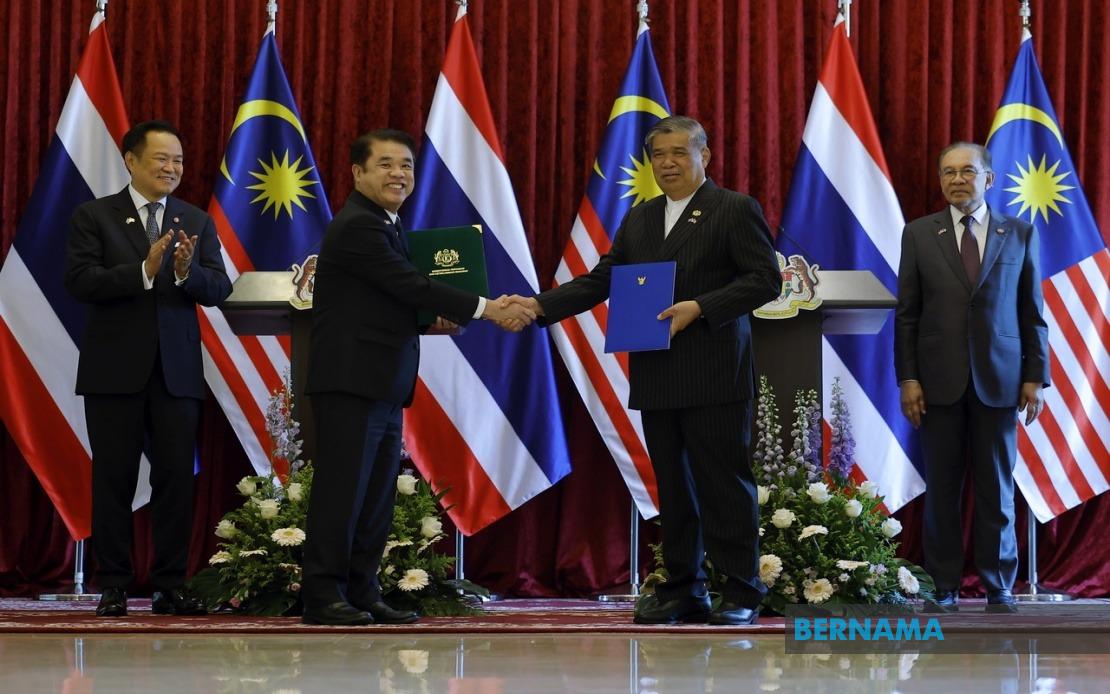
Malaysia and Thailand have successfully bridged a persistent trade dispute over fisheries products and committed to implementing a wide-ranging agricultural cooperation agreement far faster than initially expected. The breakthrough came during Thai Prime Minister Anutin Charnvirakul's inaugural official visit to Malaysia, where both nations' leaders witnessed the formal exchange of a Memorandum of Understanding designed to deepen collaboration across multiple food production and trade sectors. The accelerated timeline—reducing the implementation period from the originally proposed six weeks to just seven days—underscores the political will both governments are investing in strengthening regional food security infrastructure and bilateral commerce.
Malaysian Prime Minister Datuk Seri Anwar Ibrahim and his Thai counterpart presided over the signing ceremony in Putrajaya on July 9, with Agriculture and Food Security Minister Datuk Seri Mohamad Sabu and Thai Agriculture Minister Suriya Juangroongruangkit formalizing the agreement. At the subsequent joint press conference, Anwar emphasized that the resolution of fisheries market access obstacles represented a concrete manifestation of both countries' determination to expand their food security capabilities and deepen economic ties. The agreement had been hampered by technical and regulatory differences regarding the entry of Thai fish and seafood products into Malaysian markets, challenges that threatened to disrupt a trade relationship valued at over RM20 billion annually.
The fisheries dispute had crystallized in June when Malaysia imposed stricter import protocols, requiring Certificates of Analysis for barramundi shipments and temporarily restricting imports of five designated shrimp species. These measures were implemented to address Malaysian food safety and biosecurity standards, but they created friction with Thailand's seafood export industry and prompted urgent diplomatic engagement to find mutually acceptable solutions. Anutin acknowledged the successful negotiation in his remarks, noting that the agriculture ministers had worked constructively to identify compromises that satisfied both parties' regulatory requirements while maintaining market access—a delicate balance that reflects the sophistication of modern agricultural trade governance in Southeast Asia.
The Agricultural Cooperation MoU establishes a comprehensive institutional framework encompassing numerous dimensions of food production and trade. The agreement covers crop production systems, livestock operations, fisheries management, and the facilitation of trade flows across borders. It also addresses research and development initiatives, capacity-building programmes for agricultural professionals, and harmonization of biosecurity standards. Critically, the MoU includes provisions for strengthening sanitary and phytosanitary measures—the technical regulations that govern food safety and plant health standards—which have historically been sources of tension between trading partners with different institutional approaches to agricultural safety.
For Malaysian readers and businesses, the accelerated implementation timeline carries particular significance. The agri-food sector represents a vital component of Malaysia's economic diversification strategy, and Thailand remains both a major market for Malaysian agricultural exports and a significant supplier of products Malaysia cannot produce domestically. Malaysian exporters of coffee, cocoa, tea, and processed food items have built substantial market share in Thailand, while Malaysian importers depend heavily on Thai meat and meat-based products to supply domestic demand. Streamlining the regulatory framework through which these products cross borders reduces transaction costs, speeds up clearance times, and increases predictability for supply chains that link producers to consumers across both nations.
The structured coordination mechanism established by the MoU is designed to prevent future disputes from escalating into trade impediments. By creating transparent communication channels and scheduled consultation processes between relevant authorities, both governments aim to address emerging issues proactively rather than reactively. This institutional approach reflects best practices in modern trade governance, where dialogue and information-sharing prevent isolated technical problems from becoming broader diplomatic irritants. For Malaysia, such mechanisms are particularly valuable given the country's position as a hub for processed and value-added agricultural products, where regulatory alignment with key trading partners determines competitiveness.
The broader bilateral context provides essential perspective on why these agricultural agreements matter. Anwar and Anutin held substantive discussions last week addressing trade expansion, investment climate, and regional security concerns, indicating that agricultural cooperation sits within a larger framework of strategic partnership. Thailand and Malaysia share common interests in managing regional stability, particularly regarding maritime security and managing complex relationships with larger powers. Food security cooperation, while seemingly technical, carries geopolitical dimensions—nations that cooperate on essential supply chains develop habits of collaboration that extend into other domains, and agricultural trade represents one area where Southeast Asian nations can demonstrate mutual benefit and interdependence.
The RM20.33 billion in agricultural and agri-food trade recorded between January and December 2025 demonstrates the scale of economic activity at stake. This figure encompasses not merely raw agricultural commodities but increasingly sophisticated value-added products, processed goods, and specialty items that reflect the maturation of both economies' agricultural sectors. For Thailand, Malaysia represents a significant export market for animal products and fresh agricultural goods. For Malaysia, Thailand provides cost-effective sourcing for protein products while serving as a market for Malaysian value-added offerings. The trade relationship thus reflects complementary comparative advantages that benefit consumers and producers across both nations.
From a Southeast Asian perspective, the Malaysia-Thailand agreement signals that bilateral agricultural disputes can be resolved through substantive engagement rather than protectionist escalation. At a time when food security has become a critical concern across the region—driven by climate uncertainties, demographic pressures, and geopolitical tensions affecting supply chains—demonstrating that countries can harmonize standards and resolve market access disagreements constructively provides a valuable model. The speed with which Malaysia and Thailand resolved their differences, particularly the dramatic acceleration of the MoU's implementation timeline, suggests that when political leadership prioritizes practical outcomes, technical obstacles that might otherwise persist for months or years can be addressed expeditiously.
The sanitary and phytosanitary harmonization components deserve particular attention for Malaysian stakeholders. These technical standards are increasingly recognized as determinants of market access in the modern trading system, sometimes more consequential than tariffs. By coordinating on SPS measures, Malaysia and Thailand reduce the risk that divergent safety requirements will create hidden barriers to trade. This is especially important for Malaysia, where agricultural processors export to multiple Asian markets and must navigate different regulatory requirements. Achieving greater alignment with a major neighbor reduces complexity and costs, making Malaysian products more competitive in regional markets.
Looking forward, the successful resolution of this dispute and the implementation of the comprehensive MoU create foundations for deeper agricultural integration within ASEAN. As regional trade agreements like the ASEAN Trade in Goods Agreement (ATIGA) and the Regional Comprehensive Economic Partnership (RCEP) increasingly emphasize sanitary and phytosanitary cooperation, bilateral examples of successful harmonization build momentum for region-wide standards development. Malaysia, as an ASEAN member with sophisticated agricultural export sectors, benefits from positioning itself as a country capable of working collaboratively with neighbors to achieve trade-enabling regulatory alignment.
The rapid movement from the initial one-and-a-half-month implementation timeline to a one-week activation schedule also reflects pragmatic negotiation. Rather than allowing extended periods of uncertainty, both governments chose to demonstrate commitment through swift action. For Malaysian agribusiness, this means that the regulatory clarity and market access improvements embodied in the MoU will take effect almost immediately, allowing companies to adjust operations and marketing strategies accordingly. Anutin's prominence in attending the agreement's signature indicates Thai government support for the arrangement, suggesting that implementation by Thai counterpart agencies is likely to be smooth and timely.
The agreement's emphasis on research and development cooperation opens additional dimensions for Malaysia-Thailand collaboration. Joint R&D initiatives in tropical agriculture, sustainable fisheries practices, and agri-technology could yield innovations benefiting both countries while positioning them as thought leaders in tropical agricultural advancement. For Malaysia's research institutions and agricultural companies, partnerships with Thai counterparts provide opportunities to develop solutions addressing shared regional challenges like pest management, climate adaptation, and crop productivity enhancement. Such collaboration strengthens Malaysia's position within ASEAN as a center of agricultural innovation and expertise.

