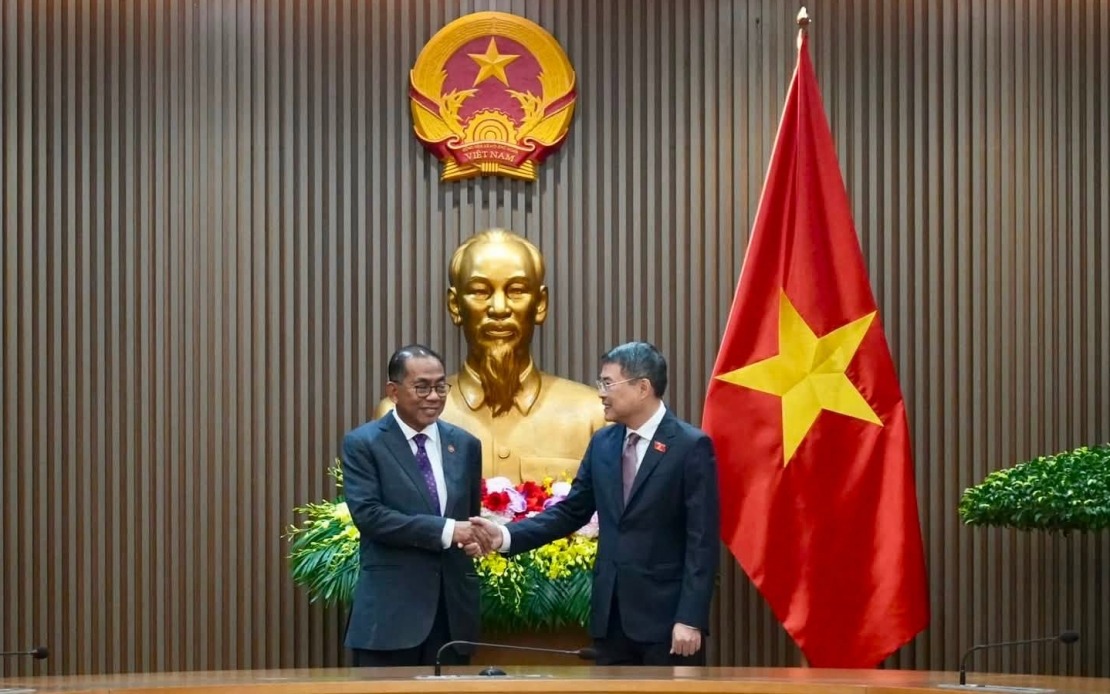
Malaysia and Vietnam have committed to significantly deepening their defence partnership, with plans to broaden cooperation across maritime security, technological advancement and the defence industrial base. Defence Minister Datuk Seri Mohamed Khaled Nordin outlined the expanded agenda following high-level discussions with Vietnamese Prime Minister Lê Minh Hưng during an official visit to Hanoi, signalling the growing strategic importance of bilateral military ties in Southeast Asia's rapidly evolving security landscape.
The two nations regard each other as trusted and dependable partners within the defence sphere, a relationship that has matured through sustained engagement and mutual respect for shared principles. This foundation of confidence has enabled both countries to pursue increasingly sophisticated cooperation mechanisms that extend beyond traditional defence exchanges to encompass the full spectrum of modern security challenges. The personal meeting between senior defence and government officials underscores the political commitment at the highest levels to advancing this partnership during a period of significant geopolitical flux.
Central to the renewed defence partnership is the continued implementation of the 2023 Memorandum of Understanding on Defence Cooperation, which provides the strategic framework and institutional scaffolding for bilateral military initiatives. This framework has proven sufficiently robust to accommodate expanding cooperation while maintaining flexibility to address emerging security concerns that were not anticipated when the original agreement was negotiated. The 2023 MoU essentially serves as a living document that evolves to reflect the changing threat environment and technological possibilities available to both militaries.
Maritime security cooperation represents a particularly significant dimension of the renewed partnership, reflecting both nations' vital interests in ensuring freedom of navigation and security in regional waterways. Malaysia and Vietnam both face challenges related to maritime territorial claims, transnational maritime crime and the protection of vital sea lanes through which substantial regional trade flows. Enhanced cooperation in this sphere would enable greater intelligence sharing, coordinated patrols and joint exercises that strengthen overall maritime domain awareness across Southeast Asia.
Capability development and technology transfer form another pillar of the expanded defence relationship. Both nations recognise that investing in military modernisation and technological sophistication is essential for maintaining credible deterrents and responding effectively to contemporary security threats. By collaborating on capability enhancement, Malaysia and Vietnam can optimise resource allocation, share expertise and potentially develop joint solutions to common defence requirements that would be more cost-effective than pursuing parallel modernisation programmes independently.
The defence industrial cooperation component holds particular significance for regional economic and security interests. A strengthened defence industry partnership between Malaysia and Vietnam could facilitate knowledge transfer, support joint production initiatives and create opportunities for domestic defence contractors to develop competitive capabilities. This dimension of cooperation also promotes self-sufficiency in critical defence systems and reduces dependency on external suppliers for essential military equipment and technology.
The two countries share a sophisticated understanding of the complex security environment confronting Southeast Asia and the broader Indo-Pacific region. Both governments recognise that traditional military threats now coexist with unconventional challenges that demand innovative responses and integrated approaches. Grey zone activities, which operate below the threshold of conventional armed conflict, present particular challenges for smaller nations seeking to protect sovereignty without escalating tensions or triggering destabilising military responses.
Cyber threats and digital warfare represent increasingly sophisticated dimensions of modern security competition that neither Malaysia nor Vietnam can adequately address through isolated national efforts. Collaborative approaches to cyber defence, intelligence sharing regarding emerging threats and joint capacity-building initiatives enable both nations to develop greater resilience against attacks on critical infrastructure and government systems. The recognition of cyber threats as a shared strategic concern reflects the evolving nature of contemporary conflict.
Artificial intelligence has emerged as a transformative technology with profound implications for military capabilities and strategic competition. Both countries must anticipate and prepare for military applications of AI systems that will reshape warfare, decision-making processes and the nature of deterrence. Cooperation in understanding AI's strategic implications, establishing responsible use frameworks and developing defensive measures against AI-enabled threats serves both nations' long-term security interests.
Cognitive warfare, the manipulation of information and perception to influence decision-making at strategic and operational levels, poses serious challenges to national security and democratic institutions. Malaysia and Vietnam, both vulnerable to foreign information manipulation and disinformation campaigns, benefit from sharing experiences in identifying and countering cognitive warfare techniques. This cooperation contributes to broader regional resilience against external influence operations.
Supply chain disruptions have gained prominence as security concerns following recent global shocks and geopolitical tensions. Defence cooperation between Malaysia and Vietnam can support development of more resilient regional supply chains for critical defence components and technologies. By diversifying sourcing arrangements and building redundancy into supply networks, both nations can reduce vulnerability to external disruption and maintain operational effectiveness during periods of international instability.
Both governments explicitly affirm their commitment to ASEAN principles, including the Southeast Asian bloc's emphasis on dialogue, diplomacy and non-intervention in internal affairs as foundational mechanisms for maintaining regional peace and stability. This shared commitment to ASEAN norms and dispute resolution through peaceful means reflects a fundamental alignment in strategic philosophy that extends beyond bilateral defence relations to encompass broader regional architecture and principles.
The expanded Malaysia-Vietnam defence partnership serves as a model for enhanced ASEAN cooperation in addressing collective security challenges. By demonstrating that capable regional countries can deepen defence ties while respecting international norms and ASEAN principles, Malaysia and Vietnam provide practical evidence that enhanced military cooperation need not be destabilising or provocative. This partnership contributes to building the collective regional resilience that ASEAN as an institution seeks to develop in confronting an increasingly complex security environment characterised by great power competition and evolving transnational threats.

