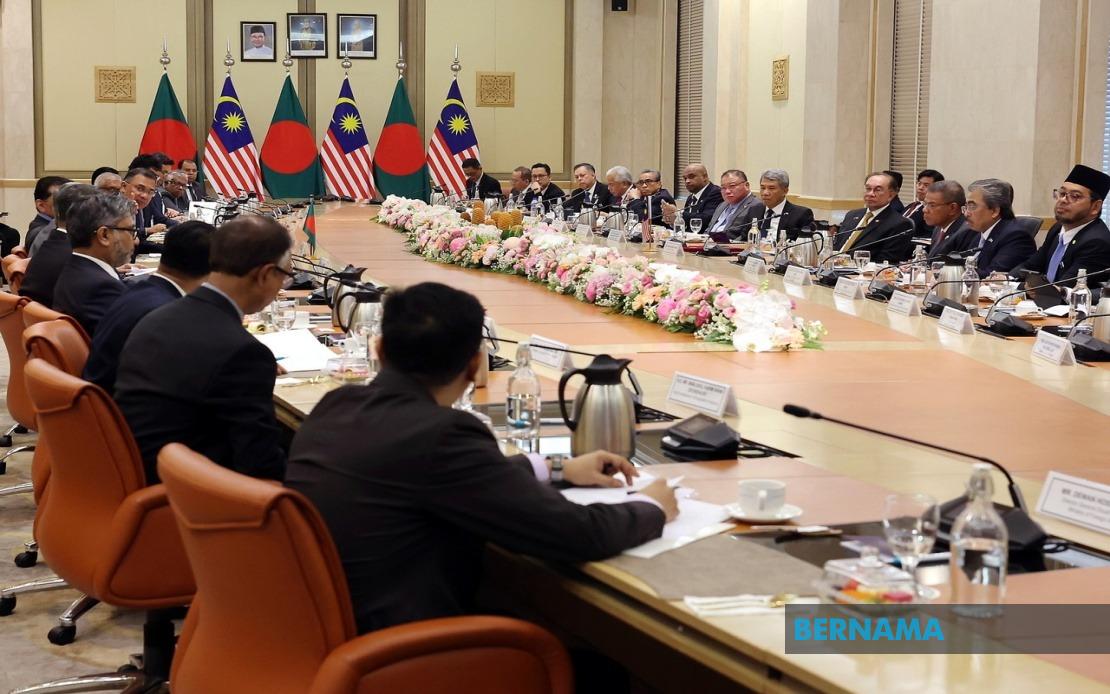
Prime Minister Datuk Seri Anwar Ibrahim has signalled a strategic shift in Malaysia's engagement with Bangladesh, moving the relationship beyond conventional economic pillars toward cutting-edge technology sectors that will define regional competitiveness in the coming decades. The announcement came during a bilateral meeting with visiting Bangladesh Prime Minister Tarique Rahman at Putrajaya on June 22, where both leaders acknowledged that their nations must invest in new domains to remain relevant in rapidly evolving global markets.
The scope of expanded cooperation encompasses artificial intelligence, renewable and conventional energy infrastructure, semiconductor manufacturing, digital economy initiatives, and advanced manufacturing capabilities. These sectors represent a deliberate pivot toward knowledge-intensive industries that promise higher value creation and technological self-sufficiency for both nations. By venturing into these domains, Malaysia and Bangladesh position themselves to capture opportunities within supply chains that are actively diversifying away from traditional concentration points, a shift accelerated by geopolitical tensions and the need for resilience.
Anwar emphasised that while investment capital remains essential to bilateral relations, the partnership must transcend the historical focus on agriculture and natural resource extraction. Agriculture will retain strategic importance, particularly given demographic pressures and food security considerations across South and Southeast Asia, but cannot serve as the exclusive foundation for deepening ties. The prime minister's framing reflects broader recognition within Malaysian policymaking circles that sustained economic growth depends on technological innovation and industrial upgrading rather than resource-dependent models.
Artificial intelligence represents perhaps the most transformative opportunity within this expanded framework. Both nations face similar challenges in deploying AI across governance, healthcare, financial services, and manufacturing sectors. Bangladesh's substantial technical talent pool and Malaysia's established digital infrastructure and regulatory frameworks could be leveraged synergistically. Collaborative research initiatives, talent exchange programmes, and joint development of AI applications suited to South and Southeast Asian contexts would create mutual advantages while reducing dependence on Western-dominated technology ecosystems.
The semiconductor sector holds particular significance given current global supply chain vulnerabilities. Malaysia already maintains considerable strength in semiconductor assembly, testing, and packaging operations, hosting major international manufacturers alongside a growing base of local companies. Bangladesh, with its manufacturing capabilities and labour advantages, could complement Malaysian operations in specific segments while developing indigenous expertise. Joint ventures and technology transfer arrangements could position the region as a more self-reliant semiconductor hub, reducing vulnerability to disruptions centred on Taiwan and South Korea.
Energy cooperation takes on added urgency as both nations pursue decarbonisation commitments while managing rising electricity demand. Malaysia's experience with liquefied natural gas infrastructure, renewable energy integration, and grid modernisation offers valuable knowledge for Bangladesh, which faces substantial challenges in expanding generation capacity and improving distribution efficiency. Collaborative projects in solar technology, wind power development, and energy storage could accelerate the transition toward sustainable energy systems while creating commercial opportunities for Malaysian technology providers and engineering firms.
The advanced manufacturing dimension reflects recognition that both countries can capture investment diverted from higher-cost jurisdictions. By developing complementary capabilities in precision manufacturing, electronics assembly, and specialised industrial production, Malaysia and Bangladesh could jointly market themselves to multinational corporations seeking diversified supply chain options. This cooperative approach contrasts with zero-sum competition and acknowledges that regional prosperity increases mutual benefits.
Formalisation of these ambitions proceeded through several instruments exchanged during the bilateral meeting. A Memorandum of Understanding on Cultural Cooperation acknowledges that deeper economic ties require parallel people-to-people engagement, knowledge sharing, and mutual understanding. Two Exchanges of Notes addressing counter-terrorism research collaboration and investment promotion demonstrate commitment to foundational institutional frameworks. These documents signal that both governments view the partnership as comprehensive rather than transactional.
Bangladesh's strategic importance to Malaysia extends beyond bilateral mathematics. As South Asia's most significant economy after India, Bangladesh increasingly influences regional trade dynamics, investment flows, and geopolitical alignments. A strengthened Malaysia-Bangladesh relationship reinforces ASEAN's connectivity with South Asia, supporting India-ASEAN integration frameworks and contributing to regional stability. For Bangladesh, access to Malaysian technological expertise and capital markets provides pathways toward industrial upgrading and export diversification.
The timing reflects broader regional dynamics. Chinese investments in both countries have drawn scrutiny regarding debt sustainability and strategic autonomy, creating space for Malaysia to position itself as a more balanced technology and investment partner. Japan and South Korea, observing these developments, may see opportunities for trilateral cooperation on semiconductors and advanced manufacturing that leverage Malaysian-Bangladeshi complementarities.
Implementing this expanded cooperation framework requires concrete mechanisms beyond rhetorical commitment. Joint working groups on AI standards and applications, semiconductor research consortia, energy technology partnerships, and manufacturing investment task forces must translate political consensus into operational reality. Educational exchange programmes and visa facilitation for technical professionals will accelerate knowledge transfer and relationship deepening.
The initiative also invites participation from Malaysian private sector actors, particularly technology companies, energy firms, and manufacturing enterprises seeking growth opportunities. Government-sponsored trade missions, investment forums, and business matching events can translate policy frameworks into commercial transactions that generate employment and innovation across both economies.
For Malaysian policymakers, this partnership represents calculated diversification of regional engagement, balancing ties with ASEAN colleagues, developed nations, and emerging economies across South Asia. Success in deepening cooperation with Bangladesh may provide a template for analogous relationships with other regional partners, multiplying Malaysia's influence while expanding opportunities for Malaysian businesses and innovators across multiple frontier sectors.