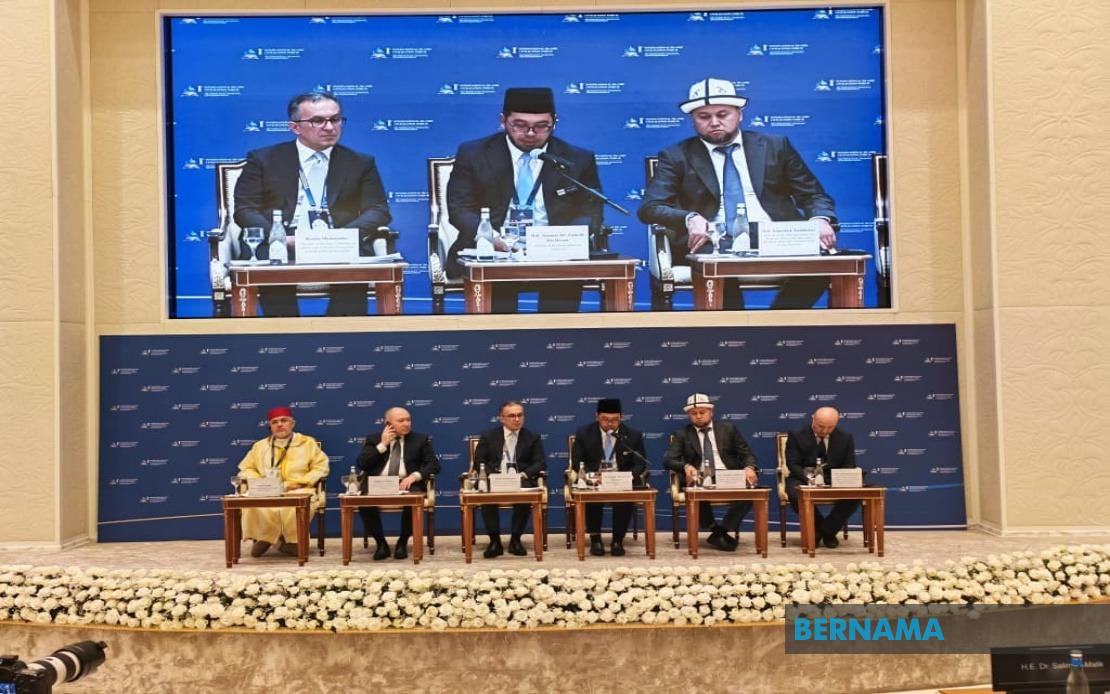
Malaysia has urged the Muslim world to harness the tragedy unfolding in Gaza as a catalyst for civilisational renewal, emphasising the need to uphold foundational values of justice, compassion, and human dignity on the global stage. Speaking at the International Islamic Civilisation Forum in Tashkent, Uzbekistan, Minister in the Prime Minister's Department (Religious Affairs) Datuk Dr Zulkifli Hasan contended that the extensive civilian suffering in Gaza represents not merely a regional crisis but a pivotal moment for the Islamic world to reassert its moral authority. The scale of humanitarian devastation, he argued, has exposed inconsistencies in how international law is applied across different geopolitical contexts, demanding introspection from both Muslim-majority nations and the broader international community.
Zulkifli framed the moment as an opportunity for the Islamic civilisation to transcend reactive posturing and instead become a proactive force in global affairs. Rather than allowing external pressures and developments to define Muslim responses, he called for the Islamic world to cultivate an independent strategic vision capable of contributing substantively to international peace and ethical governance. This shift in thinking, he suggested, represents a fundamental reorientation away from the habit of responding to crises on others' terms towards originating initiatives that reflect Islamic principles and contemporary realities. The minister argued that such agency is essential for regaining civilisational confidence and relevance in an era of unprecedented geopolitical turbulence.
The question animating his remarks centred on what role Islamic civilisation should occupy in determining humanity's trajectory forward. Zulkifli rejected the notion that Muslims should content themselves with celebrating historical achievements, noting that while Islamic societies once dominated scientific, architectural, and philosophical endeavours, dwelling on past glory without translating it into present impact diminishes civilisational vitality. He suggested that today's world desperately requires not only technological and economic advancement but also moral direction, principled governance, and value systems rooted in enduring ethical traditions—precisely the domains where Islamic thought possesses considerable resources.
The minister outlined how Islamic civilisation's historical strength derived from multiple sources beyond material grandeur. He pointed to the creation of just social structures, the cultivation of leaders guided by ethical principle rather than mere expedience, the consistent elevation of human dignity across diverse populations, and the conception of knowledge acquisition as simultaneously a service to the Divine and to humanity. These dimensions, he contended, remain profoundly relevant to contemporary challenges where technological innovation has outpaced moral reflection and where economic systems often prioritise extraction over stewardship. A genuine revival of Islamic civilisation must therefore focus on intellectual regeneration grounded in moral commitment and shared responsibility rooted in enduring religious principles.
Zulkifli proposed that such renewal must fundamentally reintegrate ethics into governance structures, restore wisdom as the complement to technical knowledge, and reorient development towards purposes aligned with human flourishing rather than narrow accumulation. Historical precedent supports such an approach. The medieval Islamic world was distinguished by its intellectual openness and willingness to absorb knowledge from diverse civilisations including Greek, Persian, Indian, and Chinese traditions. Rather than viewing such borrowing as weakness, scholars understood it as enrichment. The minister suggested contemporary Muslim societies should embrace this tradition of cosmopolitan intellectual engagement whilst maintaining ethical guardrails, particularly regarding transformative technologies.
With artificial intelligence, biotechnology, and quantum computing reshaping human possibilities, Zulkifli urged Muslim-majority nations to become active architects rather than passive consumers of the ethical frameworks governing these innovations. He proposed that the Islamic world could uniquely contribute perspectives on how technological advancement might enhance rather than diminish human dignity, how innovation should serve collective welfare, and how development must harmonise with environmental stewardship. Such positioning would require Muslims to move beyond mere ethical critique of Western technological trajectories and instead propose alternative models grounded in Islamic epistemology and values.
Environmental responsibility emerged as another critical dimension of civilisational renewal. Drawing on Islamic teachings regarding humanity's role as stewards of creation, Zulkifli advocated for Muslims to become global leaders in sustainable development and ecological conservation. This positioning connects directly to Southeast Asian and Malaysian interests, where environmental degradation from deforestation, agricultural expansion, and industrial pollution increasingly threatens regional stability and prosperity. Muslim-majority nations in Asia could leverage Islamic principles of guardianship to champion environmental frameworks that competing secular and ideological approaches might struggle to justify culturally.
Crucially, Zulkifli framed Islamic civilisational renewal not as rivalry with other traditions but as an opportunity for Muslims to contribute their distinctive perspectives to shared human challenges. He cautioned against zero-sum thinking wherein Islamic advancement necessarily implies Western or other civilisational decline. Instead, he advocated dialogue, partnership, and mutual respect as mechanisms through which the Islamic world could engage constructively with partners across all religious and philosophical traditions. Malaysia itself exemplifies this approach through its multicultural society and its commitments to both Islamic governance and interfaith cooperation.
The minister highlighted bilateral potential between Malaysia and Uzbekistan as illustrative of broader possibilities for South-Central and Southeast Asian cooperation. Uzbekistan's distinguished legacy as a centre of Islamic scholarship complements Malaysia's contemporary experience in Islamic finance, Islamic governance within multicultural democracies, and peaceful coexistence among diverse communities. Together, these nations could function as bridges spanning Central Asia and Southeast Asia, leveraging their respective strengths to advance ethical innovation, knowledge production, and sustainable development benefiting the wider Muslim world. Such positioning would enhance both countries' regional influence whilst contributing to genuine alternatives to existing global development models.
Zulkifli's remarks reflect broader conversations within Malaysian diplomatic and intellectual circles regarding Islam's role in addressing 21st-century challenges. Rather than defensive postures emphasising historical grievances, his framing suggests Muslims possess agency in shaping systems, institutions, and frameworks governing emerging domains. For Malaysia specifically, this implies opportunities to position itself as a thought leader and practical exemplar of how Islamic principles inform contemporary governance, technological adoption, environmental stewardship, and interfaith relations. The Gaza crisis, tragic as it remains, becomes in Zulkifli's analysis not merely a symbol of Islamic victimhood but a clarion call for Muslims to translate civilisational values into global influence rooted in ethical leadership rather than geopolitical competition alone.

