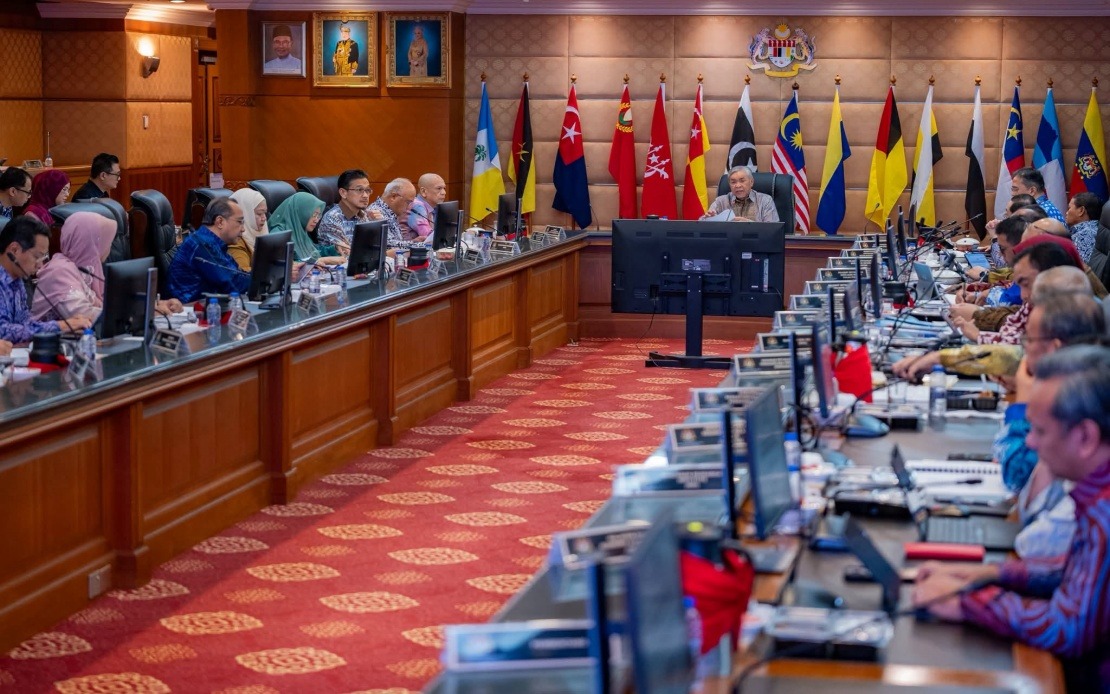
The Malaysian government has signalled a comprehensive rethink of how it tackles the country's persistent cost of living challenges, moving beyond traditional price-control measures to address systemic inefficiencies in production, distribution, and social safety nets. During the 18th Executive Committee meeting of the National Cost of Living Action Council (NACCOL) in Putrajaya on August 13, Deputy Prime Minister Datuk Seri Dr Ahmad Zahid Hamidi articulated a strategy that acknowledges the complexity of affordability issues facing ordinary Malaysians, insisting that meaningful intervention requires simultaneous attention to multiple sectors rather than isolated fixes.
The centrepiece of the council's deliberations was a detailed examination of the domestic white rice sector, an area of particular sensitivity given rice's foundational role in Malaysian households and agriculture's importance to rural communities. Rather than pursuing abrupt policy shifts that could destabilise both consumer wallets and farm viability, NACCOL is exploring a graduated transition framework anchored on subsidised rice supplies for vulnerable segments of the population. This measured approach reflects growing awareness that blanket policies often generate unintended consequences, harming precisely the groups they intend to protect while creating market distortions downstream.
Ahmad Zahid's framing of the cost of living problem reveals a sophisticated understanding of its interconnected nature. He underscored that supermarket shelf prices represent only the visible surface of a far more complex issue rooted in production economics, logistics infrastructure, and foundational access to necessities. This perspective carries particular relevance for Malaysia, where geographical disparities, import dependency, and structural agricultural challenges have long complicated efforts to stabilise food costs. The deputy premier stressed that government action must encompass not merely affordability of individual items but the entire ecosystem determining whether citizens can afford nutritious diets, quality healthcare, and quality education without financial strain.
Among the more innovative proposals emerging from the NACCOL session is the expansion of the Sumbangan Asas Rahmah (SARA) assistance programme to encompass fresh produce alongside existing cash allocations. Rather than simply boosting recipients' spending power, this initiative aims to steer direct support toward healthier consumption patterns, addressing the documented tendency for budget-constrained households to opt for calorie-dense processed foods. By integrating fresh fruits, vegetables, and lean proteins into the aid framework, the government seeks to break a cycle wherein cost pressures inadvertently push lower-income families toward nutritionally suboptimal choices with long-term health consequences.
The government's acknowledgement of external pressures on production costs signals a candid assessment of constraint within its control. Global geopolitical volatility, particularly ongoing instability in West Asia, has complicated commodity pricing and supply certainty. Simultaneously, increasingly stringent import compliance regimes impose administrative and financial burdens on agricultural producers and food importers, raising operational costs that ultimately filter through to consumer prices. Ahmad Zahid's emphasis on continuous monitoring of these factors suggests that future policy adjustments will increasingly incorporate international dynamics rather than treating the cost of living challenge as purely domestic territory.
Subsidy rationalisation emerged as another acknowledged headwind for agricultural producers. The government's broader fiscal strategy involves recalibrating subsidy architecture to target genuine need more precisely, yet this necessary reorientation imposes transition costs on farming communities already grappling with thin margins. NACCOL's focus on refining targeted assistance mechanisms for farmers and fishermen indicates recognition that subsidy reform requires complementary support structures to prevent rural livelihoods from collapsing during adjustment periods. This represents a departure from earlier approaches where subsidy cuts proceeded with minimal safety-net reinforcement.
The healthcare dimension of the cost of living strategy introduces a different challenge altogether. The RESET initiative, comprising eleven discrete interventions, attempts to moderate private sector healthcare pricing while simultaneously expanding public system capacity and treatment options. This dual approach acknowledges that Malaysia's bifurcated healthcare landscape creates affordability crises for middle-income households unable to access public facilities yet unable to comfortably afford private care. By restraining private-sector cost escalation whilst improving public provision, the government aims to prevent healthcare expenses from consuming an unsustainable proportion of household budgets.
Education financing receives parallel attention, with government analysis revealing that 62,937 Form Six and university students accessed tertiary education aid totalling RM589.6 million during the previous year. Ahmad Zahid's insistence on maintaining education affordability carries particular weight in Malaysia's context, where tertiary qualification premiums are significant yet increasingly necessary for labour market competitiveness. The identification of thirteen separate aid schemes suggests that accumulated support mechanisms may suffer from fragmentation and accessibility barriers, implying that future improvements might involve streamlining and simplification alongside funding augmentation.
The Cost of Living Action Plan 2030 represents an attempt to institutionalise the integrated, multi-sector approach evident in NACCOL's deliberations. Rather than responding to affordability crises through episodic interventions, the plan establishes a framework for coordinated action across rice production, healthcare access, educational financing, and social protection. This architecture suggests that the government recognises cost of living pressures as a systemic challenge requiring systemic solutions rather than patchwork responses.
For Malaysian households and regional observers, these developments signal a modulation in how Kuala Lumpur approaches social-economic management. The government appears to be transitioning from crisis-driven reactivity toward anticipatory policy design informed by data-driven assessment of interconnected vulnerabilities. Whether implementation matches ambition remains to be seen, particularly given the fiscal constraints and bureaucratic coordination challenges inherent in executing multisector programmes. Nevertheless, the intellectual framework articulated by Ahmad Zahid and NACCOL suggests that future cost of living interventions will become increasingly sophisticated, though potentially more difficult to execute than simpler, more isolated measures.

