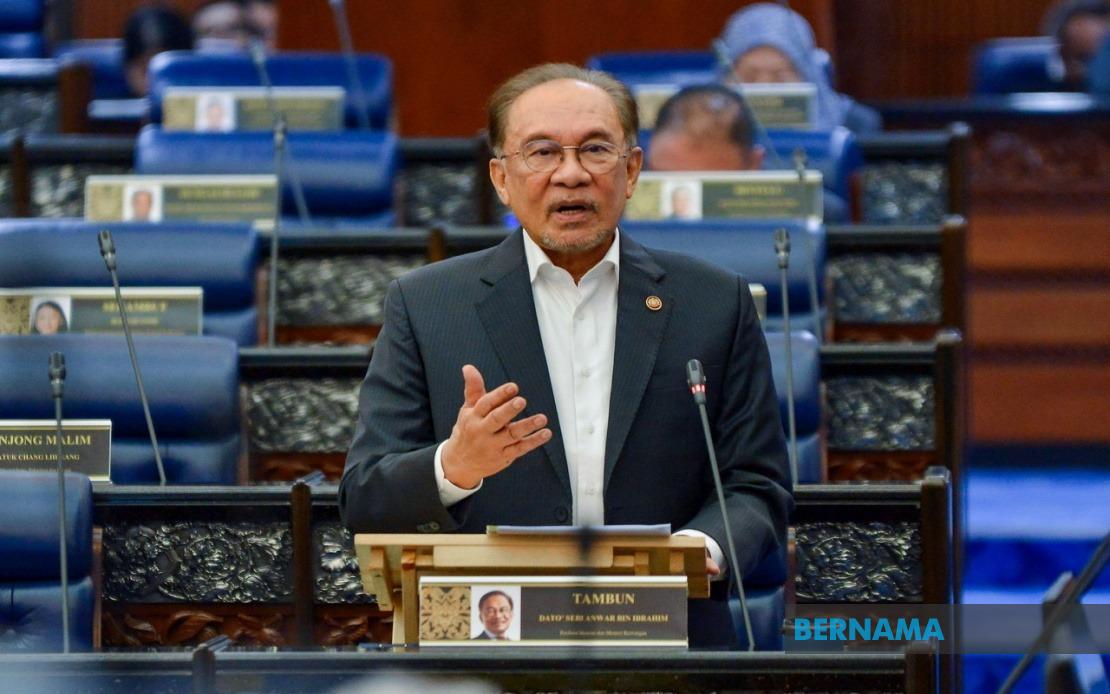
Prime Minister Datuk Seri Anwar Ibrahim has emphasised that Malaysia will persist in using international law and bilateral dialogue as its preferred tools for resolving maritime boundary disputes with neighbouring states, drawing a firm line against confrontational approaches in one of the world's most strategically contested waters. Speaking in the Dewan Rakyat, Anwar underscored that the 1982 United Nations Convention on the Law of the Sea remains the cornerstone of Malaysia's maritime dispute strategy, offering what he characterised as a clear and binding legal architecture that all parties can reference during sensitive negotiations.
While acknowledging the International Maritime Organization's role in shipping and maritime security matters, Anwar clarified that even the IMO operates within the UNCLOS framework, meaning there is no separate institutional avenue outside the convention that would alter Malaysia's negotiating position. This statement carries particular weight given regional anxieties about the Straits of Malacca, through which roughly a quarter of global maritime traffic passes. Malaysia's stance suggests the government believes existing legal instruments, rather than specialist agencies, are the appropriate venue for managing the waterway's security and governance concerns.
The Prime Minister recognised a fundamental challenge underlying Southeast Asian maritime governance: while UNCLOS provides the legal bedrock, its provisions are sufficiently broad that different countries frequently arrive at conflicting interpretations. This interpretive gap has proven particularly troublesome in the South China Sea, where competing claims overlap and historical arguments diverge sharply. Anwar's candour on this point reflects Malaysia's pragmatic understanding that law alone cannot bridge geopolitical divides without political will from all stakeholders.
On the South China Sea specifically, Anwar highlighted the ongoing effort by ASEAN member states and China to finalise a Code of Conduct intended to reduce tensions and prevent miscalculation. ASEAN has collectively agreed to anchor these negotiations in UNCLOS principles while working collaboratively with Beijing to establish binding rules of behaviour. However, Anwar noted that the Philippines has complicated these discussions through its position on the Sabah issue, an unresolved territorial matter with Malaysia that predates and overlaps with broader regional disputes. The acknowledgment reveals how historical bilateral tensions can become entangled with multilateral frameworks, slowing collective progress.
Malaysia's diplomatic persistence shines through Anwar's description of ASEAN's negotiating approach. Rather than viewing deadlock as failure, the government treats pauses in talks as strategic intervals before returning to the table. This patience reflects a regional understanding that maritime disputes, involving sovereignty and economic rights, cannot be rushed. The approach has allowed ASEAN to maintain unity on certain principles while avoiding premature confrontation that could fracture the bloc.
Anwar drew on Malaysia's bilateral experience to illustrate how economic cooperation can flourish even where sovereignty claims remain unresolved. The Joint Development Authority framework established with Vietnam serves as the practical example: both nations continue to dispute certain maritime zones, yet they have chosen collaborative resource management and benefit-sharing within contested areas rather than perpetual standoff. This model preserves each country's legal position while generating mutual economic gain, a formula that appeals to Malaysia's pragmatic approach to maritime governance.
The Prime Minister's reference to Thailand as another partner in joint development arrangements reinforces Malaysia's track record of translating UNCLOS principles into workable economic arrangements. These bilateral successes suggest that the government views maritime disputes not as zero-sum contests but as complex problems admitting of partial solutions that accommodate competing claims. For Malaysian readers and policymakers in the region, this framing offers hope that even intractable disputes need not paralyse economic cooperation or invite military escalation.
Malaysia's maritime frontier is crowded with dispute overlaps. Anwar identified six neighbouring countries with whom boundary questions persist: Brunei, Thailand, Indonesia, Singapore, the Philippines, and China. This multiplicity underscores why Malaysia has institutionalised negotiation rather than adopting ad hoc responses to individual disputes. The consistency of approach across different bilateral relationships provides predictability and prevents one dispute from contaminating others, a critical advantage in maintaining regional stability.
Progress with Brunei represents a success story within Malaysia's maritime diplomacy. Boundary negotiations with Brunei have advanced significantly, leaving only a few outstanding areas—chiefly those involving the Sarawak government—still requiring resolution. This relative progress suggests that where bilateral relationships are less fraught with historical grievance, UNCLOS-based dialogue can advance methodically. Conversely, discussions with Indonesia, particularly regarding Sabah, remain more intricate because they involve consultation with state governments alongside federal authority, adding layers of domestic coordination to international negotiation.
Anwar's emphasis on state-level consultation in talks with Indonesia reflects Malaysia's federal constitutional structure, where certain maritime matters fall partially within state jurisdiction. This domestic dimension often escapes international observers but significantly shapes Malaysia's negotiating flexibility. By involving Sabah and Sarawak leadership directly, the federal government builds consensus at home, preventing internal fragmentation that adversaries might exploit. The approach also acknowledges that states bearing the proximity and economic consequences of disputed boundaries have legitimate voices in determining negotiating positions.
The Prime Minister's reaffirmation of diplomatic method, despite the obvious frustrations such an approach entails, signals Malaysia's conviction that regional stability depends on upholding legal frameworks and restraint rather than unilateral assertion of claims. For Malaysia's maritime industries, including shipping, fishing, and energy exploration, predictable dispute-resolution mechanisms matter greatly. Constant brinkmanship would introduce uncertainty that impedes investment and commerce, whereas rules-based negotiation, even when protracted, permits economic planning around managed territorial questions.
Looking forward, Malaysia's commitment to UNCLOS and patient diplomacy will be tested as great power competition in the South China Sea intensifies. The Code of Conduct negotiations with China and ASEAN partners remain critical to preventing incidents from escalating. Anwar's parliamentary remarks suggest that Malaysia will continue encouraging all parties to respect international law and pursue dialogue over confrontation, even when progress appears glacial. This stance positions Malaysia as a stabilising voice within ASEAN and a partner amenable to rules-based resolution rather than power politics.

