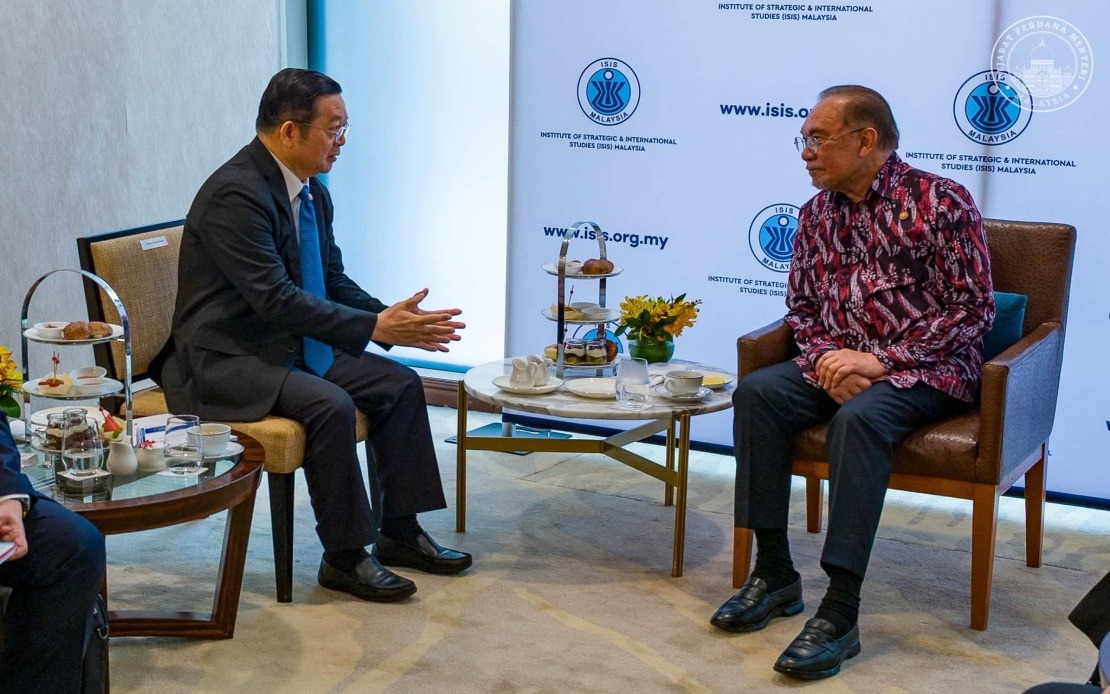
Malaysia remains committed to advancing ASEAN's institutional strength and regional cohesion, Prime Minister Datuk Seri Anwar Ibrahim declared this week following substantive conversations with the bloc's top official. The statement underscores Kuala Lumpur's strategic positioning as the association navigates an increasingly turbulent international environment marked by great power competition, economic volatility, and transnational challenges that demand coordinated regional responses.
Anwar's remarks came during a formal engagement with ASEAN Secretary-General Dr Kao Kim Hourn, who visited Malaysia after the Prime Minister delivered the keynote address at the 39th Asia-Pacific Roundtable, a prestigious gathering that convenes policymakers, academics, and security specialists to examine pressing regional and global questions. The timing of this high-level interaction signals Malaysia's intention to shape ASEAN's collective response to mounting external pressures while ensuring member states remain focused on shared prosperity and stability.
The discussion ranged across several critical dossiers that will define ASEAN's strategic posture in coming years. Myanmar's protracted political crisis, which has destabilized one of the bloc's founding members and created humanitarian and security spillovers, featured prominently in their exchange. Similarly, the South China Sea—where overlapping territorial claims, fishing rights disputes, and freedom of navigation concerns have long tested ASEAN unity—remains a focal point for regional dialogue and risk management. Both issues exemplify the internal and external pressures that strain consensus-building within the ten-member association.
Particularly significant was the discussion on artificial intelligence advancement and its implications for ASEAN economies and societies. As major technology powers compete for dominance in AI capabilities and standards-setting, Southeast Asian nations face a critical juncture in determining how they will govern, regulate, and harness these transformative technologies. Malaysia, as a developing nation with growing digital ambitions, has vested interest in ensuring ASEAN collectively shapes AI governance rather than merely adapting to frameworks imposed by external powers.
Timor-Leste's formal accession as ASEAN's newest member, completed in 2023, represents both an institutional achievement and a management challenge for the bloc. Anwar's reference to the "post-accession phase" suggests Malaysia recognizes the need for deliberate integration efforts to ensure the young nation benefits from ASEAN membership while the association harnesses Timor-Leste's strategic location and potential. This dimension speaks to ASEAN's eastward consolidation and its capacity to incorporate new members into its institutional fabric.
The mention of ASEAN Community Vision 2045 indicates sustained focus on the bloc's long-term development trajectory. This framework, adopted by member states, charts a course toward an ASEAN that is cohesive, competitive, and people-oriented. Implementation challenges are substantial, however, given disparities in development levels, institutional capacity, and political will among member states. Malaysia's emphasis on advancing this agenda suggests Kuala Lumpur views regional integration as essential to securing prosperity and influence in an environment where fragmentation would diminish collective bargaining power.
The West Asia conflict, which has reverberated through global supply chains, energy markets, and geopolitical alignments, has direct consequences for ASEAN. The region depends heavily on Middle Eastern oil and gas supplies, maintains significant trade ties with countries in the conflict zone, and hosts communities with diaspora connections to affected areas. Malaysia, with its significant Muslim population and historical engagement in Middle Eastern affairs, has particular interest in how the conflict's trajectory influences regional stability and development prospects.
Anwar's emphasis on ASEAN's core principles—unity, centrality, and close cooperation—reflects recognition that the bloc's legitimacy and effectiveness rest on adherence to these foundational commitments. Unity remains elusive given internal disagreements over Myanmar policy, South China Sea responses, and development priorities. Centrality, the principle that ASEAN should drive regional architecture rather than being subordinated to external powers, faces constant pressure from major powers seeking to expand their influence. Close cooperation requires institutional strengthening and political commitment that some member states struggle to maintain.
Malaysia's articulation of commitment carries weight given its historical role as ASEAN's founding member and its position as a moderate voice within the bloc. However, Kuala Lumpur itself faces challenges in balancing competing strategic interests. As an economy dependent on international trade, Malaysia cannot afford isolation; yet as a Muslim-majority nation with historical ties to multiple regional powers, it must navigate complex diplomatic terrain without appearing to favour any particular external actor.
The geopolitical and economic landscape confronting ASEAN has fundamentally shifted since the bloc's establishment in 1967. Cold War bipolarity has given way to multipolar competition involving established powers and rising ones, each seeking influence through economic integration, military presence, and ideological appeal. Technological disruption compounds traditional security concerns, while climate change and pandemic risks transcend conventional state boundaries. ASEAN's ability to maintain centrality and effectiveness requires constant adaptation without surrendering the principles that grant it legitimacy.
For Malaysian readers and policymakers, Anwar's statement reaffirms that regional cooperation remains central to national strategy. A weakened, fractious ASEAN would disadvantage Malaysia economically and diplomatically. Conversely, a cohesive ASEAN capable of speaking with one voice and managing internal differences constructively enhances Malaysia's security and prosperity. The challenge lies in translating rhetorical commitment into tangible collaborative outcomes across politically sensitive issues where member states hold divergent preferences and strategic calculations.

