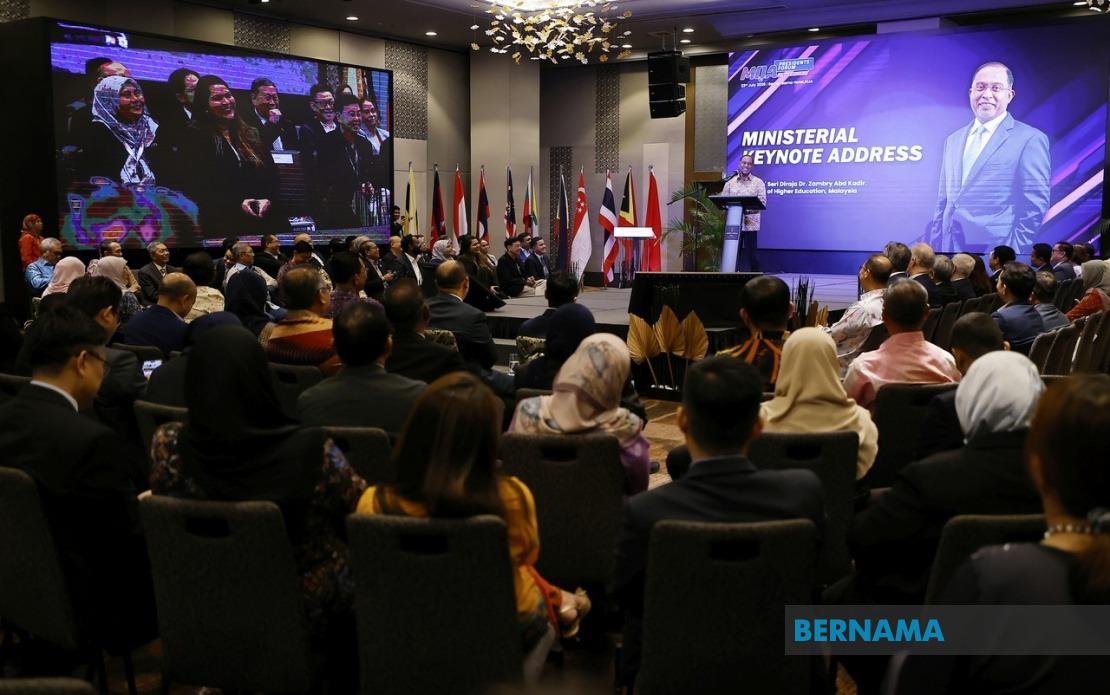
Higher Education Minister Datuk Seri Dr Zambry Abd Kadir has underscored the government's resolve to preserve academic freedom and cultivate an environment conducive to intellectual exchange, speaking at a public lecture in Putrajaya featuring Columbia University scholar Prof Dr Joseph A. Massad.
The minister's remarks signal a renewed focus on universities as platforms for diverse viewpoints to be examined through open, civil and responsible discussion. He stressed that institutions of higher learning must remain spaces where knowledge advances through dialogue that transcends geographical, disciplinary and ideological boundaries. This framing positions Malaysia's universities as integral to the nation's intellectual development and global standing.
Zambry emphasised a critical distinction between academic freedom and intellectual responsibility. The government's position recognises that liberty of thought carries corresponding obligations—scholars and students must engage in reasoned debate supported by evidence and conducted with respect for alternative perspectives. This nuanced stance addresses concerns that unfettered discourse might devolve into recklessness, while maintaining the principle that vigorous contestation of ideas strengthens rather than weakens academic institutions.
The minister highlighted Malaysia's plural and multicultural composition as a particular imperative for informed dialogue and scholarly collaboration. In societies where citizens hold fundamentally different religious, ethnic and political convictions, the capacity to engage productively across these divides becomes essential. Universities, as cradles of educated discourse, shoulder responsibility for modelling this engagement and producing graduates capable of navigating complex social questions with nuance and empathy.
Zambry's reference to contemporary challenges—artificial intelligence, social media proliferation and information fragmentation—contextualises why academic freedom matters urgently. As algorithms curate information and online platforms amplify polarisation, universities offer countervailing institutions where claims are interrogated, sources are scrutinised and conclusions are tested against rigorous standards. The minister's comments suggest the government views higher education as a bulwark against the erosion of informed public reasoning.
The invocation of Malaysia's historical embrace of disagreement without disunity—encapsulated in the phrase "we agree to disagree"—grounds the government's position in national values rather than external liberal prescriptions. This localisation of academic freedom discourse may ease tensions between those who view such principles as Western impositions and those advocating their universal applicability. By tethering intellectual freedom to Malaysian pluralism itself, the minister offers a framework where defending robust debate becomes defending Malaysian identity.
The Higher Education Ministry's stated commitment to welcoming international scholars reflects a strategic calculation: Malaysia's universities will only flourish—and attract top talent—if they remain open to global intellectual currents. The visit by Prof Massad, whose work on Middle Eastern studies and identity politics is internationally recognised, exemplifies this outreach. Institutional prestige and research excellence increasingly depend on hosting visiting luminaries and facilitating cross-border academic networks.
Zambry's emphasis on "civility, evidence and respect" navigates a delicate balance particular to Malaysia's political economy. The statement accommodates concerns that absolute freedom might be weaponised to advance partisan agendas, whilst rejecting the notion that academic discourse should be suppressed. Universities are called to maintain standards of intellectual rigour that distinguish legitimate scholarship from propaganda masquerading as analysis.
The minister's remarks also carry implications for the higher education sector's autonomy and funding. By positioning universities as essential to national development and social cohesion rather than as sources of instability, the government may be signalling willingness to grant institutions greater latitude in curriculum design, student organising and faculty recruitment. Conversely, the emphasis on "responsibility" accompanying freedom suggests expectations that academics will exercise self-regulation and avoid deliberately provocative positions lacking scholarly merit.
For Malaysian students and early-career researchers, the minister's statement offers some reassurance that intellectual exploration remains possible—yet the caveats around civility and responsibility inject an element of uncertainty about where institutional or governmental tolerance ends. This ambiguity is characteristic of many Southeast Asian democracies where formal commitments to freedom coexist with informal pressures toward conformity.
Regionally, Malaysia's positioning of itself as a defender of academic freedom while maintaining that freedom entails responsibility reflects broader tensions across Southeast Asia. Governments increasingly recognise universities' importance for innovation and competitiveness, yet remain wary of unfettered debate. Zambry's formulation attempts to square this circle, though whether the balance holds in practice—particularly when sensitive social or political issues arise—remains a crucial test of sincerity.
Looking forward, the government's commitment will be measured against concrete actions: whether controversial speakers are permitted on campuses, how student activism is treated, what curricular content is permitted, and whether academics face professional consequences for heterodox views. The minister's welcoming remarks establish a rhetorical baseline; the real trajectory of academic freedom in Malaysian universities will depend on how this principle is defended when it becomes inconvenient or politically costly.

