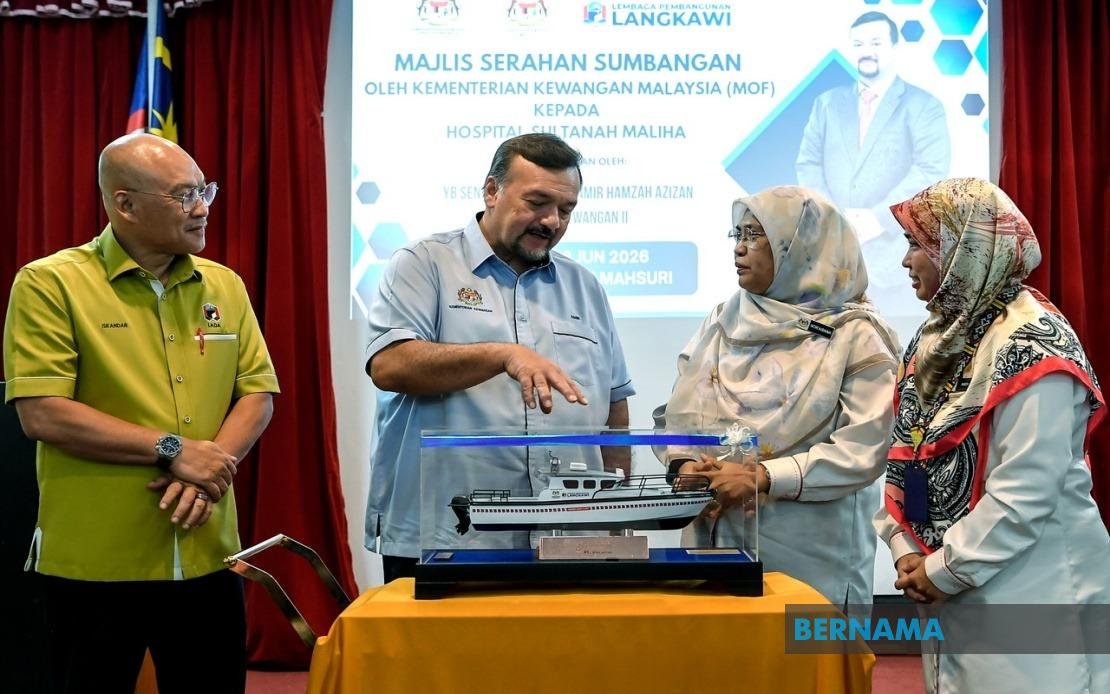
Malaysia's Ministry of Finance has committed RM5.5 million to establish a dedicated sea ambulance service serving Langkawi, marking a significant investment in the island's emergency healthcare infrastructure. The allocation covers both procurement of the vessel and initial operational expenses, with the service anticipated to commence operations in the first quarter of 2025. Finance Minister II Datuk Seri Amir Hamzah Azizan, who chairs the Langkawi Development Authority alongside his ministerial responsibilities, outlined the strategic importance of the initiative during a recent hospital visit in the archipelago.
The current system for patient transfers from Langkawi relies heavily on commercial passenger ferry services, a dependency that creates considerable vulnerability when emergency care requires rapid transport to mainland facilities. This arrangement has proven particularly problematic during periods when ferry operators reduce service frequency due to weather conditions or operational constraints. Patients requiring urgent specialist treatment face unpredictable delays that can compromise medical outcomes, a situation especially acute for serious cases requiring intensive care or surgical intervention. The dedicated sea ambulance addresses this critical bottleneck by providing round-the-clock capacity specifically optimised for medical emergencies.
Hospital Sultanah Maliha will operate the vessel, positioning the island's primary medical facility as the hub for coordinating patient transfers to major referral hospitals on the peninsula. This operational structure ensures clinical oversight remains within the healthcare system rather than depending on commercial transport providers unfamiliar with medical protocols. The ambulance is equipped to accommodate two stretchers simultaneously, allowing transport of multiple patients alongside twelve medical personnel who can maintain care standards during the journey. This capacity enables not only emergency transfers but also planned movements of recovering patients and those requiring ongoing specialist monitoring at mainland facilities.
Beyond logistical efficiency, the sea ambulance enhances dignity and safety in patient transport. The dedicated medical environment preserves patient privacy and comfort during what is often a stressful experience, maintaining appropriate clinical conditions rather than subjecting ill or injured individuals to the conditions of passenger ferries. For tourists visiting Langkawi's expanding resort infrastructure, the service provides assurance that serious medical events will not result in delays in accessing mainland tertiary care—an important consideration for insurance companies and travel operators assessing risk.
Concurrently, the Ministry of Finance has directed RM700,000 in healthcare equipment to Hospital Sultanah Maliha, reflecting broader recognition of the facility's capacity constraints. This equipment investment encompasses medical devices, information technology infrastructure, clinical furniture, transport vehicles, and security systems. The donation represents strategic support for enhancing the hospital's ability to manage the dual demands of a permanent resident population and the substantial tourist influx—Langkawi welcomes millions of international visitors annually alongside serving approximately 350,000 local residents.
A particular focus of the technology investment involves modernising the hospital's Electronic Medical Record system, aligned with wider Health Ministry digitalisation objectives. Rather than relying on paper-based documentation, Hospital Sultanah Maliha will implement portable computing stations enabling clinicians to record patient information in real time during ward rounds. This capability integrates with networked systems connecting the island facility to peninsula hospitals, accelerating information exchange between institutions and eliminating delays inherent in transferring physical records. Healthcare personnel involved in a patient's care can immediately access comprehensive medical history, current medications, and clinical notes, substantially improving treatment coordination during inter-hospital transfers.
The EMR system rollout represents a significant modernisation step for Langkawi's healthcare delivery, bringing the island facility closer to standards operational at larger peninsula hospitals. For patients transferred to referral institutions, the digitised record system eliminates the friction of reconciling different documentation systems and reduces risks of incomplete or contradictory information affecting clinical decisions. The technology also improves efficiency in routine operations—appointment scheduling, medication management, and billing—freeing clinical staff to focus on patient care rather than administrative tasks.
For Southeast Asia broadly, the Langkawi initiative illustrates how island nations and remote regions increasingly recognise dedicated medical transport as essential healthcare infrastructure rather than optional luxury. Tourism-dependent economies particularly benefit from demonstrating comprehensive emergency medical capability, as serious health incidents abroad significantly impact visitor confidence and travel decisions. The investment signals to both domestic and international insurance markets that Langkawi maintains serious-event response capacity comparable with metropolitan facilities, potentially broadening access to comprehensive travel insurance products.
The project also reflects Malaysia's broader healthcare decentralisation strategy, which seeks to enhance service quality beyond Kuala Lumpur and Selangor. By strengthening Langkawi's capacity to manage emergencies and provide initial specialist care before transfer, the government reduces pressure on overextended peninsular hospitals while improving health outcomes for island residents. The combined investment—RM5.5 million for transport capability and RM700,000 for equipment modernisation—totalling RM6.2 million demonstrates sustained commitment rather than ad-hoc intervention.
Operationally, the sea ambulance service requires sophisticated coordination with maritime authorities, weather monitoring systems, and mainland hospital capacity planning. Early operational experience will likely generate lessons applicable to other Malaysian island communities facing similar healthcare access challenges, particularly in Sabah and Sarawak where distances and geography create comparable obstacles. The Langkawi model may thus establish templates for nationwide healthcare infrastructure investment in underserved regions.
Implementation timelines for such projects traditionally prove ambitious, though the Finance Ministry's explicit commitment to early 2025 operation suggests serious preparation is underway. The service launch will require trained paramedical crew, maintenance protocols, dock facilities at both Langkawi and peninsula terminals, and integrated dispatching systems. These elements require coordination across multiple agencies, from Health Ministry operations to port authorities and maritime safety regulators. Successful execution would represent meaningful progress in Malaysia's healthcare accessibility agenda.

