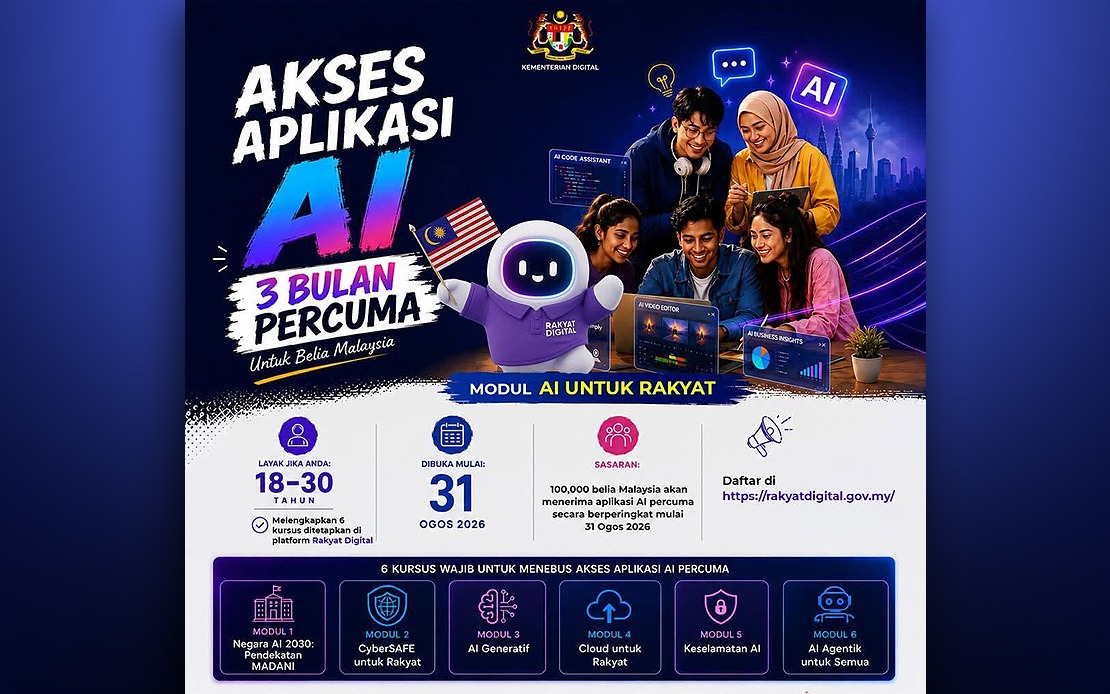
Malaysia's government has unveiled an ambitious digital initiative designed to democratize access to artificial intelligence technology among the country's youth. Announced by Prime Minister Datuk Seri Anwar Ibrahim during the 2026 National Day Premier Address celebrations in Putrajaya on August 30, the AI for the People programme represents a significant effort to ensure that young Malaysians can harness the potential of cutting-edge technology regardless of their economic circumstances. The scheme will run until 2027 with an ambitious target of training 100,000 participants aged between 18 and 30, reflecting the government's recognition that early exposure to AI tools is critical for developing the nation's digital competitiveness.
The programme operates through a structured learning pathway accessible via the Rakyat Digital portal at rakyatdigital.gov.my, where interested youths can register and begin their coursework immediately. Rather than offering tokenistic awareness campaigns, the initiative requires genuine commitment from participants, who must complete and pass six comprehensive modules covering different aspects of artificial intelligence and digital security. This educational foundation is essential, as it ensures that young Malaysians develop not merely superficial familiarity with AI but rather a meaningful understanding of both its capabilities and its responsible deployment in practical contexts.
The curriculum reflects a carefully considered blend of strategic national priorities and contemporary technology trends. The six mandatory modules—AI Nation 2030: The MADANI Approach, CYBERSAFE for the People, Generative AI, AI Security, Agentic AI for All, and Cloud for the People—establish a progression from macro-level policy understanding through to technical competency. The inclusion of AI Nation 2030: The MADANI Approach explicitly connects technology training to Malaysia's broader Madani framework, ensuring that participants grasp how AI development aligns with national socioeconomic objectives rather than viewing technology as divorced from policy context. Similarly, the prominence given to cybersecurity modules acknowledges the real risks accompanying digital transformation, an awareness particularly relevant in Southeast Asia where cyber threats are escalating rapidly.
Upon successfully completing all designated coursework, participants gain access to a three-month complimentary subscription to carefully curated AI applications and software. This tangible reward serves multiple purposes: it motivates completion of the entire programme rather than allowing dropout midway, it removes financial barriers that might otherwise prevent young Malaysians from experimenting with premium tools, and it facilitates immediate practical application of learned concepts. The initial slate of available tools demonstrates a strategic mix of local and international providers. Local innovation is represented through YTL AI Labs' IlmuChat platform, positioning Malaysian-developed solutions alongside global competitors like Alibaba's Wonderclip and MuleRun, as well as Google's Gemini Enterprise offering. This balanced approach signals that the government views both homegrown technological development and international partnerships as essential to Malaysia's AI ecosystem.
The ministry has indicated that additional AI software and tools will be progressively integrated into the programme, suggesting that the current offerings represent merely the foundation of what will eventually become a substantially richer learning and experimentation environment. This phased expansion strategy allows for iterative refinement based on participant feedback and emerging technological developments, ensuring that the programme remains current rather than becoming ossified. For Malaysia's digital development, this flexibility is particularly valuable given the extraordinarily rapid evolution of AI capabilities and applications.
Government officials have articulated clear rationales for the programme's design and scope. Digital Ministry Secretary-General Datuk Fabian Bigar emphasized that the initiative transcends mere theoretical knowledge acquisition, instead prioritizing genuine access to functional AI tools that young people can deploy for learning, creative endeavours, and enhanced productivity. This philosophy reflects international best practice in digital skills development, which increasingly recognizes that passive consumption of educational content produces far inferior outcomes compared to active experimentation with real-world applications. By coupling structured education with hands-on access to production-grade tools, Malaysia is creating conditions for genuine skill development rather than certificate-collecting.
The broader policy context reveals important strategic thinking about Malaysia's position in the global AI economy. The programme explicitly positions itself as a mechanism for realizing Malaysia's aspiration to become an inclusive AI nation by 2030, aligned with the Malaysia Digital 2030 strategic framework. This nomenclature is significant: rather than pursuing AI development solely for economic or security purposes, the government is framing technology advancement as fundamentally tied to inclusivity and broad-based benefit distribution. For a middle-income country navigating the complex transition toward high-income status, ensuring that technological gains diffuse throughout the population rather than concentrating among already-privileged groups represents a crucial strategic consideration.
The focus on young people aged 18 to 30 reflects sophisticated demographic targeting. This cohort possesses sufficient foundational digital literacy to engage meaningfully with AI concepts while remaining young enough to build extended careers leveraging these new competencies. Unlike older workers facing potential technological obsolescence, this group can potentially structure their entire professional trajectories around AI-native skillsets. Additionally, younger participants are more likely to become advocates within their communities and family networks, amplifying the programme's reach beyond formal participants through informal knowledge diffusion.
For Malaysian businesses and the broader Southeast Asian region, this initiative carries important implications. Companies across the region face growing pressure to develop AI capabilities but often lack sufficient talent pools with relevant expertise. By systematically building AI literacy among young Malaysians, the programme creates a potential talent supply that domestic enterprises can tap. Furthermore, regional companies seeking to establish or expand operations in Malaysia will benefit from the availability of workforce members with contemporary AI competencies, potentially making the country a more attractive investment destination.
The timing of this initiative deserves scrutiny in light of global AI development trajectories. Generative AI technologies have reached a critical inflection point where they are transitioning from specialized domains into everyday business processes and consumer applications. Countries that successfully build widespread AI literacy during this period establish strong advantages for subsequent waves of technological change. Malaysia's launch of the AI for the People programme during this window represents timely strategic positioning, though only if execution proves effective and participation rates approach the ambitious 100,000 target.
Challenges inevitably accompany such large-scale digital initiatives. Sustaining participant motivation across six modules while maintaining course quality represents a meaningful implementation hurdle. Digital infrastructure must reliably serve potentially hundreds of thousands of simultaneous users across the country. Curriculum developers must balance comprehensiveness with accessibility, ensuring that technical content remains digestible for participants with widely varying prior experience. The government's reliance on the Rakyat Digital portal and MyDIGITAL Corporation suggests that existing institutional frameworks will be leveraged, though their capacity for this expanded mission remains unproven.
Looking forward, the programme's success will depend substantially on how effectively participants translate acquired knowledge and tool familiarity into actual applications within their academic studies, employment, or entrepreneurial ventures. Structured follow-up mechanisms that track participant trajectories and facilitate ongoing engagement with AI applications could yield significantly higher returns than one-time training interventions. Additionally, establishing clear pathways through which high-performing participants can advance into specialized AI education or training opportunities could create productive pipeline effects.
The AI for the People initiative ultimately represents a significant commitment to ensuring that Malaysia's technological future remains widely shared rather than concentrated among elite technical specialists. By combining accessibility, practical tooling, and structured education, the government is attempting to build the broad social foundation necessary for genuinely inclusive AI development. Whether this ambitious vision translates into sustained behavioral change and meaningful economic opportunity for participants will become apparent only through careful monitoring of long-term outcomes.

