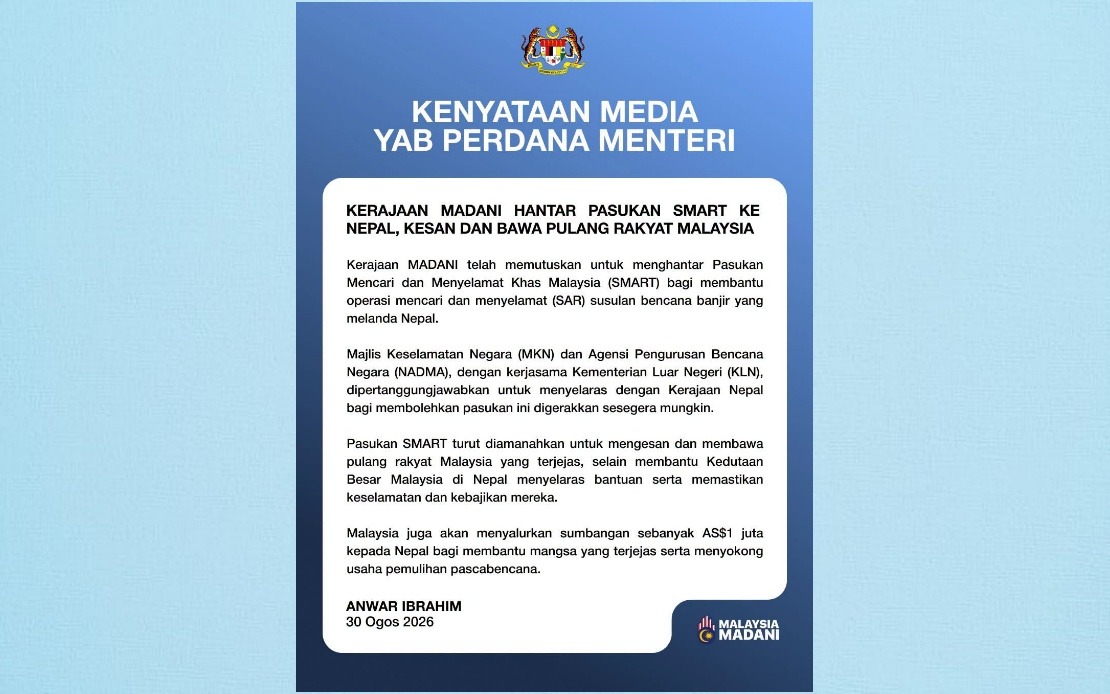
Malaysia has moved swiftly to mobilize international humanitarian support in response to the devastating floods that swept through Nepal's Rasuwa district on August 26, dispatching its specialized disaster response capabilities and pledging substantial financial assistance to the affected nation. Prime Minister Datuk Seri Anwar Ibrahim announced the government's commitment to sending the Special Malaysian Disaster Assistance and Rescue Team (SMART) to bolster Nepal's struggling search and rescue operations, marking a significant display of regional solidarity during a critical emergency window when the mountainous nation grapples with the humanitarian aftermath of catastrophic flooding and landslides.
The coordination of Malaysia's response has been entrusted to a multi-agency effort involving the National Security Council (MKN), the National Disaster Management Agency (NADMA), and the Foreign Ministry, reflecting the government's recognition of the complexity involved in orchestrating an effective cross-border relief operation. These institutions have been tasked with liaising directly with Nepalese authorities to expedite the deployment of the SMART team, ensuring minimal bureaucratic delays during a period when every hour matters for those trapped or missing in the disaster zone. The coordination framework emphasizes the institutional capacity that Malaysia has developed through previous disaster response experiences in the region.
Beyond the immediate search and rescue mission, the SMART team carries a dual mandate with particular significance for the Malaysian diaspora affected by the calamity. Team members will actively work to locate and repatriate Malaysian nationals who have been impacted by the disaster, providing direct assistance to individuals separated from their support networks and potentially facing severe hardship in the aftermath of the flooding. This locating and welfare focus underscores Malaysia's commitment to protecting its citizens abroad, a responsibility that takes on heightened urgency when those individuals are scattered across a devastated landscape with compromised communications infrastructure.
The Malaysian Embassy in Nepal will benefit substantially from SMART team deployment, which will augment the embassy's capacity to coordinate wider humanitarian initiatives and manage the mounting welfare concerns of affected Malaysian nationals. Embassy staff, already stretched by the unprecedented surge in assistance requests and information inquiries, will gain critical operational support in distributing aid resources and maintaining contact with displaced Malaysians. The team's presence effectively multiplies the embassy's operational reach during a crisis when traditional diplomatic functions must expand dramatically to encompass emergency humanitarian coordination.
The financial commitment of US$1 million represents a meaningful contribution tailored specifically to Nepal's immediate and medium-term recovery requirements. This funding will address the pressing humanitarian needs of those directly impacted by the flooding and landslides, including provisions for temporary shelter, clean water, medical care, and essential supplies for displaced populations. The allocation also acknowledges the longer-term reconstruction challenges that Nepal will face, with resources designated for post-disaster recovery initiatives that extend beyond emergency response into infrastructure rehabilitation and community restoration efforts.
The situation underscoring this response remains dire, with official Nepalese authorities reporting widespread destruction across Rasuwa district and surrounding regions. However, the Foreign Ministry's confirmation that 55 Malaysians remain uncontactable has elevated the crisis's significance within Malaysia's foreign policy agenda, converting an international tragedy into a matter with direct implications for Malaysian families anxiously seeking news of their relatives. The uncontactable status does not necessarily indicate confirmed fatalities but rather reflects the profound communications and transportation disruptions that persist across the disaster zone, where entire communities remain isolated from broader information networks.
Nepal's vulnerability to such catastrophic events reflects its geographical position within the Himalayan terrain, where monsoon systems and topographical conditions create conditions for severe flash flooding and landslide activity. The August 26 disaster represents the type of hazard that Nepal confronts with painful regularity, yet the scale and intensity of individual events can still overwhelm even experienced disaster management frameworks. Regional observers note that climate patterns are intensifying such events, making cross-border disaster cooperation increasingly essential for South Asian nations seeking to manage escalating humanitarian challenges.
Malaysia's rapid deployment response demonstrates the institutional relationships that Southeast Asian nations have cultivated through the ASEAN framework and bilateral partnerships, enabling coordinated action when regional crises emerge. The government's decision to mobilize resources within hours of confirmed impact reflects established protocols and mutual understanding regarding humanitarian obligations among regional neighbors. This responsiveness carries diplomatic significance beyond immediate aid delivery, reinforcing Malaysia's positioning as a reliable partner in regional stability and humanitarian concerns.
The SMART team's composition and operational history provide confidence regarding deployment effectiveness, as the unit has gained experience through previous regional emergencies and disaster scenarios. Team members possess specialized training in search and rescue operations within challenging mountainous terrain, alongside medical and psychological support capabilities that prove invaluable in post-disaster environments. Their deployment bridges Malaysia's technical expertise with Nepal's ground-level knowledge of local conditions, creating a collaborative framework optimized for operational efficiency under extremely difficult circumstances.
For Malaysian citizens currently in Nepal or whose relatives remain in the affected region, the government announcement provides reassurance that institutional mechanisms exist to prioritize their safety and welfare. Families anxiously tracking news coverage and awaiting information can engage with embassy resources and rely on structured search protocols coordinated through the SMART deployment. The visible commitment of senior government officials, including the Prime Minister's personal statement, signals to both Malaysian nationals and international observers that the government treats this crisis with appropriate seriousness and urgency.
The broader implications of Malaysia's response extend to regional expectations regarding humanitarian cooperation and mutual aid during transnational emergencies. By deploying specialized resources and committing financial support, Malaysia establishes benchmarks for how developed Southeast Asian economies contribute to crisis management in neighboring countries facing natural disasters. This approach reinforces networks of reciprocal assistance that strengthen overall regional resilience and position ASEAN nations as collaborative actors in managing shared environmental and humanitarian vulnerabilities that transcend conventional borders.

