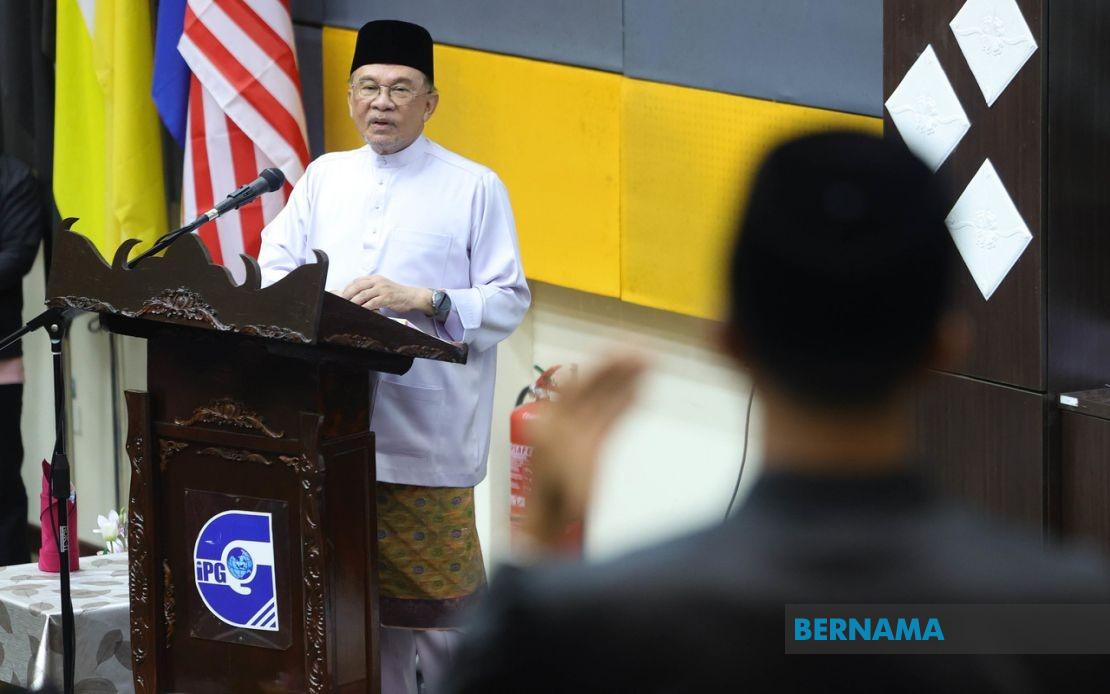
Malaysia's education system stands at a critical juncture where it must fundamentally reshape how it prepares teachers for the demands of a technology-driven future, Prime Minister Datuk Seri Anwar Ibrahim declared at a national education forum in Nilai. Speaking with characteristic emphasis on balanced progress, Anwar underscored that the country cannot afford to lag behind in adopting transformative technologies such as artificial intelligence and advanced scientific disciplines, yet must simultaneously ensure that educators and learners remain anchored to core values that define a cohesive society.
The challenge Malaysia faces is particularly acute given the pace at which technological innovation is reshaping workforces and skill requirements across the globe. Traditional curricula and pedagogical approaches, however well-established, no longer suffice in an environment where the tools and knowledge domains of today may become obsolete within years. Anwar's assertion that education systems must remain dynamic rather than static reflects a pragmatic recognition that static approaches to teacher development will produce graduates unprepared for the realities they will encounter. This is not merely an abstract concern for Malaysia, which aspires to compete within regional and global knowledge economies where technical expertise in STEM fields—particularly emerging domains like artificial intelligence, data science, and advanced engineering—has become increasingly valuable.
Yet the Prime Minister's framing reveals a deeper concern that extends beyond mere technical competence. His invocation of the principle to "reach for the skies while keeping our roots on the ground" encapsulates a philosophy that progress need not come at the expense of moral and cultural foundations. This formulation carries particular resonance in the Malaysian context, where rapid modernization and technological adoption have occasionally generated tensions with traditional values, religious observance, and cultural identity. Anwar's argument posits that these elements are not in opposition but rather mutually reinforcing—that teachers versed in cutting-edge technology and rooted in ethical principles are better equipped to guide students through complex choices about how technology should be deployed in society.
The emphasis on character development and ethical grounding among educators speaks to an understanding that teachers function not merely as transmitters of information but as moral exemplars and guides. In an age where students increasingly encounter fragmented information sources and competing narratives, particularly through digital platforms, the ethical orientation of educators becomes arguably more important rather than less. Anwar's point that mastery of modern technology alone is insufficient unless balanced by character development suggests that technical expertise divorced from moral judgment may even become dangerous—a concern that gains urgency as artificial intelligence and other powerful technologies raise increasingly complex ethical questions about privacy, bias, equity, and human agency.
A particularly striking dimension of Anwar's address was his explicit connection between educational values and social cohesion in a multiracial, multireligious society. He warned that education would fail its fundamental purpose if teachers or students were to become vectors for hatred directed at other communities. This concern, while not unique to Malaysia, takes on particular significance given the nation's history of communal tensions and the occasional emergence of rhetoric designed to deepen rather than bridge differences. By framing the cultivation of mutual understanding and respect as integral to educational quality rather than extraneous to it, Anwar positioned tolerance and interfaith comprehension as educational outcomes themselves, not merely as peripheral social goods.
The Prime Minister's argument that no nation, however powerful, can remain secure by sowing seeds of racial or religious hatred represents a departure from purely utilitarian or competitive framing of education. Instead, it grounds educational philosophy in a conception of human values and social stability as prerequisites for any meaningful advancement. This perspective acknowledges that a nation consisting of technically proficient individuals consumed by mutual suspicion and sectarian animosity would ultimately fail to harness its human capital effectively. Conversely, a society characterized by genuine tolerance, mutual respect, and commitment to shared human values would be better positioned to navigate technological change, invest collectively in innovation, and build institutions capable of managing the disruptions that rapid development inevitably brings.
The participation of Education Minister Fadhlina Sidek and Institut Pendidikan Guru Kampus Putra Tanjung Malim (IPGKPT) director Dr Kartini Abdul Mutalib at the event underscores the government's intention to operationalize these principles within teacher training institutions. IPGKPT, as one of Malaysia's primary teacher training centers, occupies a crucial position in translating policy aspirations into pedagogical reality. The institutional involvement suggests that these are not merely rhetorical flourishes but represent directives that will shape curriculum development, faculty recruitment, and the assessment criteria by which future educators are evaluated.
For Malaysian educators and policymakers, the implications are multifaceted. Teacher training programs will need to evolve to incorporate both substantive expertise in emerging technologies and sustained engagement with ethical, philosophical, and cultural questions about how those technologies intersect with human society. This demands investment in faculty development, curriculum redesign, and potentially the creation of interdisciplinary teaching teams that bring together technologists, ethicists, religious scholars, and social scientists. It also necessitates a recalibration of how teaching excellence is measured—moving beyond standardized test scores to encompass educators' capacity to develop their students' moral reasoning, cultural awareness, and ability to work across communal lines.
Regionally, Malaysia's approach carries significance for other Southeast Asian nations grappling with similar challenges of technological adoption, educational modernization, and the maintenance of social cohesion in increasingly diverse societies. The explicit articulation of a philosophy that refuses to pit technological progress against human values, rather than treating them as incompatible imperatives, offers a potential model for education systems seeking to avoid the false choice between tradition and modernity.
Moreover, Anwar's framing reflects a recognition that the global competition for talent and economic advantage increasingly hinges not simply on technical capabilities but on the ability to foster creative, ethically grounded, culturally intelligent individuals capable of solving complex problems while maintaining social bonds. A teacher who understands artificial intelligence but dismisses the concerns of communities affected by technological displacement, or who lacks the moral framework to consider questions of equity in algorithmic design, remains fundamentally limited in their capacity to prepare students for genuine leadership in an interconnected world.

