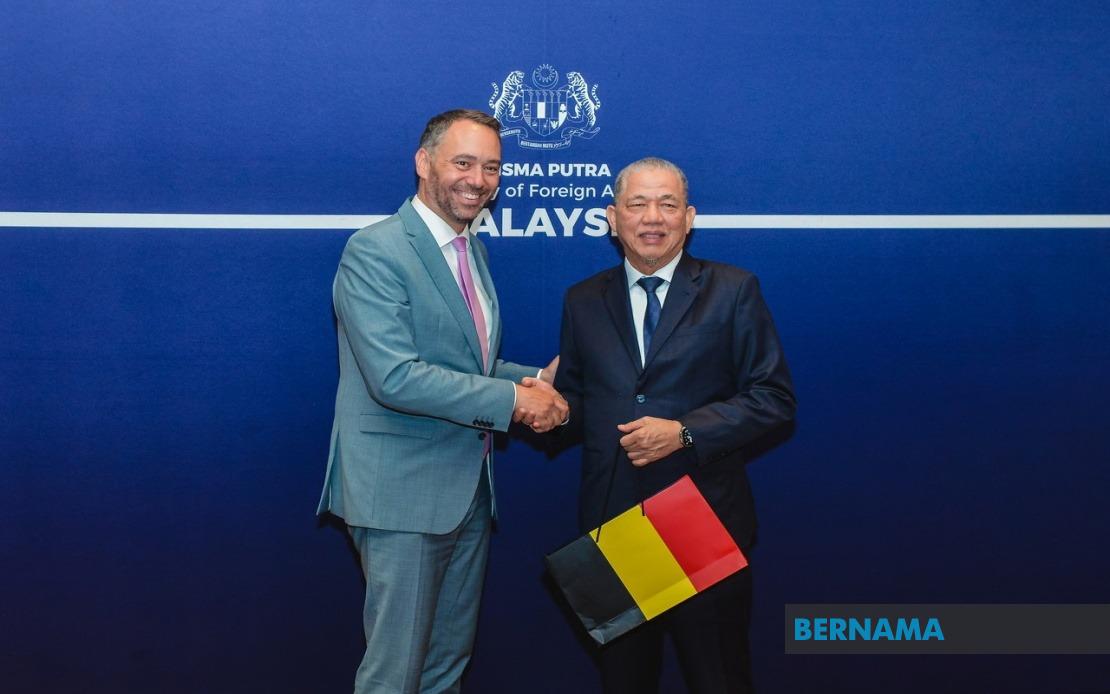
Malaysia has given Belgium formal assurances that maritime passage through the South China Sea will remain unrestricted, with Deputy Prime Minister Datuk Seri Fadillah Yusof emphasising that the region's bloc remains steadfastly committed to maintaining peace, stability, and unobstructed access for all shipping. The commitment emerged from high-level talks held in Kuala Lumpur on Thursday between Fadillah and Belgium's Deputy Prime Minister and Foreign Affairs Minister, Maxime Prévot, reflecting growing international concerns about potential disruptions to critical sea lanes in one of the world's busiest trade corridors.
The reassurance carries particular weight given escalating anxieties among European and global trading partners about supply chain vulnerabilities reminiscent of incidents witnessed in the Strait of Hormuz, where shipping disruptions have previously inflicted substantial economic damage. Fadillah articulated Malaysia's position with unambiguous clarity, stating that Southeast Asian nations would guarantee open access without any form of blockade or impediment. His remarks underscored the foundational principles that bind ASEAN members together—a framework centred on maintaining security, upholding strict neutrality, and safeguarding the free movement of international commerce through these strategically vital waters.
PreVot's visit to Malaysia represents his inaugural trip to the country since taking office in February 2025, and the bilateral engagement proved considerably broader than maritime security matters alone. The Belgian minister specifically requested Malaysia's assessment of broader regional security dynamics, seeking to understand Kuala Lumpur's perspective on the complex geopolitical terrain that encompasses the South China Sea and related risk factors. This proactive outreach reflects Belgium's position as a significant European economic and political actor seeking direct engagement with Southeast Asian leadership on issues that directly affect European commercial interests and supply chain resilience.
Beyond security considerations, the two governments identified substantial opportunities for deepening their relationship across multiple dimensions. Belgium signalled its intention to strengthen bilateral trade flows and indicated a willingness to reconsider its current travel advisory status for Sabah, a gesture that Malaysian officials will welcome as it removes potential barriers to increased tourism and business movement between the two nations. The willingness to revisit such advisories demonstrates Belgium's commitment to practical engagement that transcends symbolic gestures and directly addresses Malaysian concerns about international perceptions.
A particularly noteworthy element of the discussions centred on Malaysia's halal ecosystem, where Belgium has identified an opportunity to potentially adopt Malaysian standards as a model for broader European Union implementation. This recognition of Malaysian expertise in halal certification and compliance represents meaningful international validation of the country's specialisation in this increasingly important sector. As demand for halal products and services continues expanding among Europe's growing Muslim populations and among consumers increasingly seeking ethical and transparent supply chains, Malaysia's established framework could become a reference point for European regulators and businesses seeking internationally recognised standards.
The energy transition domain emerged as another significant area of potential cooperation, with discussions focusing on how Belgian expertise in emerging technologies and advanced materials could be leveraged to accelerate Malaysia's transition toward cleaner energy systems. This aligns closely with Fadillah's portfolio responsibilities as Minister of Energy Transition and Water Transformation, positioning Malaysia to benefit from European technological innovation while offering Belgium's industrial sectors new investment and partnership opportunities within Malaysia's growing green economy. Such collaboration could prove mutually advantageous, allowing Malaysian enterprises to access cutting-edge technology while Belgian companies gain footholds in Southeast Asia's expanding sustainable development markets.
Both governments also emphasised the importance of strengthening connections between their business communities, recognising that government-to-government engagement, while essential, requires complementary private-sector dynamism to achieve meaningful economic integration. The discussions touched upon encouraging greater Belgian corporate investment into Malaysia, suggesting that both nations view expanded business-to-business relationships as fundamental to deepening their overall strategic partnership. Such investment flows could span multiple sectors, from advanced manufacturing to renewable energy infrastructure to financial services.
The bilateral engagement also encompassed people-to-people dimensions, reflecting an understanding that sustainable international relationships require cultural and social foundations alongside political and economic ones. Expanding exchanges in education, cultural programming, and civil society engagement can build the mutual understanding and goodwill necessary for long-term partnership resilience. These softer dimensions of diplomacy often receive less international attention than major policy announcements but frequently prove decisive in determining whether formal agreements translate into genuine cooperation.
Fadillah's clear articulation of ASEAN's stance on South China Sea access carries broader significance within the context of ongoing regional tensions and great-power competition. By explicitly reaffirming the bloc's commitment to maintaining open passage and rejecting any form of blockade, Malaysia positions itself and ASEAN as defenders of international maritime law and the rules-based order that underpins global commerce. This positioning matters considerably for Malaysia, which derives substantial economic benefit from its geographic position along critical shipping routes and whose prosperity depends upon continued stability and openness in Southeast Asian waters.
The presence of Foreign Ministry Secretary-General Tan Sri Amran Mohamed Zin and Belgium's Ambassador to Malaysia Peter Van Acker at the official luncheon underscored the significance accorded to the bilateral discussions within both governments' diplomatic hierarchies. This level of representation signalled that both parties viewed the engagement as substantively important rather than merely ceremonial, setting a foundation for potentially expanded cooperation across the multiple domains identified during the talks. The inclusion of senior diplomatic personnel also facilitated behind-the-scenes discussions that may not have been publicly detailed but could prove consequential for future policy implementation.
Looking forward, the Prévot visit appears to have laid groundwork for a more expansive Malaysia-Belgium relationship encompassing security dialogue, commercial partnership, and technical cooperation. For Malaysia specifically, the affirmation of international support for South China Sea freedom of navigation provides important external validation of ASEAN's security framework at a time when regional anxieties about great-power competition remain elevated. Simultaneously, the discussions opened doors for Malaysian businesses and government agencies to benefit from European expertise in areas ranging from green energy to standards development, creating tangible benefits that extend beyond diplomatic messaging into concrete economic and technological domains.

