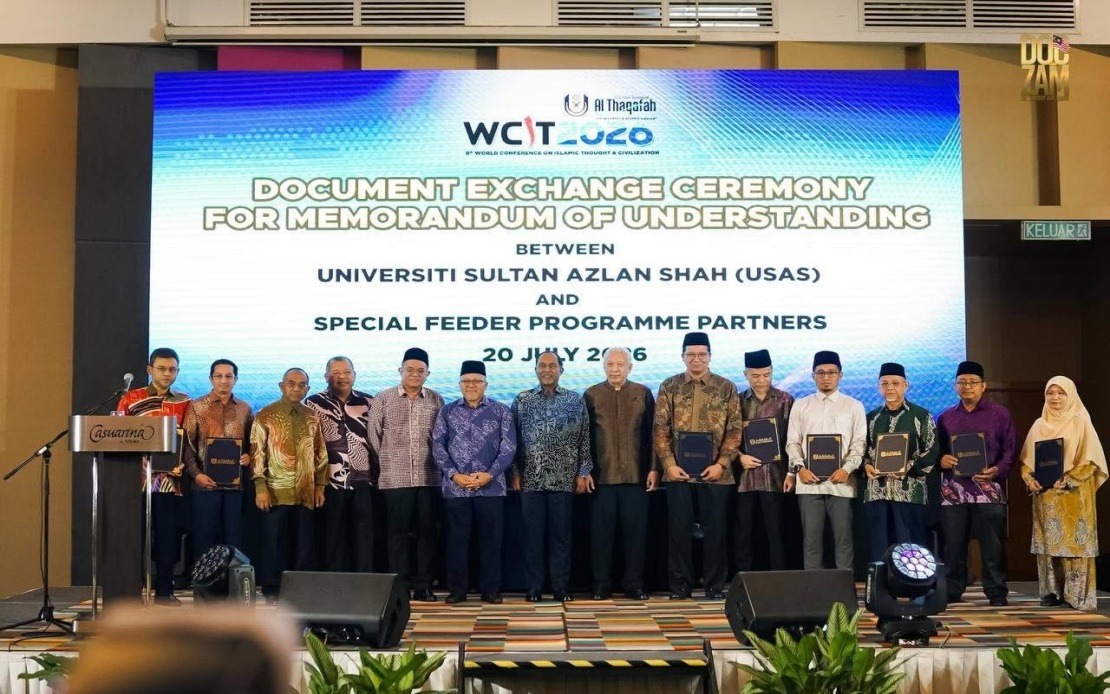
Malaysia is positioning itself as a crucial nexus for advancing Islamic thought and fostering international intellectual collaboration, according to Higher Education Minister Datuk Seri Dr Zambry Abdul Kadir. Speaking at an event organised by Universiti Sultan Azlan Shah in conjunction with the 8th World Conference on Islamic Thought and Civilisation (WCIT2026), the minister outlined the nation's broader aspirations to become a strategic partner in developing an inclusive, progressive knowledge ecosystem that transcends traditional boundaries and embraces global perspectives on education and civilisation.
The WCIT2026, which commenced in late July, represents a significant milestone for Malaysia's role in the Muslim world's intellectual landscape. Attended by more than 180 delegates, scholars, researchers, and thinkers from various countries, the three-day conference functions as a dedicated platform for assembling diverse academic voices and constructing robust international networks centred on Islamic scholarship. This gathering reflects a deliberate strategy by Malaysian institutions to elevate the country's standing as a preferred destination for serious intellectual discourse on faith, knowledge, and contemporary challenges affecting Muslim communities globally.
Zambry's keynote remarks emphasised a critical distinction between historical nostalgia and future-oriented advancement within Islamic civilisation. He articulated a vision where the ummah's progress must be anchored in rigorous knowledge production, systematic research methodologies, technological innovation, and ethical leadership structures. This pragmatic approach challenges conventional narratives that emphasise cultural memory over institutional capacity-building, suggesting that Malaysia views educational excellence and intellectual rigour as the primary vehicles for addressing contemporary pressures facing Muslim societies.
Central to the minister's address was a provocative assertion regarding the universal nature of knowledge and learning. He contended that education transcends parochial concerns of politics, sectarian conflict, and technological allegiance, arguing instead that intellectual heritage belongs to humanity as a collective rather than remaining the exclusive preserve of any single nation or civilisation. This framing positions Malaysia as an advocate for knowledge democratisation and intellectual pluralism—principles with significant implications for how the country markets its universities and research institutions to the wider Islamic world and beyond.
Zambry invoked historical examples to underscore the irreversible consequences of institutional destruction during periods of conflict. His references to the destruction of Baghdad's intellectual institutions, Granada's cultural erasure, Sarajevo's libraries, and the ongoing Palestinian conflict served as sobering reminders that physical devastation of universities and knowledge repositories represents civilisational catastrophe. These allusions suggest Malaysia's awareness of how educational infrastructure serves as both a practical foundation for societal advancement and a symbolic repository of cultural continuity—a concern that reverberates across Southeast Asia, where several nations have experienced their own intellectual losses during various periods of upheaval.
The hosting of WCIT2026 reflects Malaysia's deliberate investment in soft power through educational diplomacy. By convening major international academic conferences focused on Islamic thought, Malaysia strengthens its credentials as a culturally significant player within the Organisation of Islamic Cooperation member states while simultaneously marketing itself to global academic and philanthropic networks interested in Islam-related scholarship. This strategy differentiates Malaysia from competitors seeking to establish regional educational leadership, as it explicitly links academic excellence with civilisational advancement rather than treating universities as purely economic or technological assets.
For Southeast Asia more broadly, Malaysia's emphasis on bridging knowledge dialogues carries implications for the region's intellectual independence and academic autonomy. As global powers increasingly vie for influence over higher education agendas, Malaysia's positioning as an independent node in international scholarly networks offers smaller regional nations an alternative model for institutional development—one rooted in indigenous intellectual traditions rather than wholesale adoption of Western academic frameworks. This approach has potential to reshape how neighbouring countries conceptualise their universities' missions and international relationships.
The conference's focus on generating solutions benefiting both the ummah and the broader global community indicates Malaysia's commitment to ensuring that Islamic scholarship remains engaged with pressing contemporary issues rather than confined to theological or historical domains. This inclusive orientation signals readiness to collaborate with institutions and thinkers across religious and cultural lines, potentially positioning Malaysia as a mediator in increasingly polarised global conversations about religion, development, and modernity.
Zambry's remarks also reveal ongoing discussions within Malaysian educational circles about maintaining intellectual independence amid technological disruption. His explicit caution against allowing education to become subordinate to technological imperatives suggests awareness that rapid digitalisation and artificial intelligence developments risk subordinating human knowledge creation to algorithmic efficiency. This perspective echoes concerns articulated across Southeast Asia regarding how emerging technologies might reshape educational missions and academic labour.
The three-day conference represents a substantial investment in Malaysia's knowledge infrastructure and international standing. By demonstrating capacity to organise large, sophisticated academic gatherings attracting elite scholarly participation, Malaysia enhances its brand as a mature intellectual centre capable of hosting discussions at the highest conceptual levels. Success of WCIT2026 would likely strengthen Malaysia's candidacy for hosting future major international academic conferences and attracting research talent and institutional partnerships.
Moving forward, the extent to which Malaysia can convert this diplomatic investment into tangible institutional outcomes—including enhanced research output, increased international student recruitment, and expanded collaborative networks—will determine the conference's lasting impact. The minister's articulation of an educational vision encompassing inclusivity, integrity-driven leadership, and competitive institutional excellence provides a coherent framework through which Malaysian policymakers and university administrators can align their practical strategies with broader civilisational aspirations.

