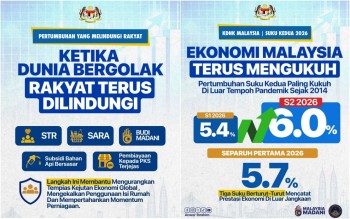
Malaysia's economic expansion accelerated to 6 per cent in the second quarter of 2026, a performance that exceeded analyst projections and represented the country's most robust second-quarter growth outside the pandemic era since 2014. The result comes as a significant vindication of government economic stewardship at a moment when the broader global economy faces mounting headwinds from supply chain disruptions and regional instability in West Asia.
Prime Minister Datuk Seri Anwar Ibrahim highlighted the achievement as evidence of the MADANI Government's capacity to insulate the domestic economy from external shocks. In an announcement through social media, he underscored that the growth trajectory had been sustained despite adverse international conditions, including inflationary pressures spawned by successive crises affecting the Middle East and their ripple effects through global supply networks. The narrative advanced by the prime minister frames the economic expansion not merely as a statistical success, but as validation of policy choices designed to protect ordinary Malaysians from the worst consequences of international turbulence.
The government has deployed a multifaceted approach to maintain consumer purchasing power and sustain domestic demand during a period of global economic uncertainty. Direct cash assistance programmes, notably BUDI MADANI and the Sumbangan Tunai Rahmah (STR) initiative, have channelled resources to households, while the Sumbangan Asas Rahmah (SARA) scheme has targeted specific vulnerable populations. Anwar emphasised that behind the headline figures lie less visible interventions aimed at price stabilisation and supply chain management, measures intended to prevent the kind of commodity-driven inflation that has ravaged purchasing power in other emerging markets.
For Malaysian policymakers and observers across Southeast Asia, the second-quarter result carries particular weight given the region's exposure to global supply shocks and the persistent vulnerabilities created by geopolitical tensions. Malaysia's growth rate contrasts with moderated expansion observed in comparable economies, suggesting that the sequencing and design of fiscal transfers and price controls have proved effective in sustaining both consumer confidence and productive investment. The 6 per cent expansion indicates that domestic demand remains resilient, a critical foundation for employment generation and sustained government revenues.
The prime minister's framing of the result centred not on complacency but on acknowledging incompleteness. He articulated a vision in which growth must be accompanied by broader-based prosperity, emphasising that the quantum of expansion matters less than its distribution across income levels. This language signals awareness that headline GDP growth can mask widening inequalities, underemployment, and stagnation in real wages—vulnerabilities that have fuelled political discontent in other jurisdictions. The MADANI Government's commitment to "meaningful income, quality job opportunities" reflects acknowledgment that growth divorced from wage growth and employment quality invites social friction.
The sustainability question looms over the achievement. While 6 per cent growth in a single quarter is noteworthy, maintaining such a trajectory requires continued domestic spending and investment alongside external demand recovery. The government faces a balancing act between maintaining supportive fiscal transfers to households and managing medium-term debt sustainability. The cost of programmes like STR and SARA, while economically justified as counter-cyclical measures, accumulates across fiscal years, constraining the government's future flexibility if global conditions deteriorate further.
Regional implications warrant consideration as well. Malaysia's growth outperformance may reflect policy choices that other Southeast Asian economies, particularly those with larger informal sectors or less developed social transfer infrastructure, struggle to replicate. The result could intensify discussion within ASEAN forums about best practices in protecting populations from supply shocks while maintaining macroeconomic stability. Simultaneously, Malaysia's resilience may attract attention from regional competitors and development partners evaluating policy frameworks during turbulent international periods.
The prime minister's invocation of Islamic concepts ("Insya-Allah") alongside economic terminology reflects the MADANI framework's integration of values-based governance with technocratic economic management. This rhetorical strategy seeks to anchor growth performance within a broader national vision of equity and development. Whether such framing translates into tangible improvements in living standards for middle and lower-income Malaysians will determine public perception of economic achievement, particularly as inflation continues and real wage gains remain elusive for many workers.
Looking forward, the government faces pressure to maintain growth momentum while addressing structural economic challenges: limited productivity gains in key sectors, dependence on commodity cycles, and competition from neighbouring economies for foreign direct investment. The 6 per cent result, whilst impressive cyclically, underscores the vulnerability of Malaysian growth to external demand and commodity pricing rather than indigenous innovation and productivity improvements. Policymakers will need to consider whether growth support measures should gradually transition towards investment in human capital, research and development, and economic diversification—shifts that require time horizons extending beyond immediate cyclical management.
The announcement also reflects political dimensions often absent from economic data releases. In demonstrating economic competence and protective capacity, the MADANI Government projects a narrative of steady stewardship designed to sustain electoral credibility as the country moves toward future electoral contests. Growth figures serve as concrete evidence of governance effectiveness, a particularly salient argument in democracies where economic outcomes substantially influence voter preferences. This political economy context does not diminish the genuine achievement of resilient growth, but it illuminates why government emphasis falls so heavily on communicating economic success to the broader public.

