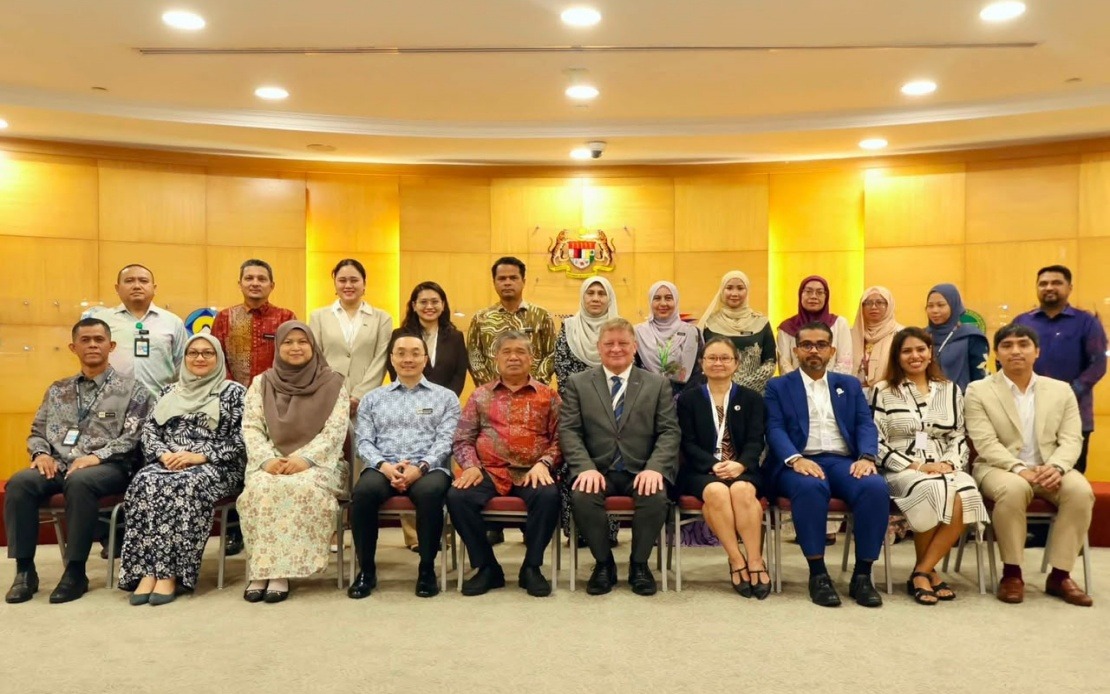
Malaysia is deepening its engagement with European agricultural and technology partners as it accelerates plans to modernise its agri-food sector. The focus came into sharp relief during a meeting in Putrajaya between Minister of Agriculture and Food Security Datuk Seri Mohamad Sabu and Chris Humphrey, executive director of the EU-ASEAN Business Council (EU-ABC), along with his delegation.
The encounter, held at Wisma Tani, zeroed in on four interconnected priorities that reflect the government's broader agricultural transformation agenda. Chief among these is the rollout of Malaysia's National Agro-Food Policy 2.0 (DAN 2.0), a comprehensive framework designed to bolster domestic food security while positioning the country to withstand global supply chain shocks. The policy also charts a path toward integrating cutting-edge technologies, particularly artificial intelligence systems, which are increasingly seen as essential to boosting agricultural productivity and reducing resource wastage in Southeast Asia's tropical farming environment.
Beyond technology adoption, the discussion addressed the structural vulnerabilities within Malaysia's dairy production system. Strengthening the local dairy supply chain has become urgent as the nation grapples with import dependency and seeks to harness domestic capacity. Simultaneously, officials underscored the need to elevate animal health and biosecurity standards, an area where European expertise and regulatory frameworks offer valuable lessons for improving Malaysia's livestock sectors and safeguarding against disease outbreaks that could devastate producers and threaten food availability.
Minister Mohamad Sabu characterised the European Union as one of Malaysia's most strategically valuable partners in the effort to reshape the national agri-food system toward sustainability, operational resilience, and technological sophistication. The framing reflects a recognition that Southeast Asia's agricultural sector faces mounting pressures from climate variability, resource scarcity, and supply chain fragility—challenges that European nations have confronted directly and for which they have developed practical, scalable solutions.
The minister articulated a clear rationale for the partnership: addressing global food security challenges, mitigating climate change impacts, and building buffer capacity against future disruptions to international trade flows. For Malaysian policymakers, these are not abstract concerns. The country remains a net food importer in several critical categories, and any sustained disruption to input supplies or logistics networks directly threatens inflation and food accessibility for lower-income households.
A significant dimension of the discussion involved Malaysia's request for sustained European corporate investment in capacity building among local farmers and breeders. The minister specifically highlighted the need for support in meeting stringent quality standards and Sanitary and Phytosanitary (SPS) measures—technical regulatory requirements that function as gateways to premium markets, particularly in Europe and other developed economies. Access to EU markets depends heavily on compliance with these standards, making training and technology transfer critical for Malaysian agricultural exporters seeking to diversify revenue streams and reduce price volatility exposure.
Both parties reaffirmed their commitment to the ongoing Malaysia-European Union Free Trade Agreement (MEUFTA) negotiations, signalling that agricultural trade liberalisation remains a priority for both sides. A successful MEUFTA would lower tariff barriers and streamline customs procedures, creating opportunities for Malaysian agricultural producers to reach European consumers while potentially attracting investment in value-added food processing and export-oriented farming operations. The stakes are particularly high for Malaysia's palm oil, rubber, cocoa, and tropical fruit sectors, all of which stand to benefit from predictable, rules-based market access.
The delegation exchange also underscored a strategic imperative: leveraging European technology and expertise to modernise Malaysia's agro-food supply chain infrastructure. This involves not merely adopting new equipment or software, but fundamentally reimagining how the country produces, processes, distributes, and markets food products. Digital traceability systems, precision agriculture tools, and data analytics platforms can enhance efficiency, reduce post-harvest losses, and improve food safety outcomes—benefits that extend across the entire supply chain, from smallholder farms to retail shelves.
Minister Mohamad Sabu capitalised on the meeting to extend an invitation to the EU-ABC delegation to attend MAHA 2026, Malaysia's premier agricultural showcase scheduled for August 28 to September 6 at the Malaysia Agricultural Expo Park (MAEPS) in Serdang, Selangor. The invitation carries symbolic weight, positioning Europe as a key stakeholder in Malaysia's agricultural future while providing a platform for EU companies to showcase innovations and explore partnerships with Malaysian producers, agribusinesses, and technology firms. MAHA 2026 will likely feature significant programming around sustainability, climate resilience, and digitisation—areas where European agricultural sectors have developed substantive expertise.
The convergence of these discussions points toward a broader strategic recalibration in Malaysian agriculture policy. Rather than pursuing food security exclusively through domestic production expansion—an approach constrained by land availability and environmental limits—Malaysia is positioning itself as a hub for agricultural innovation and a nexus between European technology providers and Southeast Asian farming communities. This model acknowledges resource constraints while leveraging the region's growing market demand for food products and the European sector's accumulated knowledge and investment capital.
For Southeast Asian farmers and agribusinesses more broadly, Malaysia's deepening EU engagement signals an opening to access advanced technologies, training programmes, and market opportunities. The model of capacity building and standards compliance that Malaysia is pursuing with European partners could establish benchmarks for the wider ASEAN region, potentially catalysing similar partnerships and knowledge-sharing networks across the bloc.
The timing of these diplomatic efforts also reflects global macro-economic currents. Geopolitical tensions, protectionist trade policies, and climate-driven agricultural volatility are creating incentives for countries to diversify trading relationships and technology sources. By cultivating robust partnerships with European agricultural specialists and firms, Malaysia positions itself as a stable, rules-respecting partner capable of bridging technological divides and facilitating knowledge transfer within Southeast Asia.

