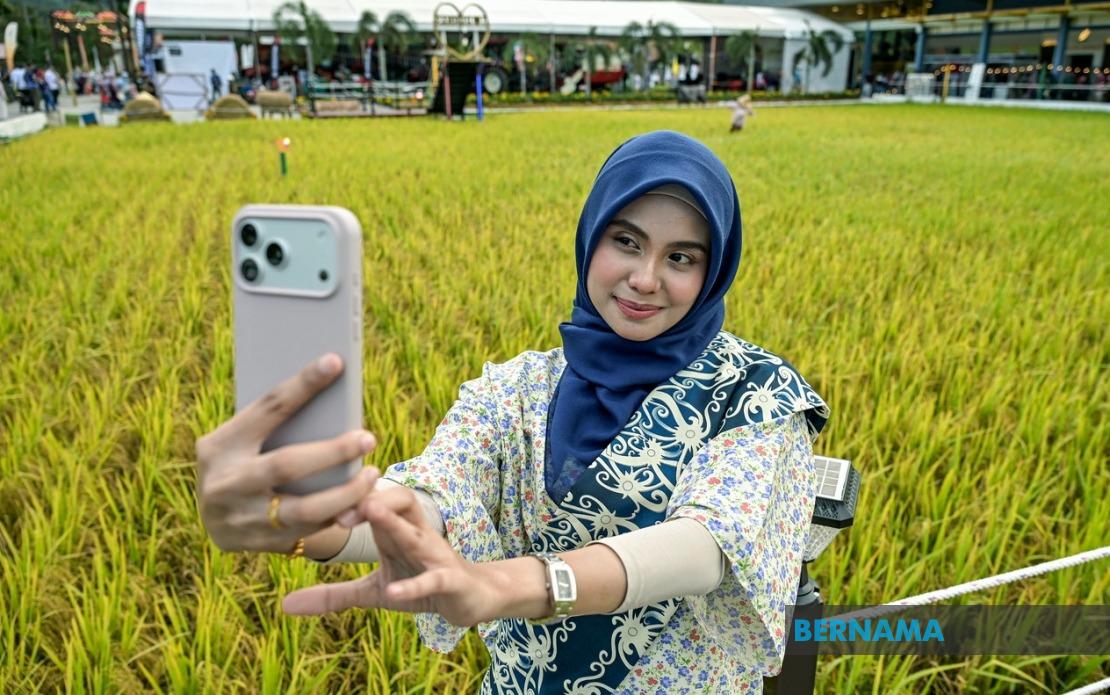
Malaysia's paddy farming sector has achieved a notable milestone with the inaugural Paddy Art installation at Laman Padi, which has secured recognition from the Malaysia Book of Records as the nation's largest paddy art formation. The striking artwork, unveiled during the Malaysia Agriculture, Horticulture and Agrotourism Exhibition (MAHA) 2026 at Malaysia Agro Exposition Park Serdang (MAEPS), depicts the Jalur Gemilang national flag integrated with symbolic heart and hand motifs alongside the word 'Jati', all rendered through sophisticated agricultural design.
The creation of this landmark display involved meticulous agricultural planning and execution. Using the MR284 paddy variety, farmers employed a staged planting technique that capitalises on natural variations in crop maturation to produce distinct colour contrasts across the field. This approach demonstrates how traditional rice cultivation methods can be adapted for artistic and cultural expression, merging practical agricultural knowledge with creative vision. The project exemplifies what becomes possible when farming communities embrace innovation within their existing operations.
The achievement carries particular significance for Malaysia's vision of diversifying its agricultural landscape. Agriculture and Food Security Minister Datuk Seri Mohamad Sabu emphasised that the Paddy Art initiative resulted from strategic collaboration between government bodies and private-sector partners, reflecting a broader shift in how the nation conceptualises farming's role in the economy. Rather than viewing agriculture primarily through the lens of commodity production, the minister articulated a vision where paddy cultivation becomes a platform for creative enterprise and cultural expression.
Beyond its record-breaking status, the Paddy Art installation signals a fundamental rethinking of rural development in Malaysia. Minister Mohamad stressed that paddy fields now represent untapped potential for value creation across multiple dimensions: technology integration, educational programming, employment generation, and agrotourism development. This perspective addresses a critical challenge facing Malaysian agriculture—the need to make farming economically viable for younger generations and small-hold operators who might otherwise abandon traditional livelihoods.
Agrotourism has emerged as a particularly promising avenue, especially among urban dwellers and young people whose familiarity with agricultural processes has diminished over successive generations. The minister highlighted how targeted attractions and amenities within paddy environments can generate visitor traffic, creating supplementary income streams for farming families and regional communities. This revenue diversification becomes increasingly important as rural economies contend with the pull of urban employment and the costs of modern farming operations.
The Laman Padi installation itself occupies seven acres across the MAEPS site, comprising seven distinct paddy plots alongside two dedicated information centres and galleries. Each component has been designed to offer visitors different narratives and experiential dimensions, creating a comprehensive exploration of paddy cultivation. The scope of the development reflects a government commitment to establishing agrotourism as a legitimate agricultural sector worthy of substantial investment and sophisticated infrastructure.
Visitor engagement has exceeded initial expectations, with the facility attracting approximately 4,000 visitors during its opening day and projecting daily crowds of around 10,000 throughout the ten-day MAHA 2026 exhibition. These figures suggest strong public interest in understanding agricultural heritage and contemporary farming practices. Paddy Industry Development Division secretary Shamsul Akbar Sulaiman noted that the installation blends traditional and contemporary elements to chronicle the evolution of Malaysia's rice and paddy industries, providing both historical context and present-day insights.
The educational dimension of Laman Padi deserves particular emphasis given Malaysia's longer-term agricultural sustainability challenges. Approximately ten participating schools have integrated paddy-related activities into their exhibition programmes, offering students direct exposure to cultivation practices through hands-on learning opportunities. This exposure proves invaluable in cultivating appreciation for farming among cohorts who might otherwise view agriculture as outdated or unappealing compared to urban professional careers.
Shamsul Akbar characterised Laman Padi as a strategic collaboration platform extending across Malaysia's rice and paddy industry supply chain, with major players including BERNAS engaging in product promotion and showcase activities. This inclusive approach encourages industry-wide participation while allowing companies to build brand visibility among visitors representing diverse consumer demographics. The venue also incorporates comprehensive culinary programming, featuring food concepts and dishes from across Malaysia that highlight rice and paddy-derived products.
The infotainment model underpinning Laman Padi's programming strategy merits recognition as a sophisticated approach to agricultural education and promotion. Rather than delivering information through static displays or lecture formats, the facility integrates entertainment, demonstrations, interactive showcases, and promotional activities designed to engage visitors across different age groups and educational backgrounds. This methodology acknowledges that successful agrotourism requires entertainment value alongside educational content to maintain visitor interest and encourage repeat visitation.
The Malaysia Book of Records designation represents external validation of the project's achievements while positioning Malaysia within a broader global context of agricultural innovation. Nations increasingly recognise that farming sectors must evolve beyond commodity production to incorporate cultural, educational, and recreational functions. Malaysia's record-breaking paddy art joins international examples of creative agricultural expression, establishing the country as a participant in this emerging movement.
Looking forward, the success of Laman Padi at MAHA 2026 provides a blueprint for expanding agrotourism initiatives across Malaysia's rice-growing regions. Rural communities in states such as Kedah, Terengganu, and Perak possess comparable agricultural landscapes and infrastructure that could support similar developments. The model demonstrates how paddy farmers might transition from exclusive focus on grain yields to generating income through visitor experiences, branded products, and educational programmes.
Ultimately, the Paddy Art installation and surrounding Laman Padi facility represent a significant evolution in Malaysian agricultural thinking. By marrying artistic vision with farming expertise, and by positioning paddy fields as educational and cultural attractions, the initiative suggests pathways toward more resilient rural economies. As agricultural sectors worldwide grapple with demographic shifts, environmental pressures, and market volatility, Malaysia's investment in agrotourism indicates recognition that farming's future requires imagination and diversification alongside traditional productivity measures.

