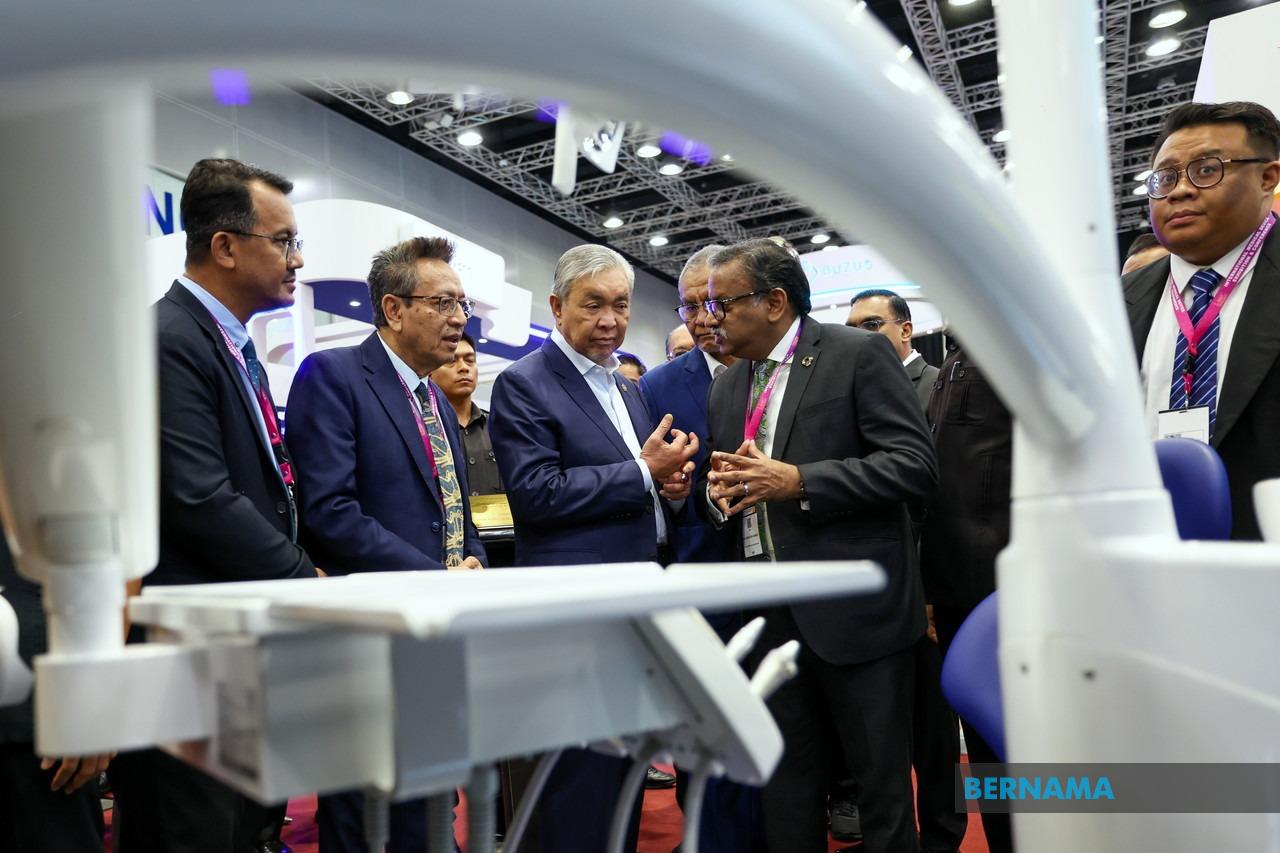
Malaysia is pursuing an ambitious expansion of its medical device export sector, with Deputy Prime Minister Datuk Seri Dr Ahmad Zahid Hamidi announcing a target to exceed RM50 billion in shipments by 2030. This represents a significant jump from the RM34.54 billion achieved in 2025, reflecting confidence in the country's growing capability in medical technology manufacturing. The initiative comes at a pivotal moment as the global medical device market continues its rapid expansion, valued at over USD572 billion last year and projected to reach USD1 trillion by 2034—a market opportunity Malaysia is determined to capture a larger share of.
Ahmad Zahid, speaking at the closing ceremony of the International Medical Device Exhibition and Conference (IMDEC) 2026, outlined three strategic ambitions designed to measure progress in developing Malaysia's MedTech industry. The first and most publicly visible target focuses on export volume growth, building on existing infrastructure and international relationships. However, the Deputy Prime Minister stressed that future expansion must increasingly pivot toward producing higher-value products rather than relying on volume increases alone. This reflects a maturing understanding of the sector's development, where countries like Malaysia face pressure to move beyond contract manufacturing into innovation-led production.
The second strategic pillar involves cultivating homegrown champions capable of competing on the regional and global stage. Ahmad Zahid indicated that Malaysia would maintain its open-door policy toward leading international MedTech corporations while simultaneously investing in developing local enterprises that possess their own proprietary technology and intellectual property. This dual approach represents a balance between attracting foreign direct investment—which brings capital and technical expertise—and building indigenous innovation capacity that would allow Malaysian companies to capture higher profit margins and establish long-term competitive advantage. The aspiration to develop at least 10 Malaysian firms meeting these criteria demonstrates ambition tempered with realism about the timeframe required for such development.
The third objective addresses the quality and character of employment generated by MedTech sector growth. Ahmad Zahid emphasised that at least 50 percent of jobs created by new medical device investments by 2030 must be managerial, technical, and supervisory positions, reflecting his concern that capital-intensive foreign projects often create primarily low-skill assembly line positions. Currently, the sector's MTS index stands at only 33.1 percent, indicating substantial room for improvement. This benchmark reveals a critical insight: Malaysia recognises that merely attracting investment volume is insufficient if the employment gains are predominantly routine, low-wage positions that do not significantly enhance workforce productivity or earning potential.
The underlying philosophy guiding these three ambitions reflects Ahmad Zahid's conviction that capability development must precede large-scale investment rather than following it reactively. Speaking in his capacity as National Technical and Vocational Education and Training Council chairman, he articulated a frustration with the traditional model where multinational firms arrive in Malaysia only after identifying immediate labour shortages, then expect the education system to rapidly adapt. Instead, he called for international companies to engage much earlier in the process, collaborating with Malaysian institutions to shape training programmes, anticipate future skills requirements, provide workplace exposure to students, and create apprenticeship opportunities before formal hiring begins.
This proactive approach addresses a structural challenge that has hindered Malaysia's industrial development: the mismatch between educational outputs and employer requirements. By involving foreign and domestic MedTech companies in curriculum design and skills forecasting years in advance, Malaysia aims to ensure that graduates enter the workforce with precisely the competencies the sector demands. Such partnerships would reduce onboarding time and costs for employers while providing students with clear career pathways and practical knowledge grounded in actual industry needs. The model reflects lessons learned from Southeast Asian competitors and developed economies that have successfully built high-value manufacturing ecosystems.
Recent investment performance provides momentum for these ambitions. In 2025, Malaysia approved RM4 billion in new medical device investments spanning 46 separate projects, generating approximately 3,400 employment opportunities. While these numbers demonstrate continued investor confidence, Ahmad Zahid's emphasis on the quality of those jobs suggests concern that many positions created may not meet the MTS threshold. This gap between quantity and quality of employment illustrates why the 2030 targets cannot rely solely on attracting additional foreign capital; instead, they require deliberate structural changes to how Malaysia develops and positions its workforce.
The IMDEC 2026 conference itself underscored Malaysia's growing prominence in the MedTech conversation. The three-day event, running from August 26 to 28, convened over 160 exhibitors representing manufacturers, suppliers, and service providers alongside more than 50 regional and international speakers addressing regulation, innovation, and healthcare transformation. Such gatherings serve multiple purposes: they enable knowledge exchange, facilitate networking between companies and potential partners, attract foreign investor interest, and position Malaysia as a credible hub for MedTech activity in Southeast Asia.
For Malaysian policymakers, the medical device sector represents an attractive diversification target within the broader manufacturing economy. It offers higher value-add potential than traditional electronics or automotive manufacturing, appeals to skilled workers seeking challenging careers, and aligns with global megatrends including ageing populations and rising healthcare spending. Southeast Asia's own demographics—with populations ageing faster than most developing regions—create both market demand for medical devices and talent pools familiar with local healthcare contexts.
However, realising the RM50 billion export target requires navigating several challenges. Malaysia must compete for multinational investment against established hubs like Singapore and emerging contenders across the region. Domestic innovation capacity remains limited relative to advanced economies, requiring sustained investment in research institutions and tax incentives for R&D. Supply chain integration across ASEAN remains incomplete, potentially constraining the ability to achieve economies of scale in specialised component production. Regulatory harmonisation across Southeast Asian markets would unlock efficiencies but demands diplomatic and technical coordination.
The emphasis on developing Malaysian MedTech champions also highlights a sobering reality: most MedTech startups require years of development, substantial capital investment, and access to sophisticated testing and regulatory expertise before generating commercial returns. This necessitates patient capital sources—whether government development funds, impact investors, or corporate venture arms of multinationals—willing to support local firms through extended incubation periods. Ahmad Zahid's framing suggests the government recognises this imperative and may be prepared to deploy supporting instruments.
The Deputy Prime Minister's articulation of these three ambitions also carries implications for Malaysia's broader positioning within global supply chains and regional competition. By explicitly prioritising high-value employment and indigenous innovation capability, Malaysia signals that its long-term development strategy emphasises moving beyond low-cost labour competition toward knowledge-intensive manufacturing. This mirrors trajectories pursued by countries like South Korea and Taiwan decades earlier, though conducted in an era of greater global integration and competition.
Ultimately, the RM50 billion export target serves as a useful focal point, but the deeper ambition involves transforming Malaysia's role in medical device value chains. Success will require coordinated efforts across multiple institutions—government agencies managing investment facilitation and skills development, educational institutions partnering with industry, corporate investors committing to workforce development, and local entrepreneurs building globally competitive firms. Whether Malaysia can sustain the policy consistency, capital commitment, and institutional coordination required over the next five years will determine whether 2030 sees the ambitions realised or revised.

