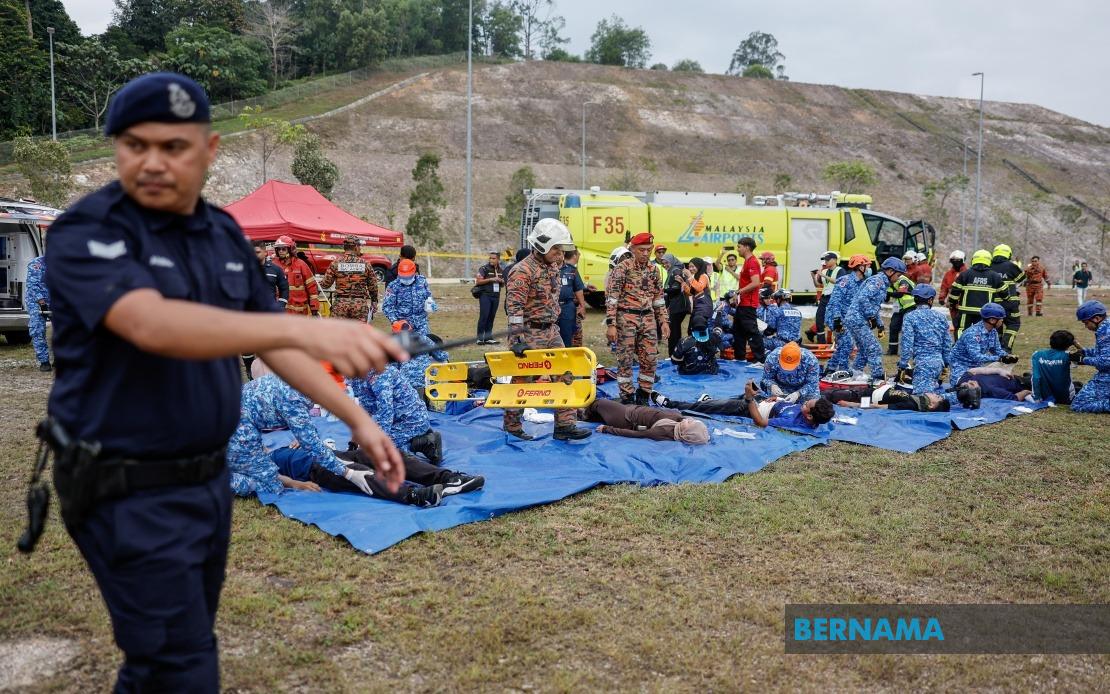
Malaysia conducted its inaugural full-scale aviation disaster simulation on July 16 designed specifically to test how emergency responders would handle an aircraft accident occurring well outside an airport's immediate vicinity. Ex Urban Falcon 2026, held at the Denai Alam Rest and Service Area along the Damansara-Shah Alam Elevated Expressway, brought together more than 20 enforcement and emergency response agencies to respond to a simulated ATR72 crash positioned approximately six kilometres from Sultan Abdul Aziz Shah Airport in Subang. The exercise represented a significant departure from previous disaster response drills, which had focused on scenarios unfolding within or near airport boundaries.
According to Airport Fire and Rescue Services general manager Muhammad Hidayat Ismail, the primary aim was to evaluate whether Malaysia Airports Holdings Berhad and coordinating agencies could effectively mobilise resources and execute emergency operations under the National Aeronautical Search and Rescue Manual framework when incidents occur outside standard airport control zones. Under NAMSA provisions, AFRS maintains responsibility for a radius extending eight kilometres from an airport's midpoint, yet the practical challenges of responding to accidents in that outer zone had never been comprehensively tested through a full-scale exercise until now. This gap in preparedness testing highlighted a genuine vulnerability in Malaysia's aviation safety infrastructure, particularly given the densely populated areas surrounding major airports.
The simulation incorporated realistic complications that responders would face in genuine emergencies. Navigation difficulties proved among the most significant obstacles, as response teams had to manoeuvre through narrow roads, cross multiple toll plazas, and coordinate logistics across congested urban corridors—a stark contrast to the controlled environment of airport runways and dedicated emergency access routes. These infrastructure constraints directly impact response times, which in aviation disasters can determine whether injured passengers receive critical medical intervention within the crucial golden hours. The exercise exposed operational gaps that standard airport-perimeter drills simply cannot replicate, forcing agencies to confront the harsh reality that off-airport scenarios demand fundamentally different tactical approaches.
One critical distinction that emerged from the simulation concerns victim survivorship rates. Muhammad Hidayat emphasised that crashes occurring beyond airport grounds typically result in lower survival percentages due to unpredictable terrain, vegetation, and debris patterns that complicate rescue extraction. The uneven landscape surrounding the exercise location meant that casualty numbers could easily exceed the number of survivors—a sobering scenario that required participating teams to shift their resource allocation strategies accordingly. This reality underscores why exercises like Ex Urban Falcon 2026 serve essential functions: they force agencies to confront statistical probabilities and adjust procedures before actual lives depend on their decisions.
Disaster Victim Identification operations emerged as another crucial component requiring heightened inter-agency coordination. Led by the Royal Malaysia Police, DVI procedures become exponentially more complex in off-airport settings where victims may be scattered across wide areas, identification records could be damaged, and chain-of-custody protocols face environmental contamination risks. The exercise provided a realistic testing ground for these protocols, enabling the police forensic teams and supporting agencies to identify procedural weaknesses before facing them during an actual catastrophe. Such coordination across multiple agencies with distinct mandates and operational cultures requires intensive advance planning and mutual understanding of respective roles.
From a technological standpoint, Malaysia's aviation emergency response infrastructure demonstrates substantial capability. AFRS operates cutting-edge aircraft firefighting vehicles engineered to meet International Civil Aviation Organisation and Civil Aviation Authority of Malaysia specifications and standards. These vehicles represent significant investments in public safety infrastructure, yet their effectiveness depends entirely on the coordination mechanisms and decision-making processes that bind disparate agencies together. The exercise served partly to validate that technical capability had been matched with organisational readiness, though Muhammad Hidayat's remarks suggested room for refinement in several operational procedures.
The scope of Ex Urban Falcon 2026 underscored the complexity of modern aviation disaster response in populated regions. The drill mobilised 450 personnel drawn from critical public and private sector agencies, orchestrated through a strategic partnership involving MAHB, NADMA, the Selangor state government, and PROLINTAS-DASH. This institutional architecture reflects the multi-jurisdictional nature of off-airport incidents, where airport authorities, highway operators, local government, federal emergency management agencies, police, fire services, and medical personnel all claim legitimate roles. Coordinating such a coalition in real time, under stress, without the benefit of advance notice distinguishes genuine emergency management capability from theoretical preparedness.
Findings from the exercise were scheduled for formal review during a special workshop on July 26 and 27, where participating agencies would collectively analyse performance data, identify bottlenecks, and develop specific improvement measures. This structured feedback mechanism reflects international best practices in emergency management, where exercises gain value not merely from testing protocols but from creating institutional memory and driving continuous improvement cycles. The workshop would enable agencies to translate observed challenges into concrete procedural amendments, technological investments, or resource redistributions that strengthen the overall response architecture.
Muhammad Hidayat characterised the exercise outcomes positively, noting that participating agencies executed their assigned duties according to existing procedures and that firefighting and rescue operations proceeded smoothly. However, his observation that this marked the first comprehensive test of off-airport scenarios suggests earlier exercises may have lacked sufficient realism to expose critical vulnerabilities. The positive performance during the controlled simulation does not guarantee equivalent effectiveness during an actual emergency with unpredictable variables, genuine casualties, and intense media and political scrutiny. Nevertheless, the willingness to conduct such demanding exercises and openly acknowledge areas for improvement reflects Malaysia's maturing approach to aviation safety governance.
For Malaysian aviation safety, the exercise carries implications extending beyond the immediate region around Subang Airport. Similar vulnerabilities likely affect other major airports serving densely populated areas, including Kuala Lumpur International Airport, Penang International Airport, and growing regional facilities. A successful framework developed through Ex Urban Falcon 2026 could establish replicable standards for off-airport disaster response that other airports adopt. This standardisation would enhance overall sectoral resilience and provide consistent public confidence in the nation's capacity to manage aviation emergencies regardless of location. The demonstrated commitment across 20+ agencies signals that Malaysia recognises aviation safety as a shared institutional responsibility rather than an airport operator's isolated function.

