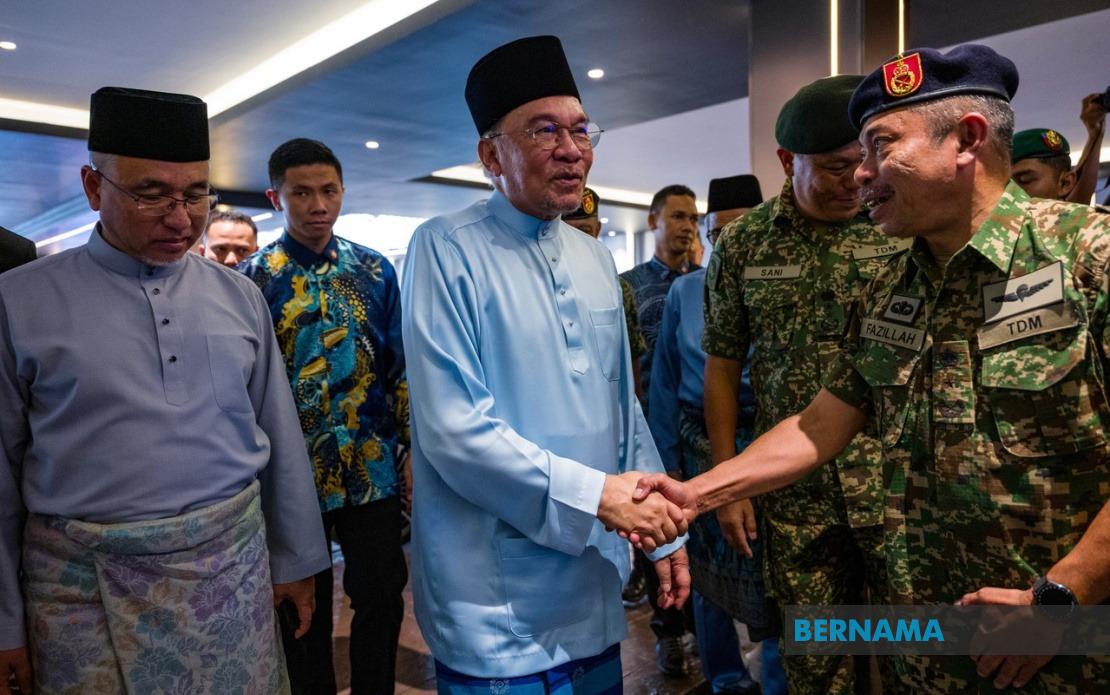
Prime Minister Datuk Seri Anwar Ibrahim has signalled the government's intent to substantially boost defence spending in the coming budget cycle, a move the Malaysian Armed Forces leadership has welcomed as a concrete demonstration of Putrajaya's commitment to transforming the nation's military capabilities. Chief of Defence Force General Tan Sri Malek Razak Sulaiman endorsed the budgetary expansion, framing it as validation of the administration's broader agenda to strengthen institutional defence readiness and ensure the MAF remains adequately resourced for its constitutional responsibilities.
The increased allocation carries significance beyond simple numerical augmentation of the defence budget. Speaking at the Semarak Kenegaraan Programme with the MAF at Terendak Camp in Melaka, Anwar underscored that additional funds would enable systematic modernisation of military hardware and equipment. This expenditure sits within the parameters of the MAF's Future Force strategic development plan, a long-term roadmap designed to transition Malaysia's defence posture toward contemporary operational standards and technological integration. Such planning reflects recognition that force modernisation demands sustained, predictable funding rather than sporadic capital injections.
Personnel welfare constitutes a critical dimension of the budgetary expansion often overshadowed by headline figures on procurement. The government has committed to concrete improvements in service members' living standards, including rehabilitation of military housing quarters, construction of a dedicated military hospital, and maintenance of essential utilities including water supply systems. These initiatives address longstanding concerns within the military community regarding the gap between civilian public service standards and conditions experienced by defence personnel and their families. Anwar, who doubles as Finance Minister, positioned these improvements as integral to maintaining institutional morale and operational effectiveness.
The connection between materiel welfare and military performance represents a critical analytical thread. Armed forces globally have documented direct correlations between personnel welfare investments and retention rates, operational readiness, and unit cohesion. Malaysia's military faces persistent challenges in retaining experienced personnel, particularly junior officers attracted to higher-remuneration private sector opportunities. By coupling equipment modernisation with tangible welfare improvements, the government signals a holistic approach to military institution-building rather than relegating personnel concerns to secondary status in budget hierarchies.
General Tan Sri Malek Razak framed the budgetary commitment as evidence of governmental determination to cultivate military modernisation as a national defence priority. His statement that the additional allocation would support transformation of the MAF into "a superior force and an integrated deterrent" reflects strategic thinking about Malaysia's evolving security environment. The region faces intensifying maritime pressures, transnational security threats, and diplomatic tensions requiring enhanced force projection capabilities and technological sophistication. Budget increases must therefore be understood within this broader geopolitical context rather than as merely administrative adjustments.
The modernisation initiative arrives at a juncture when neighbouring regional powers have significantly expanded defence expenditures. Thailand, Indonesia, and Vietnam have pursued substantial military acquisitions and technological upgrades over recent years, raising questions about Malaysia's relative positioning in regional defence capability matrices. While Malaysia maintains robust institutional military structures, capability gaps in certain critical domains have prompted strategic reviews. Increased budgetary allocation enables methodical closure of identified deficiencies in assets, training infrastructure, and technological integration across service branches.
Beyond capital equipment, the government has agreed in principle to streamline promotion mechanisms for both MAF and Royal Malaysia Police personnel. This administrative reform addresses bureaucratic impediments that historically prolonged career advancement timelines, potentially dampening morale and incentivising talented personnel departures. Alignment of military promotion procedures with broader public service schemes suggests rationalisation of career incentive structures across security and defence institutions. Such harmonisation can enhance coordination between complementary agencies and reduce institutional friction arising from divergent advancement methodologies.
The budgetary commitment carries implications for Malaysia's defence industrial base and international defence partnerships. Expanded procurement budgets typically translate into enhanced engagement with foreign defence contractors, technology transfer agreements, and potential development of domestic defence manufacturing capabilities. Government policy preferences regarding sourcing—whether prioritising regional suppliers, established defence manufacturers, or encouraging domestic industrial participation—will shape which international relationships deepen and which domestic industries benefit from modernisation-driven procurement cycles.
For Malaysian policymakers, the budget expansion reflects a strategic calculation that defence capacity requires continuous investment to remain credible. The regional security environment, characterised by maritime disputes, transnational terrorism, and great power competition, necessitates armed forces equipped with contemporary capabilities. However, budgetary increases alone cannot guarantee military effectiveness; efficient resource utilisation, institutional reform, and personnel development remain equally critical. The government's framing of this allocation as part of comprehensive modernisation strategy—encompassing technology acquisition, personnel welfare, and administrative efficiency—suggests awareness that military transformation demands multifaceted investment beyond procurement figures.
Stakeholder reception of the budgetary initiative within the military establishment has been notably positive, with senior defence leadership explicitly endorsing the government's approach. This convergence between political commitment and military institutional interests creates favourable conditions for implementation of modernisation programmes. However, translating budgetary allocations into tangible capability improvements requires sustained political attention, effective programme management, and coordination across multiple government agencies responsible for procurement, logistics, and personnel administration. The coming Budget 2027 debate will reveal parliamentary and public attitudes toward defence spending priorities and defence sector modernisation relative to competing national budgetary pressures.

